"SADD, the Price of Stopping the Subway: KRW 600 Million"... Mobility Rights Trapped in Court [Seocho Samgeori]
- Input
- 2026-09-20 16:37:44
- Updated
- 2026-09-20 16:37:44
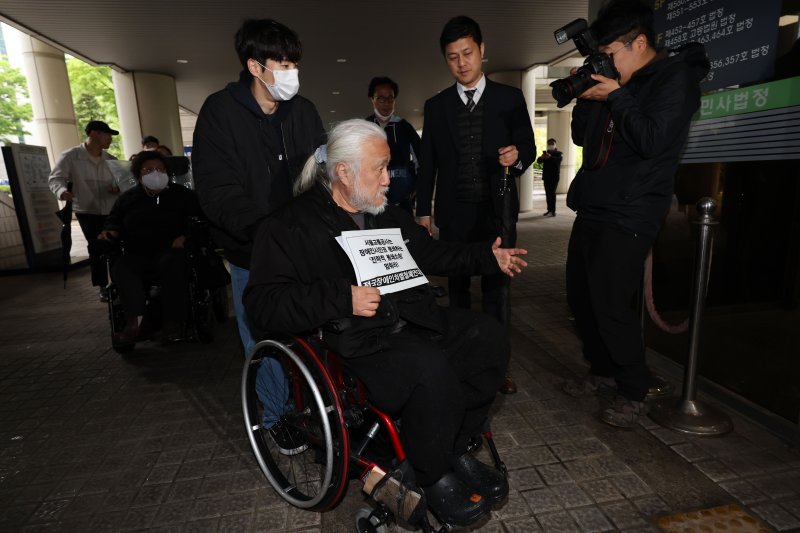
[Financial News] The damages lawsuit filed by Seoul Metro against the National Solidarity for the Elimination of Discrimination against the Disabled (SADD), which has continued its boarding protests on Seoul subway platforms, has dragged on for more than four years. The "boarding protests," which became a social flashpoint amid the passage of a mobility-rights ordinance by the Seoul Metropolitan Council, have stopped. However, the legal battle stemming from more than five years of activism is still underway.
According to legal sources on the 20th, Seoul Metro's KRW 600 million damages lawsuit against SADD, its representative Park Gyeong-seok, and 14 other individuals will reach its fourth hearing in November. After a compulsory mediation proposal previously presented by the court fell through, proceedings on the merits have begun in earnest, leaving the two sides deadlocked over their legal arguments.
More than 1,000 instances of "inconvenience" caused by "boarding protests"
The protests began after a wheelchair lift fell at Oido Station in Siheung-si, Gyeonggi Province, in 2001, killing a person with a disability. Beginning on the International Day of Persons with Disabilities in 2021, the activists moved their protests to the morning commute. As of January 19 this year, the "commute-time subway protests" had exceeded 1,000 instances, and the inconvenience caused to passengers had grown accordingly. According to Seoul Metro, complaints related to SADD totaled 4,532 last year, more than quadrupling from 1,104 in 2023.About a year after the protests began, Seoul Metro filed a KRW 601.45 million damages lawsuit on January 6, 2023. The operator argues that SADD activists intentionally delayed trains by placing wheelchairs between platforms and train cars during rush hour, preventing the doors from closing. The resulting losses included delayed-train operating costs, ticket refunds, alternative transportation expenses, and the cost of deploying additional personnel for on-site safety management.
Seoul Metro also argued that keeping large numbers of commuters from exercising their mobility rights for extended periods during the morning rush hour constituted an unlawful act beyond the limits of the constitutionally guaranteed freedom of assembly and protest. It maintains that SADD members should collectively bear responsibility for the damages.
Around January 2023, Seoul Metro began filing a series of damages lawsuits against SADD. In addition to the first lawsuit seeking approximately KRW 50 million, the cases include a KRW 127.8 million claim filed in 2023 for sticker removal and cleaning costs, as well as a KRW 387.6 million claim over disruptions to train operations at Hyehwa Station and elsewhere in the second half of 2023 and in 2024. Lawsuits totaling more than KRW 1.168 billion are currently pending.
SADD: "Sorry to citizens... Responding to 'silencing lawsuits'"
SADD, for its part, argues that the protests constituted both an exercise of constitutional rights and a legitimate act. It also points out that no causal link has been established between the alleged damages claimed by Seoul Metro and the specific actions of individual protesters.SADD particularly criticizes Seoul Metro, a public corporation, for pursuing a strategic lawsuit against public participation (SLAPP) that uses massive damages claims as leverage to chill minority-rights advocacy and freedom of expression.
At the end of 2022, the court proposed that Seoul Metro secure elevator access routes at every subway station by 2024, while SADD would pay Seoul Metro KRW 5 million for each protest that delayed train operations by more than five minutes. SADD indicated that it was willing to accept the proposal, but Seoul and Seoul Metro objected, saying, "We cannot allow even a single minute of train delays," causing the mediation to collapse. SADD maintains that the lawsuits have since been used to pressure its members while Seoul Metro continues to pursue the damages claims.
An SADD representative explained, "Money is not the goal; this is a strategic lawsuit aimed at stopping our actions. We have formed a civil litigation defense support team and are responding." The representative added, "We always feel deeply sorry and burdened by the inconvenience caused to citizens," and explained, "Going forward, we plan to stop boarding protests that bring trains to a halt and focus instead on campaigning inside stations and calling for dialogue."
The conflict remains unresolved as welfare issues that should be addressed through policy and dialogue in the political and administrative spheres have spilled into the judicial arena through civil damages lawsuits. Choi Kang-yong, an adjunct professor at Sogang University Law School, emphasized, "When the freedom of movement of ordinary citizens directly conflicts with the freedom of assembly and protest of social minorities, harmoniously balancing these two fundamental rights is one principle the Constitutional Court of Korea uses to resolve conflicts between fundamental rights. Judicial rulings and institutional mediation must work together with precision so that the rights of both sides can be harmoniously guaranteed within the framework of the law."
[email protected] Lee Chang-hoon Reporter