2025 Greenhouse Gas Emissions Reach 685.71 Million Tonnes; Net Emissions Rise Due to Wildfires
- Input
- 2026-09-20 12:56:13
- Updated
- 2026-09-20 12:56:13
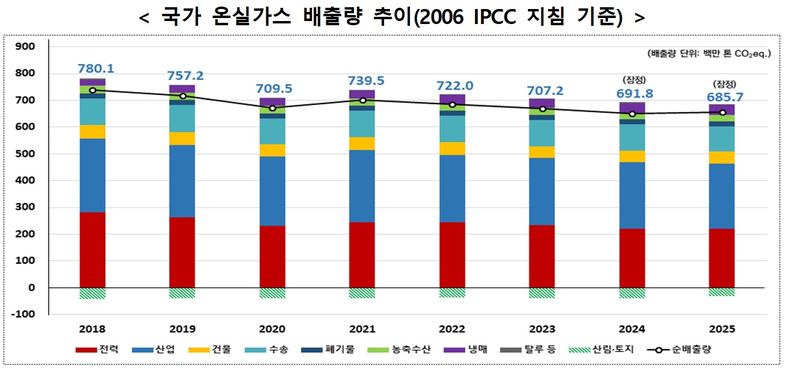
[Financial News] Preliminary national greenhouse gas emissions totaled 685.71 million tonnes in 2025, down 6.1 million tonnes, or 0.9%, from the previous year. However, net emissions edged up as wildfires reduced the amount of greenhouse gases absorbed by forests and land.
The Greenhouse Gas Inventory and Research Center of Korea (GIR), under the Ministry of Climate, Energy and Environment, said its preliminary estimate of the "2025 National Greenhouse Gas Emissions" showed that gross emissions totaled 685.71 million tonnes, based on the 2006 Intergovernmental Panel on Climate Change (IPCC) guidelines. Emissions decreased in the industrial, transport, agriculture, livestock and fisheries, and waste sectors, while they increased in the power, building and refrigerant sectors.
Power-sector emissions totaled 220.43 million tonnes, up 0.2% from the previous year. Total power generation remained similar to the previous year, but nuclear generation fell 2.2% as the number of maintenance and shutdown days increased. Coal-fired generation rose 2.2% to make up the difference. Renewable-energy generation, however, increased 8.5%. Compared with 2018, the share of carbon-free generation, including nuclear and renewable energy, rose from 29% to 40.8%, while coal's share fell from 41.9% to 28.7%. As a result, power-sector emissions declined 21.5% over the longer term.
Industrial emissions fell 2.1% to 242.93 million tonnes. The main factor was lower production in emissions-intensive industries such as steel, petrochemicals and cement. Although semiconductor production increased, improvements in process-reduction technologies limited the rise in emissions. Building-sector emissions increased 3.3% to 45 million tonnes as greater consumption of city gas followed a rise in heating degree days. Transport-sector emissions fell 2.9% to 94.59 million tonnes as diesel consumption declined amid the wider adoption of zero-emission and hybrid vehicles. Emissions of refrigerants, including HFCs and other fluorinated greenhouse gases, rose 3.9% to 36.28 million tonnes, driven in part by the growth of the cold-chain industry.
The amount of greenhouse gases absorbed by forests and land fell 22.8% to 31.03 million tonnes. This was due to the impact of the Gyeongsangbuk-do wildfires last March, which increased emissions from biomass burning by 8.3 million tonnes. Consequently, net emissions—gross emissions minus removals—totaled 654.70 million tonnes, up 3.1 million tonnes, or 0.5%, from the previous year. Compared with 2018, 2025 emissions were down 84 million tonnes, or 11.4%. The government said, however, that an additional 149 million tonnes must be cut by 2030 to meet the 2030 Nationally Determined Contribution (NDC) target, while up to 182 million tonnes must be reduced between 2031 and 2035 to meet the 2035 target.
The government said it established an institutional foundation for the decarbonization transition this year through a revision of the Renewable Energy Act to rationalize setback-distance standards, the first overhaul in 15 years of the Renewable Portfolio Standard (RPS), and the enactment of a special law supporting areas where aging coal-fired power plants are being retired. The cumulative number of electric vehicles reached 1 million this year, and one in five new vehicles sold in the first half of the year was electric. Going forward, the government plans to bring forward the deployment of 100 GW of renewable energy to before 2030 and pursue a coal-fired power phase-out roadmap. It also plans to increase green-transition funding for industry from KRW 8.7 trillion to KRW 10.6 trillion and announce by the end of the year a Green Transformation (K-GX) strategy targeting emissions-intensive industries such as steel, petrochemicals and cement.
Choi Min-ji, head of the GIR, said, "The foundation for accelerating the renewable-energy-centered decarbonization transition was laid last year to achieve the 2030 national greenhouse gas reduction target." She added, "In cooperation with relevant ministries, we plan to pursue the National Strategy for Carbon Neutrality and Green Growth and the Second National Basic Plan, which include sectoral and annual targets for the 2035 reduction goal, while strengthening annual implementation reviews."
[email protected] Lee Yu-beom Reporter