Government to Create 11 More Regulatory Free Zones Outside Seoul Metropolitan Area... Calls for Candidate Projects
- Input
- 2026-09-20 13:21:03
- Updated
- 2026-09-20 13:21:03
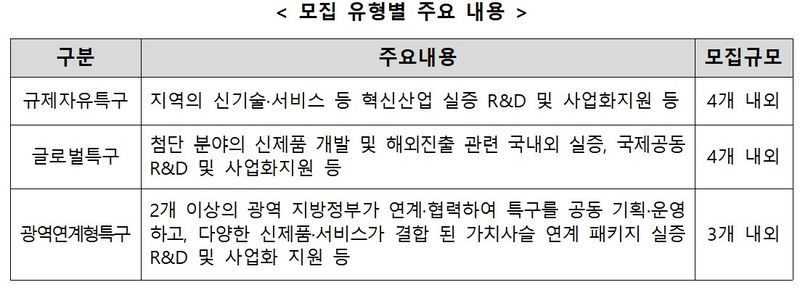
According to the Ministry of SMEs and Startups on the 20th, the call for projects will cover three types: Regulatory Free Zones, which support regulatory improvements in new technology and new industry sectors; Global Special Zones, which support product development tailored to overseas demand and demonstrations for entering foreign markets; and Interregional-Linked Special Zones, which promote package-based demonstrations through cooperation and coordination among regions.
Around 11 zones will be selected in total: four Regulatory Free Zones, four Global Special Zones, and three Interregional-Linked Special Zones.
Eligible applicants are special, metropolitan, and basic local governments outside the Seoul metropolitan area. Applications will be accepted from November 2 to 6.
The Ministry of SMEs and Startups will select candidate projects based on factors including the ripple effects of regulatory improvements, their contribution to developing local economies, and the feasibility of regulatory reform and commercialization. Final designations are scheduled to follow a review by the committee for regulatory special cases and other matters concerning Regulatory Free Zones in the first half of next year, as well as deliberation and a resolution by the Regulatory Free Zone Committee.
A Regulatory Free Zone is a system under which a local government applies for a zone plan and, after consultations with the relevant ministries, grants regulatory exemptions to new technology and service operators within the zone for a specified period. The system is operated by rationalizing related regulations once safety has been confirmed through demonstrations.
A total of 57 Regulatory Free Zones have been designated since the system was introduced in 2019. Of the 77 laws for which regulatory demonstrations were completed and revisions requested, 63 have been amended.
Further details are available on the websites of the Ministry of SMEs and Startups and the Korea Institute for Advancement of Technology (KIAT).
[email protected] Kim Hyun-cheol Reporter