Jeju Province and Provincial Council Hold First Permanent Consultative Meeting: Joint Effort on Budget, Jeju 4·3, Public Institutions and G20
- Input
- 2026-09-20 11:21:58
- Updated
- 2026-09-20 11:21:58
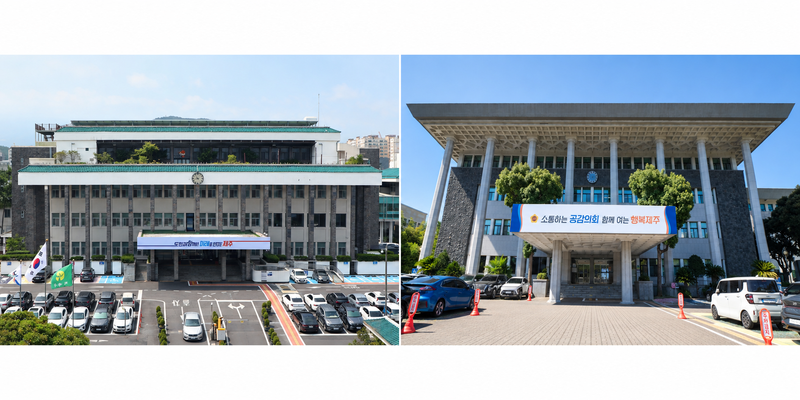
[Financial News | Jeju = Jeong Yong-bok] A consultative table bringing together Jeju's key issues—from next year's fiscal management and follow-up measures for Jeju 4·3 to the relocation of public institutions from the Seoul metropolitan area to the regions and efforts to attract the 2028 Group of Twenty (G20) Summit—will be launched.
Jeju Special Self-Governing Province and the Jeju Special Self-Governing Provincial Council will hold a permanent policy consultative meeting at 3 p.m. on the 21st at Tamna Hall in the Jeju Special Self-Governing Provincial Office. It will be the first such meeting since the launch of the ninth popularly elected Jeju provincial administration and the 13th Jeju Provincial Council.
Wi Seong-gon, governor of Jeju Special Self-Governing Province, and Song Young-houn, chairman of the Jeju Special Self-Governing Provincial Council, will serve as co-chairs. The council will be represented by its vice chair, standing committee chairs, negotiating-group representatives and chair of the Special Committee on Budget and Accounts. Jeju Province will send its vice governor for administrative affairs, vice governor for climate and the economy, and other senior bureau and office officials.
The meeting's main purpose is to bring discussions on individual issues together and establish a joint response. Key agenda items will include the direction of fiscal management for 2027, a just resolution of Jeju 4·3, efforts to attract public institutions in the second phase of relocation to Jeju, and the campaign to host the 2028 G20 Summit in Jeju.
Next year's fiscal management directly links the provincial administration's policy priorities with the council's budget review. The extent to which the two sides can share the broad direction and priorities of fiscal management could affect the drafting of the budget proposal and the council's review process.
The need for a joint response on Jeju 4·3 is particularly strong as follow-up measures, including additional reporting, compensation and corrections to family records, continue.
The enforcement decree of the Special Act on Jeju 4·3 took effect on the first of this month. Additional reports by victims and bereaved family members will be accepted again from February 1 through July 31 next year, while the deadline for applying for compensation has been extended by three years to December 31, 2029. The deadlines for applications to create or correct family relation registers and to report marriages and adoptions have also been extended to August 31, 2028.
Attention is also focused on how specifically Jeju Province and the council will formulate joint requests to the central government concerning support for additional reporting and compensation procedures, as well as corrections to family records.
The second-phase relocation of public institutions to the regions is another national balanced-development issue requiring a joint response from the two bodies. Jeju Special Self-Governing Province and the council have identified six institutions as key targets: Korea Racing Authority (KRA), Korea Airports Corporation (KAC), Korea Institute of Energy Technology Evaluation and Planning (KETEP), Korea Institute of Atmospheric Prediction Systems, Korea Marine Environment Management Corporation (KOEM), and Korea Trade-Investment Promotion Agency (KOTRA).
Jeju is emphasizing the need to attract KRA, KAC and KETEP in particular, citing their links to the region's industries and policies. The institutions to be relocated and the timing will be determined as the government's second-phase relocation plan takes shape. The key task ahead is to develop persuasive arguments and support measures for the central government and the institutions concerned.
The effort to attract the 2028 G20 Summit will also be addressed as a joint agenda item. South Korea is scheduled to chair the G20 in 2028. Hosting the G20 Summit in South Korea would come 18 years after the 2010 Seoul G20 Summit.
Jeju Province stepped up its campaign on the 16th by launching the National Committee for Promoting the Hosting of the 2028 G20 Summit in Jeju. Wi Seong-gon and Yang Moon-seok, chairman of the Jeju Chamber of Commerce and Industry, are serving as co-chairs, with economic, cultural, tourism, sports and civic organizations taking part.
Jeju Province is highlighting the concentration of conference and accommodation facilities at the International Convention Center Jeju and the Jungmun Tourist Complex as a major competitive advantage. According to the province, the Jungmun Tourist Complex area has 20 top-tier accommodation facilities and 132 meeting rooms, allowing it to accommodate up to 35,000 people simultaneously.
However, the host city will not be selected based solely on conference and accommodation facilities. Jeju must demonstrate its airport accessibility, transportation network, summit security, medical services, telecommunications and experience in operating international conferences as a whole. How Jeju Province and the council divide their roles in the campaign and in supporting related infrastructure will also be an issue going forward.
The two bodies plan to adopt a joint agreement based on the results of their discussions.
The practical outcome of the meeting will depend on what tasks are included in the joint agreement. The future significance of the policy consultative meeting is expected to hinge on how specifically the provincial administration and the council present joint demands and implementation plans on issues—such as fiscal management, Jeju 4·3, public institution relocation and the G20 bid—that are closely tied to central government policies and budgets.
[email protected] Jeong Yong-bok Reporter