Ruling Party Targets Constitutional Amendment Agreement by March-April Next Year; Seeks Referendum in First Half
- Input
- 2026-09-20 11:33:02
- Updated
- 2026-09-20 11:33:02
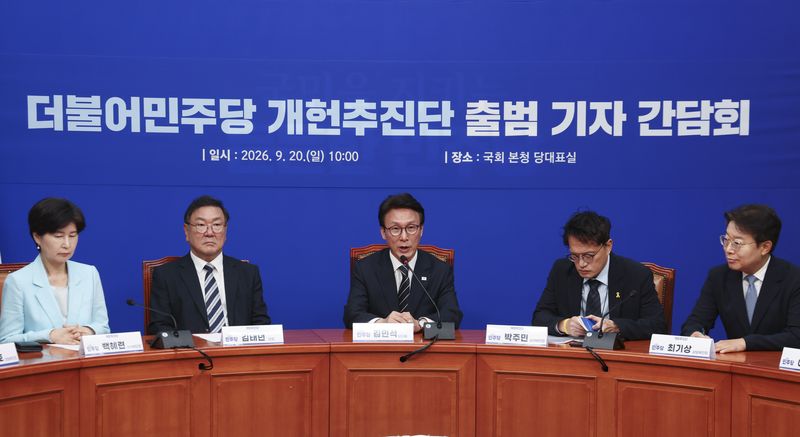
The Democratic Party of Korea held a press conference at the National Assembly of the Republic of Korea on the 20th to launch its Constitutional Amendment Task Force and announced this timeline. Specifically, the party plans to formulate its own proposal by gathering opinions from party members and experts on issues including the inclusion of 5.18 and the Busan–Masan Uprising, among others, in the Preamble to the Constitution; reform of the power structure and political system; and the strengthening of basic social rights. At the same time, it will pursue the constitutional amendment through a two-track approach, consulting not only the main opposition People Power Party but also the Rebuilding Korea Party (RKP), the Social Democratic Party, the Progressive Party, the Basic Income Party and other political parties by the end of the year. To that end, it also plans to call for the formation of a special committee on constitutional amendment at the National Assembly of the Republic of Korea.
Agreement with the People Power Party is crucial for the amendment bill to pass the National Assembly of the Republic of Korea. Under the Constitution, a constitutional amendment bill must receive approval from at least two-thirds of all National Assembly members. After passage by the National Assembly of the Republic of Korea, it must be put to a national referendum within 30 days, where it must receive votes from a majority of eligible voters and approval from a majority of those voting.
In May, an amendment bill that included provisions to enshrine the spirit of 5.18 and the Busan–Masan Uprising in the Preamble to the Constitution and strengthen controls over martial law was placed on the agenda of a plenary session of the National Assembly of the Republic of Korea. However, it failed after the People Power Party boycotted the vote. Of the 286 sitting members at the time, at least 191 votes—two-thirds—were required for passage, but only 178 lawmakers participated, meaning the vote itself could not proceed.
Kim Min-seok, leader of the Democratic Party of Korea, who attended the launch ceremony, urged the People Power Party to begin serious discussions on constitutional reform, saying that President Lee Jae Myung had stated he had no intention of seeking a second term through a constitutional amendment. Kim said, "The president has expressed his commitment to constitutional reform several times and has clearly addressed the obstacles raised by the opposition. Let us now move beyond nitpicking and turn to serious discussions on constitutional reform."
Kim Tae-nyeon, head of the task force, also said, "Whenever I have met with lawmakers from the People Power Party and spoken with them, every one of them has said, without exception, that the Constitution needs to be amended. Because the president has made clear that he has absolutely no intention of seeking a second term, I believe the obstacle caused by that suspicion has been removed."
The Democratic Party of Korea plans to separate the constitutional amendment referendum from the general election as much as possible to prevent controversy over its potential political benefits and disadvantages. Regarding the failure of previous attempts to amend the Constitution, Kim Tae-nyeon said, "They were calculated based on political interests—whether a constitutional amendment referendum would benefit or hurt their own party and political camp." He added, "Keeping the amendment process as far as possible from the political interests and advantages or disadvantages of each party is the best way to achieve constitutional reform. We are considering holding it roughly one year before the general election, keeping it as far away from the election as possible."
[email protected] Song Ji-won Reporter