'World Transport Olympics' to Draw Up to 60,000 People From Around the Globe... A Look at ITS World Congress Preparations [On-the-Ground Report]
- Input
- 2026-09-20 12:00:00
- Updated
- 2026-09-20 12:00:00
[Financial News, Gangneung = Jeong Gyeong-su] 'D-31.' This was the phrase most frequently seen in Gangneung on a visit to the city on the 17th.
With the ITS World Congress, a five-day event scheduled for next month from the 19th to the 23rd, just over a month away, Gangneung was busy preparing to welcome visitors. The ITS World Congress is the largest transportation-related event, often described as the "transport Olympics." It will be held in Gangneung for the third time in South Korea, following Seoul in 1998 and Busan in 2010. Unlike previous congresses held in major cities, this is the first time the event will take place in a midsize city.
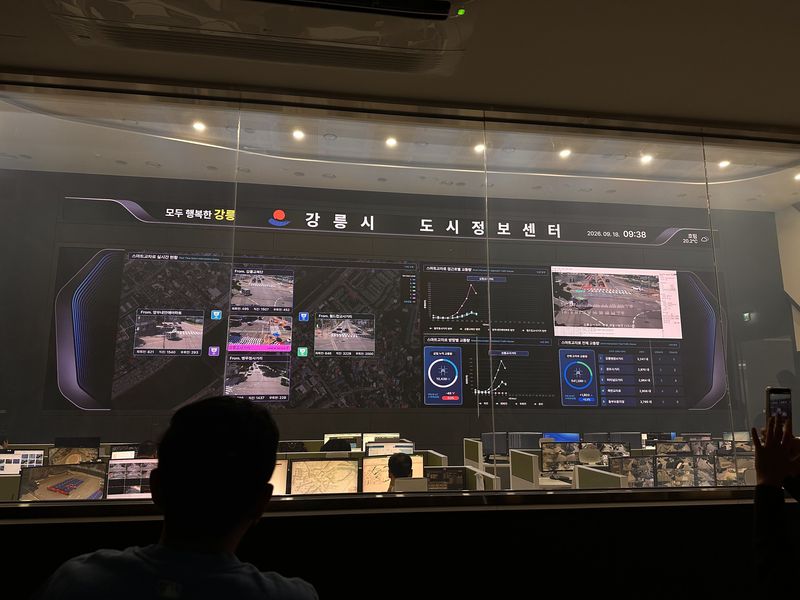
The Ministry of Land, Infrastructure and Transport (MOLIT) and Gangneung plan to showcase the city's unique strengths to the world. Since 2021, Gangneung has received nearly 100 billion won in national funding and connected 359 intersections online. As a tourism city visited by 35 million people annually, it has focused on building transportation infrastructure. Particular emphasis was placed on installing closed-circuit television (CCTV) cameras capable of collecting real-time traffic information from across Gangneung.
One of the city's signature services is real-time traffic signal navigation. Gangneung provides real-time signal information for intersections throughout the city by linking its system with Kakao Navi, TMAP, NAVER Map and Hyundai Motor Group navigation services. Lee Eun-young, a digital roads team leader at MOLIT, said, "Tourists who lack access to public transportation tend to rely heavily on navigation systems. Because they can receive real-time signal information from the moment they pass through an interchange, the system can help compensate for the city's limited road infrastructure."
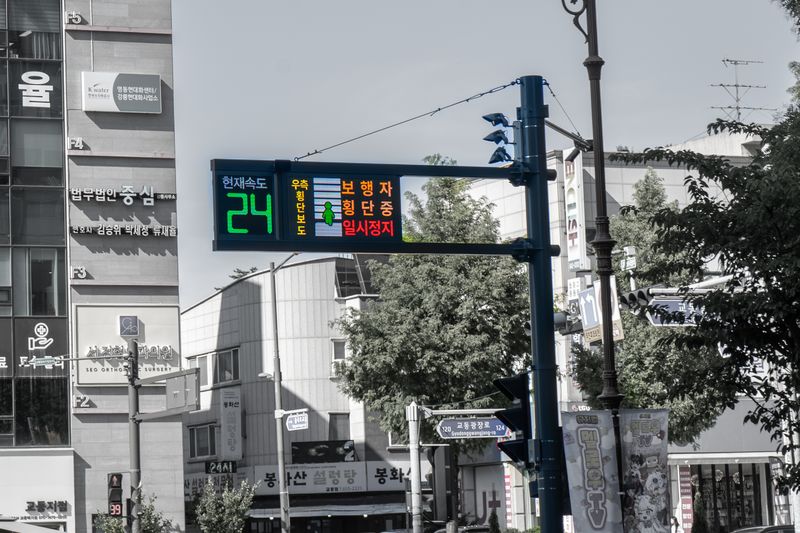
The most notable features are the smart crosswalks and the emergency vehicle priority signal system. Smart crosswalks analyze the walking patterns of elderly people, children and others, then provide information to drivers on the road. In particular, they tell vehicles making right turns whether pedestrians are using the crosswalk and how much time remains based on that information. When vulnerable road users, such as children or older people, are crossing, the crossing time may also be automatically extended according to their location. This helps prevent accidents involving vehicles turning right. Gangneung said that since the introduction of smart crosswalks, jaywalking has fallen by 90.6% (from 802 cases to 75), while violations involving failure to stop at the stop line have declined by 11.5%.
The emergency vehicle priority signal system is designed for ambulances, fire engines and other emergency vehicles. Artificial intelligence (AI) analyzes real-time traffic conditions through CCTV cameras installed on roads throughout the city. By combining information from emergency vehicle tablets with dispatch orders based on accident reports, the city information center controls traffic in real time by adjusting traffic signals along the route whenever an ambulance, fire engine or other emergency vehicle is passing through. The average arrival time for emergency vehicles has been reduced from 13 minutes to five minutes, while the average travel speed has increased by 1.4 km/h.
Gangneung is also serving as a testing ground for autonomous driving services aimed at addressing an aging population. The city operates an autonomous driving pilot zone spanning 68.5 km and has deployed autonomous "Masil Buses" on remote routes. It has also introduced autonomous trucks to support industrial complexes. In the future, Gangneung plans to establish late-night autonomous demand-responsive transit (DRT) services and city buses through an agreement with Hyundai Motor Company. Lim Shin-hyeok, head of Gangneung City's ITS Promotion Division, said, "Remote routes face severe deficits among transportation operators and a serious shortage of drivers. Autonomous DRT can help address these problems. Starting next month, we will operate two autonomous vehicles in downtown Gangneung from 10 p.m. to 5 a.m., filling not only geographic blind spots but also gaps in service hours."
The active participation of companies is also noteworthy. Domestic conglomerates and public institutions, including Hyundai Motor Group and LG Electronics, as well as 161 overseas companies and institutions, will take part. All 434 exhibition booths sold out early. Sponsorship has also exceeded its target, with more than 2.1 billion won raised.
The Gangneung congress, the first to be held in South Korea in 16 years, will welcome up to 60,000 visitors from 90 countries, based on cumulative attendance. Lee Jong-ki, secretary-general of the ITS Secretariat, said, "We expect this congress to generate an economic impact of 198 billion won and create 980 jobs."
[email protected] Jeong Gyeong-su Reporter