[Exclusive] Budget for police AI and advanced public-safety projects rises 15-fold in four years... AI makes inroads into investigations
- Input
- 2026-09-21 14:44:44
- Updated
- 2026-09-21 14:44:44
[Financial News] The police are accelerating efforts to integrate artificial intelligence (AI) into frontline public-safety operations. The budget for public-safety projects involving AI and advanced equipment has increased approximately 15-fold over the past four years since the adjustment of investigative powers between the police and prosecution in 2021. As the police take on greater responsibility for investigations following reforms to the criminal justice system, AI developed directly by frontline investigators is also being used to trace the flow of funds in financial crimes.
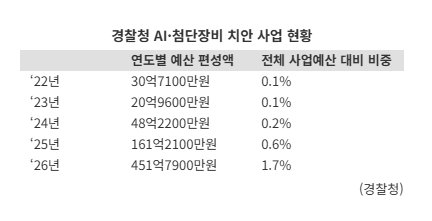
According to the Status of Police Public-Safety Projects Involving AI and Advanced Equipment, which Financial News obtained from the Korean National Police Agency on the 20th, the budget for related projects rose from 3.071 billion won in 2022 to 45.179 billion won this year, a 14.7-fold increase in four years. The share of the total project budget also grew from 0.1% to 1.7% over the same period.
The scope of the projects has also expanded. This year, 5.5 billion won was allocated to investigative-support AI, more than double last year's 2.677 billion won. Newly included in this year's budget are an 1.8 billion won retrieval-augmented generation (RAG)-based AI assistant for public-safety operations, a 2.338 billion won AI-based comprehensive incident-response system, a 1.711 billion won AI-based illegal-post detection and blocking system, and a 720 million won intelligence system for drug channels on social media. A new 5.3 billion won was also allocated to the AI-based civil petition and police officer work-support service Everyone's Police Officer.
The police are particularly expanding the use of investigative-support AI in stages. Following recommendations for similar cases and assistance with drafting investigative documents, its functions are being expanded to include drafting decisions and recommending questions for interview records. The police also plan to extend its use to analyzing investigation results. Kim Jongcheol, acting commissioner general of the Korean National Police Agency, said at a recent press briefing that the agency is pursuing greater work efficiency through AI, along with expanding personnel, strengthening investigative managers' leadership capabilities, and increasing the recruitment of specialists.
Account analysis cut from eight hours to nine minutes
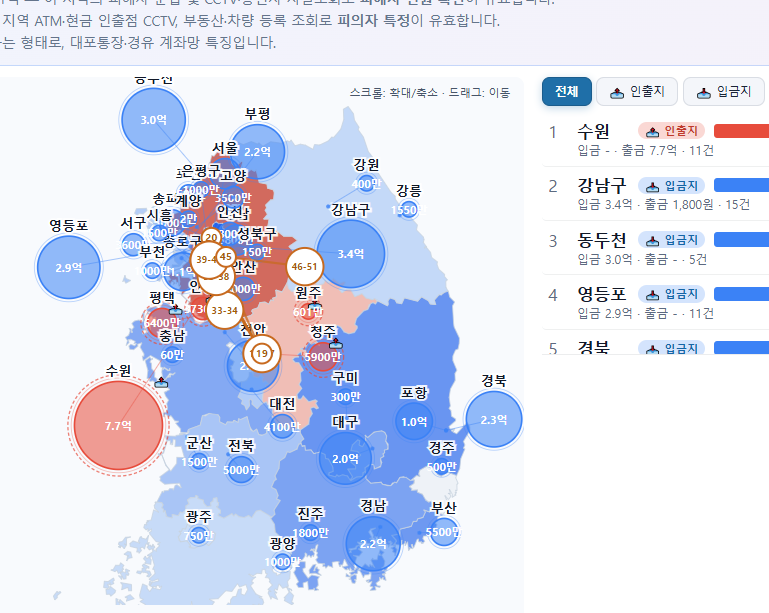
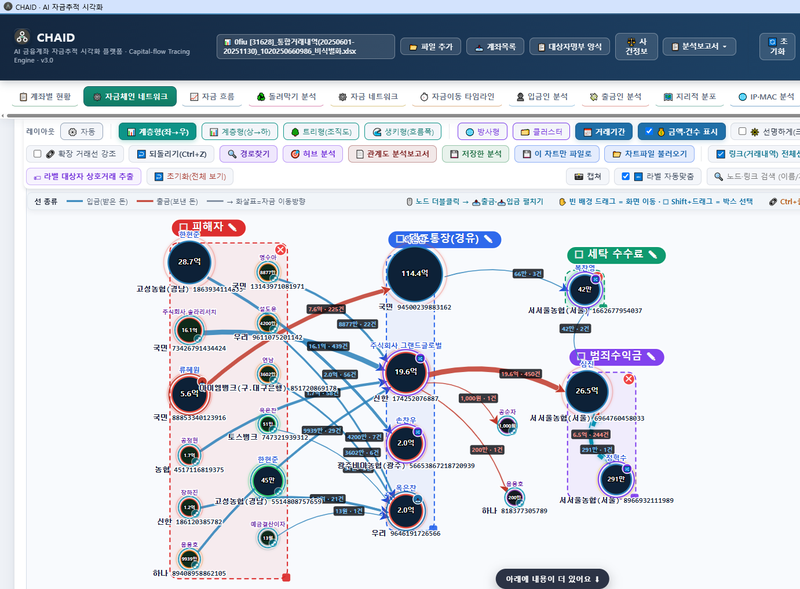
AI has also entered the actual investigative field. The Metropolitan Investigation Unit of the Gyeonggi Nambu Provincial Police Agency distributed CHAID, an AI program for analyzing financial accounts developed directly by six field investigators, to investigative departments for use beginning on the 2nd.
When an investigator inputs transaction records obtained from financial institutions, CHAID visualizes fund flows as a network and analyzes risk levels for each account and multi-stage fund-transfer routes. It identifies which accounts should be checked first among the many accounts and uses rules to assess mule accounts, accomplices, fund hubs, and structures suspected of illegal fundraising. The AI does not simply produce a conclusion; it also provides the grounds for its assessment. Investigators retain final judgment and responsibility.
Im Jong-ho, an investigator with the Gyeonggi Nambu Provincial Police Agency who participated in developing CHAID, said, "Previously, we received Excel files from banks and manually checked, one by one, where the money had gone," and explained, "CHAID can extract the necessary transaction records, visualize them immediately, and turn the analysis into a report."
The program was designed to reduce differences among investigators by enabling even those with limited experience in account analysis to produce results at a consistent level. According to the Gyeonggi Nambu Provincial Police Agency, the time required for a rookie investigator to analyze one account has been reduced from about eight hours to about nine minutes with CHAID. While it previously took about two hours to diagram fund flows, CHAID generates them automatically. Reports that once took two to five hours can also now be prepared with a single click.
Security was also considered because the program handles sensitive financial information. CHAID is designed to run independently on the police's closed internal network without communicating externally, ensuring that the data being analyzed is not transmitted outside the agency. It runs as an executable without a separate server, making it easy to distribute to other police offices.
As the shortage of investigative personnel persists, the police expect AI systems to reduce the time spent on repetitive data analysis and organization, allowing investigators to focus more on assessing cases and recovering victims' losses. In an actual investment-guidance scam case, investigators used CHAID to trace the flow of funds through multiple mule accounts and work backward from check withdrawals and users. They ultimately arrested every member of a money-laundering organization in the Seoul metropolitan area that was disguised as a gift-certificate business.
"AI, a tool to boost investigative efficiency... Guidelines needed"
Experts said AI could be effectively used to analyze investigative materials and support investigators' work. Yeom Gun-woong, a professor in the Department of Police and Fire Administration at U1 University, said, "AI will be highly beneficial for organizing vast amounts of investigative material and determining the direction of an investigation," adding, "It can be used efficiently in crimes such as digital, fraud, and phishing offenses, which require extensive analysis and information gathering."Some, however, said that accuracy must be improved and standards for using AI established as its adoption expands. Professor Yeom stressed, "AI must be continuously advanced, and clear guidelines must be established on privacy protection, the scope of investigations, and how extensively AI should be used."
[email protected] Kim Ye-ji Reporter