Starship Set for Orbital Flight... 'SOL Aerospace Value Chain' Draws Attention [ETF Square]
- Input
- 2026-09-20 17:12:58
- Updated
- 2026-09-20 17:12:58
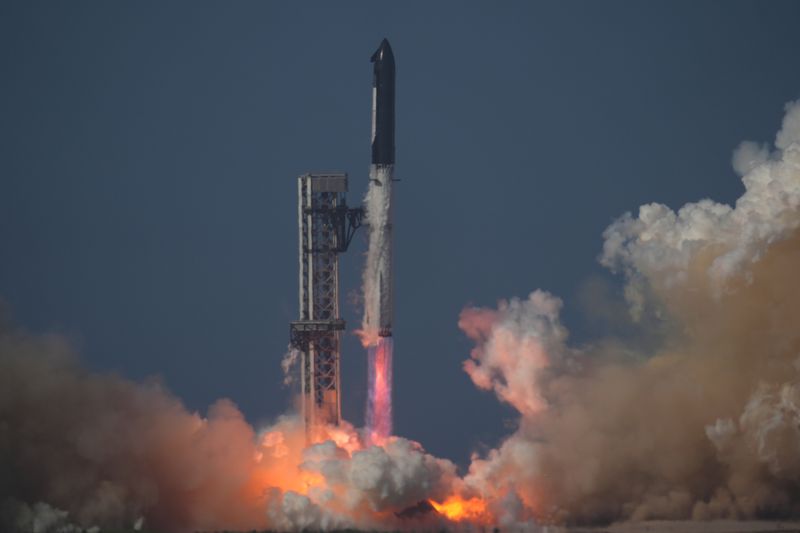
[Financial News] The SOL Aerospace Value Chain ETF is drawing attention after news that SpaceX's next-generation spacecraft, Starship, is set to make its first orbital flight. The ETF includes Korean aerospace materials, parts, and equipment companies.
According to the Korea Exchange on the 20th, SOL Aerospace Value Chain rose 12.20% last week (14–18), based on closing prices. Its price rose from 6,640 won on the 11th to 7,450 won on the 18th. The ETF tracks Shinhan Asset Management's Akros Aerospace Value Chain Index, which invests across Korea's aerospace value chain, including launch-vehicle materials, parts, and equipment; low-Earth-orbit (LEO) satellite communications; and space-data services.
As of the 19th, the publicly disclosed portfolio weights were 15.3% for Sphere, 13.4% for Intellian Technologies, 12.5% for Hanwha Systems, 12.3% for HANKOOK VACUUM METALLURGY, and 11.8% for Satrec Initiative. The top five holdings account for about 65% of the total. The structure covers the supply chain—from materials such as special alloys and aluminum to satellite antennas, power amplifiers, and satellite platforms.
The launch schedule has driven the share-price gains. Subject to regulatory approval, SpaceX plans to conduct Starship's 14th flight on the 28th local time. The mission will send the vehicle around an orbit at an altitude of about 275 km six times before deploying 26 Starlink V3 satellites for the first time. On the 17th, when news broke of the orbital-flight attempt, the ETF jumped 8.47% in a single day, ranking first among domestic ETFs.
Among the holdings, HANKOOK VACUUM METALLURGY posted the sharpest rise, gaining 24.4%. Its share price rose from 48,200 won to 60,000 won. It was followed by RFHIC (23.1%), Sphere (20.4%), Hanwha Systems (12.8%), and Satrec Initiative (11.8%). ALMAC, meanwhile, fell 5.1%.
Hong Ye-rim, a researcher at Korea Investment & Securities, said of Sphere, "If Starship's 14th flight succeeds, it could transition from a developmental test launch vehicle into a commercial launch vehicle that transports Starlink V3," and added, "As the deployment of Starlink V3 then gathers pace, investment in vehicle production and launch infrastructure could expand."
Kim Hong-sik, a researcher at Hana Securities, said RFHIC was in "a typical shortage phase, in which demand is growing due to factors such as the resumption of spectrum auctions, while the number of suppliers is shrinking following NXP Semiconductors' withdrawal from the communications business."
Domestic developments are also providing support. On the 17th, the Defense Acquisition Program Administration (DAPA) signed an administrative arrangement with the European Union (EU) to expand cooperation on low-Earth-orbit satellite communications, while the fifth launch of Nuri (KSLV-II), carrying 15 satellites, is scheduled for October 7. The Korea AeroSpace Administration (KASA)'s 2027 budget proposal totals 1.6491 trillion won, up 529 billion won from this year's 1.1201 trillion won.
However, the gap before expectations are confirmed by actual results remains a concern. Based on NAV, the ETF has returned -14.36% over the past three months and -26.49% since its listing in June. The launch schedule itself is also subject to regulatory approval. The 14th flight was postponed once, from the 22nd to the 28th.
Seol Tae-hyun, a researcher at DB Securities, said of the defense and aerospace theme, "Although concerns about policy noise and valuation pressures persist, the theme's overall direction has not been significantly undermined," adding, "It is advisable to focus on responding quickly while paying closer attention to the earnings trends of the leading theme."
[email protected] Han Young-jun Reporter