Reform of Local Education Subsidy Grant Formula Proposed... Superintendent Ko Eui-suk: "This Will Shake the Foundations of Jeju Education"
- Input
- 2026-09-20 10:04:23
- Updated
- 2026-09-20 10:04:23

[Financial News Jeju = Reporter Jeong Yong-bok] The government is pushing to change the formula for calculating Local Education Subsidy Grants from the current system, which automatically links grants to 20.79% of domestic taxes, to a new formula that reflects economic growth and changes in the school-age population. This has intensified conflict with provincial and metropolitan education offices. The government says the reform will ensure stable funding for elementary and secondary education while expanding investment in early childhood, higher and lifelong education. However, educators argue that education funding needs should not be assessed solely on the basis of declining student numbers.
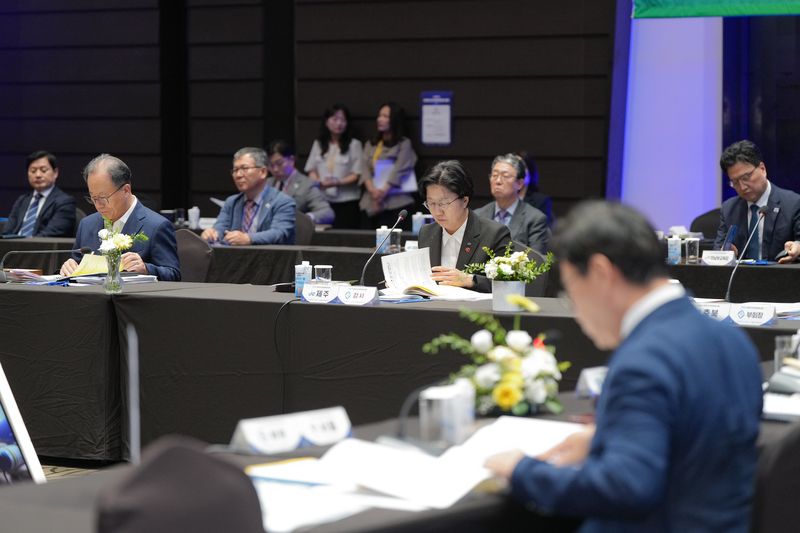
The Jeju Special Self-Governing Province Office of Education said on the 20th that Jeju Superintendent of Education Ko Eui-suk attended the 109th General Meeting of the Korean Council of Superintendents of Education, held at Sono Calm Yeosu in South Jeolla Province on the 17th, where participants discussed education-related issues, including reform of the Local Education Subsidy Grants system. Superintendent Ko said the nation's education superintendents would jointly respond to the government's proposed reform.
Superintendent Ko said, "If this continues, the foundations of Jeju education and the future of Jeju will be undermined," and called on the government and the National Assembly to secure stable education funding that reflects the views of educators.
She made clear her opposition to using the decline in student numbers as a direct basis for reducing education funding.
Superintendent Ko said, "Reducing funding simply because the number of students has declined is a simplistic and short-sighted decision. The crisis in education funding is a crisis of educational opportunities that should be provided to children, and it will lead to a crisis for Jeju society as a whole."
She also argued that the government must consider spending needs that are rising independently of student numbers, including AI-based future education, efforts to alleviate overcrowded classes, and increases in personnel costs. She called for the proposed reform of the Local Education Subsidy Grants system to be reconsidered from the ground up, with sufficient input from educators.
The core of the reform plan announced by the government on August 21 is to abolish the current system that automatically links grants to 20.79% of domestic taxes and replace it with a formula that reflects the nominal growth rates over the most recent three years and changes in the school-age population in the previous year's grants.
Under the government plan, only 35% of the change in the school-age population would be reflected in the grant calculation. If the total amount of grants calculated under the formula falls below the previous year's amount, the state would make up the difference. The government explained that this mechanism is intended to reflect changes in funding resulting from the decline in the school-age population on a limited basis while taking inflexible expenditures, such as personnel costs, into account.
The difference between the current allocation based on 20.79% of domestic taxes and the amount calculated under the new formula would be transferred to the education and talent account of the newly established Future Response Fund. The funds would be invested in early childhood education and care, as well as higher and lifelong education.
The government projects that, after the reform, Local Education Subsidy Grants will increase from 76.4 trillion won in 2026 to 92.7 trillion won in 2030. The Ministry of Education says the changes will reduce sharp fluctuations in grants caused by tax revenue changes and improve the financial predictability of provincial and metropolitan education offices.
Education superintendents are primarily concerned that directly reflecting the decline in the school-age population in the new formula could result in slower growth in funding for elementary and secondary education than under the current system. A key issue is how to account for spending that is difficult to reduce in proportion to declining student numbers, including AI and digital education, school facility improvements, efforts to alleviate overcrowded classes, and special education.
Superintendent Ko said, "Please discuss the proposed reform of the Local Education Subsidy Grants system from the ground up, not through a unilateral overhaul, while fully gathering input from educators."
[email protected] Jeong Yong-bok Reporter