LG Electronics puts AI data centers on a 'power diet' with high-efficiency turbo chiller
- Input
- 2026-09-20 10:24:39
- Updated
- 2026-09-20 10:24:39
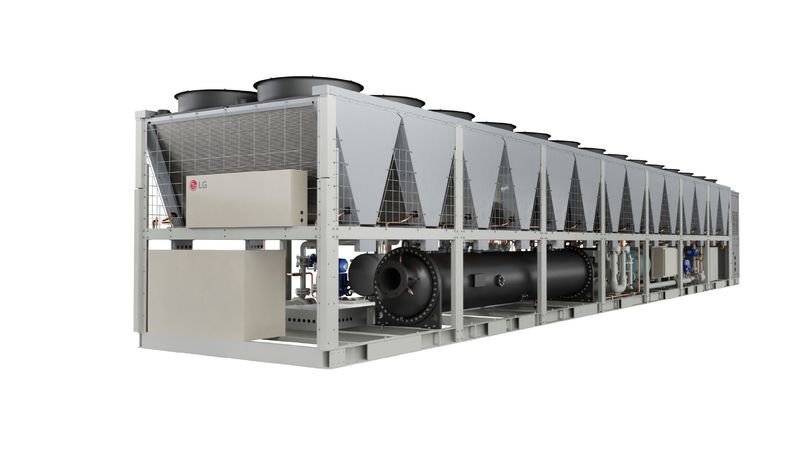
[Financial News] LG Electronics is strengthening its push into the rapidly growing global AI data center (AIDC) market by unveiling a customized turbo chiller designed for AI data centers.
LG Electronics announced on the 20th that it had launched a new air-cooled oil-free inverter turbo chiller, or turbo chiller. By introducing the larger-capacity turbo chiller, which offers greater capacity than screw chillers, LG Electronics has further strengthened its AIDC cooling portfolio.
The product focuses on reducing power consumption and total cost of ownership (TCO), responding to global environmental, social and governance (ESG) and carbon regulations, and addressing demand for early data center commissioning and flexible expansion.
The key feature of the new turbo chiller is LG Electronics' proprietary oil-free magnetic bearing technology. It uses magnetic levitation to suspend the rotating shaft in the air with electromagnetic force, eliminating mechanical friction losses while improving performance. Because it does not use lubricating oil, the system requires neither an oil circulation pump nor piping. It also prevents the formation of an oil film inside the heat exchanger, which can reduce cooling efficiency.
As a result, the new product's net part-load value (NPLV), which determines a chiller's actual operating efficiency, is more than 20% higher than that of inverter screw chillers commonly used in existing data centers. Other advantages include extending compressor life, reducing maintenance costs for periodic inspections such as oil changes and filter management, and minimizing the risk of downtime.
LG Electronics has applied refrigerant free-cooling technology to the new product. During the milder seasons and winter, when outdoor temperatures are low, the system circulates refrigerant naturally without operating the compressor. The compressor accounts for more than 80% of a chiller's power consumption during operation, so stopping it allows refrigerant condensed by the outdoor air to circulate on its own and remove heat, preventing unnecessary power consumption. The technology can reduce annual power consumption by an additional approximately 30% compared with conventional water-based free-cooling systems, further improving the data center's key metric, power usage effectiveness (PUE).
LG Electronics has also improved the product's ability to meet global refrigerant regulations by using R-513A, whose global warming potential (GWP) is more than 50% lower than that of the existing R-134a refrigerant.
The new product incorporates hydronic modular technology to enable rapid data center commissioning and flexible expansion. Previously, sending chilled water produced by a chiller to server rooms required numerous pumps and pipes to be welded and assembled, consuming considerable time and money. To address this issue, LG Electronics has pre-integrated and manufactured numerous essential systems—including pumps, valves and emergency buffer tanks—as finished units inside ISO-standard containers. At the site, operators need only connect the main chiller and container module, much like assembling Lego blocks, to start operation immediately, shortening the construction period. The system also allows facility investments to be made flexibly in line with a data center's expansion plans.
The new product also incorporates numerous technologies to improve operational reliability, taking into account the nature of AIDCs, where uninterrupted operation is essential despite various potential disruptions.
Lee Jaesung, head of LG Electronics' Eco Solution (ES) Business Division and president, said, "This new product is a solution that brings together all the value AI data center customers need, from exceptional efficiency to rapid on-site deployment based on modular technology." He added, "We will firmly establish our leadership in the rapidly reshaping global AI data center cooling market by leveraging our differentiated technological capabilities."
[email protected] Im Su-bin Reporter