Semiconductor-backed Electronics and Telecommunications Industry Drives One-Third of Wage Growth; Gaps Widen Across Industries
- Input
- 2026-09-20 12:00:00
- Updated
- 2026-09-20 12:00:00
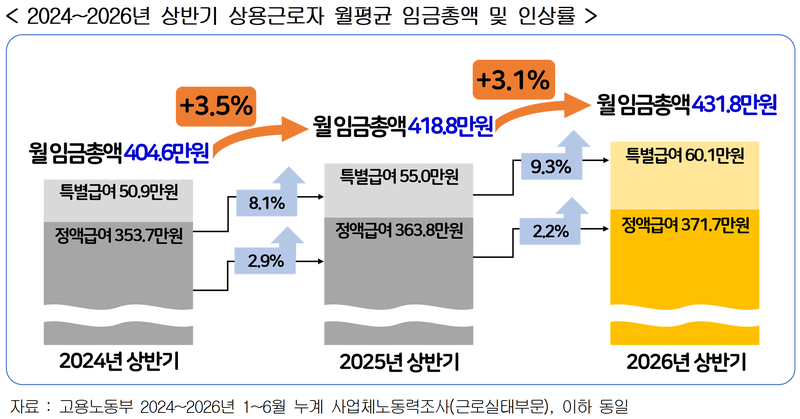
[Financial News] Wage gains in the first half of this year were concentrated in performance-based pay in several industries, including semiconductors. The increase in special pay in the electronics and telecommunications industry, which accounts for 2.5% of all regular employees, drove one-third of the overall wage increase. As growth in fixed wages such as base pay slowed, the increase in special pay varied by establishment size, widening the wage gap.
■ Special Pay in Electronics and Telecommunications Drives Wage Gains
According to KEF's "Analysis of Wage Increase Trends by Establishment Size and Industry in the First Half of 2026," released on the 20th, average monthly total wages per regular employee reached 4,318,000 won in the first half of this year, up 3.1% from the same period a year earlier. The growth rate was 0.4 percentage points lower than the 3.5% recorded in the first half of last year. Total wages comprise fixed wages and special pay, excluding overtime pay. Regular employees are wage earners whose employment contracts have no specified duration or last at least one year.Fixed wages, including base pay and regular allowances, rose 2.2% to an average of 3,717,000 won per month. The growth rate was 0.7 percentage points lower than in the first half of last year. In contrast, special pay, including performance bonuses and fixed bonuses, increased 9.3% to 601,000 won. Based on first-half figures, this was the highest level since 2011, when statistics covering establishments with one or more employees began to be published.
The electronics and telecommunications industry, which includes semiconductor manufacturing, led the increase in special pay. Average monthly special pay in the industry surged 66.0%, from 2,568,000 won in the first half of last year to 4,264,000 won this year. Although fixed wages rose by just 1.4%, the increase in special pay pushed total wages up 23.1% to 9,434,000 won.
Average monthly total wages in industries other than electronics and telecommunications rose 2.2% to 4,187,000 won. The growth rate of special pay also remained at just 1.8%.
There were approximately 377,000 regular employees in the electronics and telecommunications industry, accounting for about 2.5% of the total. However, the increase in special pay in the industry raised average monthly wages per regular employee by approximately 42,000 won, representing 32.4% of the overall increase of approximately 131,000 won. The electronics and telecommunications industry also includes non-semiconductor fields, so the increase cannot be attributed solely to the semiconductor industry.
■ Monthly Wage Gap Between Establishments With 300 or More Employees and Smaller Establishments Reaches 2.68 Million Won
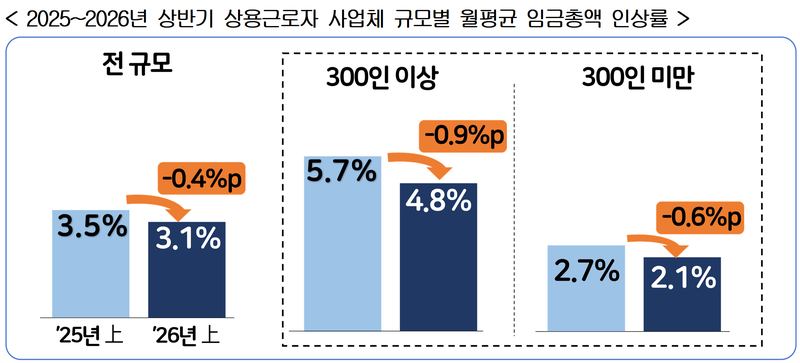
Special pay trends also diverged by establishment size. Average monthly special pay at establishments with 300 or more employees rose 14.7% year on year to 1,824,000 won. This exceeded the previous record of 1,661,000 won set in the first half of 2022. At establishments with fewer than 300 employees, however, special pay rose just 0.6% to 320,000 won.The growth rate of fixed wages was lower at establishments with 300 or more employees, at 1.4%, than at smaller establishments, where it was 2.2%. However, the difference in special pay reversed the rankings for total wage growth: 4.8% at larger establishments versus 2.1% at smaller ones.
As a result, average monthly total wages stood at 6,497,000 won at establishments with 300 or more employees and 3,818,000 won at smaller establishments. The gap widened by 219,000 won, from 2.46 million won in the first half of last year to 2,679,000 won this year.
Wage growth did not spread across all industries. Among the 17 broad industry categories surveyed, six recorded higher total wage growth than in the first half of last year, while the remaining 11 recorded lower growth.
Growth in manufacturing rose from 4.8% last year to 5.9% this year, while growth in professional, scientific and technical services increased from 2.7% to 5.7%. Among the subcategories of these industries, electronics and telecommunications, which includes semiconductor-related establishments, and research and development led the increase, with total wages rising 23.1% and 13.1%, respectively.
By contrast, total wages declined year on year in five industries: electricity, gas, steam and air conditioning supply (-3.1%); construction (-0.7%); real estate (-0.6%); mining (-0.6%); and information and communications (-0.2%).
Ha Sang-woo, a KEF executive director, said, "In the first half of this year, the increase in special pay in the electronics and telecommunications industry, driven by improved semiconductor performance, had a considerable impact on overall wage growth." He added, "Companies should share their results with employees, but determine the amount of compensation after taking future investment and long-term competitiveness into account, and distribute it fairly according to the performance and contributions of organizations and individuals." He continued, "Companies should be wary of demands for wage increases that exceed their ability to pay based on compensation at other high-performing companies. Companies and employees should work together to improve productivity and, based on that productivity, expand corporate competitiveness and the ability to pay wages."
[email protected] Kim Dong-ho Reporter