70% of Exporters Say "It Is Difficult to Find Buyers"... Securing Overseas Sales Channels Is the Biggest Challenge
- Input
- 2026-09-20 11:00:00
- Updated
- 2026-09-20 11:00:00
[Financial News] Seven out of 10 South Korean exporting companies were found to have difficulty securing overseas buyers and trading partners. Experts say support is needed to identify buyers whose purchasing power and likelihood of doing business have been verified, and connect them with companies from initial consultations through contract signing. The United States ranked first among the countries where companies hope to expand exports, while the Middle East was also cited as a promising region for market diversification.
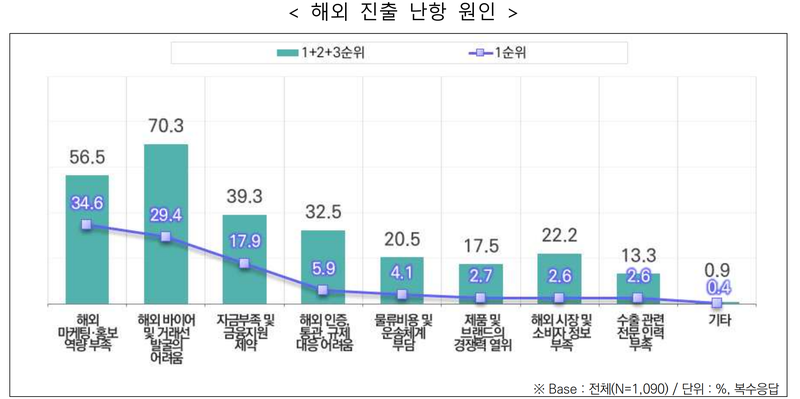
According to the '2026 Survey on Overseas Marketing Support Programs' released by KITA on the 20th, 70.3% of respondents cited 'difficulty finding buyers and trading partners' as an obstacle to exports. The survey was conducted from the 7th to the 13th of last month among 1,090 companies in the trade industry nationwide. Small and medium-sized enterprises accounted for 93.2% of respondents, while midsize and large companies made up 5.6% and 1.2%, respectively.
Some 56.5% of companies cited a lack of overseas marketing and promotional capabilities. This was followed by a lack of funds and difficulties securing financing at 39.3%, and responding to regulations such as overseas certification and customs clearance requirements at 32.5%. Respondents were allowed to select multiple answers for this question.
The support companies requested also focused on securing business counterparts. Identifying and vetting promising buyers ranked first at 54.3%, followed by connections with local distributors and agents at 41.2%, one-on-one consultations and matching with buyers at 39.8%, and support for participating in overseas trade shows at 34.9%.
When asked what should be prioritized in overseas marketing support programs, 71.2% selected 'securing buyers with high purchasing power and a high likelihood of doing business.' This indicates strong demand for companies to be connected not merely with more potential contacts, but with buyers screened for their actual purchasing potential.
The United States ranked first at 51.7% among the countries where companies want to newly enter or expand exports within the next three years. It was followed by Japan at 35.7%, China at 26.3%, Vietnam at 25.1%, and the United Arab Emirates (UAE) at 19.3%.
Interest in Middle Eastern countries was high compared with their current export volumes. Based on cumulative export value from January through August this year, the UAE and Saudi Arabia ranked 26th and 32nd, respectively, among South Korea's export destinations. However, they ranked fifth and 10th, respectively, among the countries where companies hope to expand. KITA analyzed that companies view the Middle East as a promising market for diversifying their exports.
The main outcomes of KITA's support programs included finding new buyers at 54.6%, follow-up meetings and negotiations with buyers at 27.7%, and obtaining information on overseas markets at 26.1%. Among companies that participated in the programs over the past three years, 23.0% said they had newly secured potential distribution networks in countries where they hoped to expand, while 17.7% said they had succeeded in exporting to markets where they previously had no export record.
Based on the survey results, KITA plans to improve its existing marketing support programs and develop new initiatives. Through its 13 regional headquarters nationwide, it will also share the findings with local governments and export support organizations and recommend that they be reflected in locally tailored programs.
Jeong Hee-cheol, head of KITA's Overseas Marketing Division, said, "The difficulty of finding overseas buyers remains the biggest obstacle for our small and medium-sized exporting companies and a challenge that export support organizations must address. KITA will continue to provide support by linking offline touchpoints, such as trade shows and business-matching events, with online support systems, including tradeKorea and the Global Matching Center, so that companies can meet suitable buyers and achieve tangible results, such as export contracts."
[email protected] Kim Dong-ho Reporter