"Sell Before the Holiday or Buy?" Foreign Investors Return as Red-Hot Semiconductor Stocks Push KOSPI Toward 7,000
- Input
- 2026-09-20 08:15:48
- Updated
- 2026-09-20 08:15:48
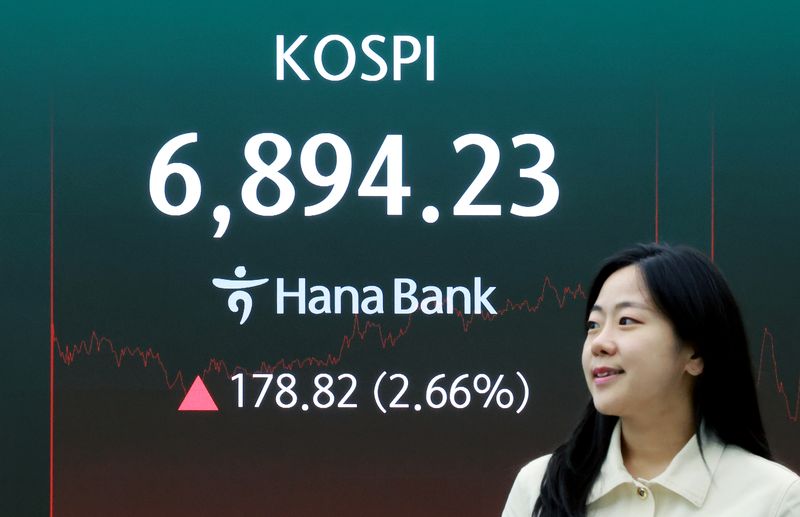
[Financial News] The KOSPI Composite Index has successfully rebounded after shaking off concerns over the burden of a hawkish rate hike by the U.S. Federal Reserve System (Fed). Driven by foreign investors' return to net buying and a sharp rally in major semiconductor stocks, the index quickly recovered the 6,890 level and is expected to attempt to reclaim the 7,000 mark, a round-number milestone, next week.
According to the financial investment industry on the 20th, the KOSPI surged 178.82 points, or 2.66%, from the previous session to close at 6,894.23 on the 18th. It briefly climbed as high as 6,914.08 during the session, breaking above 6,900. On a weekly basis, from the 14th to the 18th, the index edged down 0.23% on concerns over further U.S. monetary tightening and rising oil prices. However, a sharp rally late in the week allowed it to recover most of its losses.
Foreign investors and institutions, the key forces on the supply-and-demand front, led the market's rebound that day. Foreign investors turned to buying after eight trading sessions, recording more than KRW 400 billion in net purchases in the KOSPI market. They also bought more than KRW 500 billion in the futures market, driving the index higher. Institutions likewise posted more than KRW 1.5 trillion in net buying, creating a joint buying push with foreign investors.
Investor sentiment improved as uncertainty in global financial conditions eased. At its September Federal Open Market Committee (FOMC) meeting, the Fed raised its policy rate by 0.25 percentage points to an annual range of 3.75%–4.00% and signaled the possibility of another hike this year. However, the Bank of England's rate freeze and a decline in international oil prices, with West Texas Intermediate crude oil (WTI) falling to around $101 on expectations of increased supplies from Saudi Arabia, coincided with a rapid stabilization of the U.S. 10-year Treasury yield in the 4.9% range after it had hovered above 5%. A relief rally unfolded as the market focused on reduced uncertainty over the monetary policy path and the authorities' commitment to controlling inflation.
The sharp rise in the Philadelphia Semiconductor Index (SOX), along with remarks by NVIDIA CEO Jensen Huang about expanding chip demand, further lifted the shares of South Korea's two leading semiconductor companies. In the KOSPI market, SK hynix surged 6.42% to move above the KRW 1.85 million level, while Samsung Electronics rose 3.37% to the KRW 260,000 range. By sector, electrical and electronics stocks gained 4.46%, while information technology stocks advanced 4.40%. The KOSDAQ (Korea Securities Dealers Automated Quotations) also closed up 0.60% at 827.12, extending its gains to four consecutive sessions.
Market watchers are focused on whether the KOSPI can achieve the roughly 1.5% gain needed to reach 7,000. The key variable is a liquidity gap ahead of the Chuseok holiday. Since South Korea's stock market will be open for only three days, from the 21st to the 23rd, before the holiday next week, profit-taking and a wait-and-see stance in preparation for the risks of a long market closure could increase short-term volatility. The rising exchange rate and the impact of the Bank of Japan's policy rate hike to 1.25% will also determine whether foreign investors' buying continues.
Still, the prevailing view is that the index has sufficient momentum for further gains, given the solid improvement in semiconductor earnings driven by artificial intelligence (AI) and the historical pattern of a rebound after Chuseok as waiting funds flow into the market. Externally, South Korea's September 1–20 trade figures, due on the 21st, and the U.S. S&P Global PMI, scheduled for release on the 23rd, will be followed by the outcome of the U.S.-China summit held on the 24th while South Korea's stock market is closed. The results are expected to be a key turning point for the market's future direction.
[email protected] Moon Young-jin Reporter