LG CNS Successfully Concludes 'Optimization Grand Challenge 2026,' a Battle of Mathematical Minds
- Input
- 2026-09-20 10:00:00
- Updated
- 2026-09-20 10:00:00
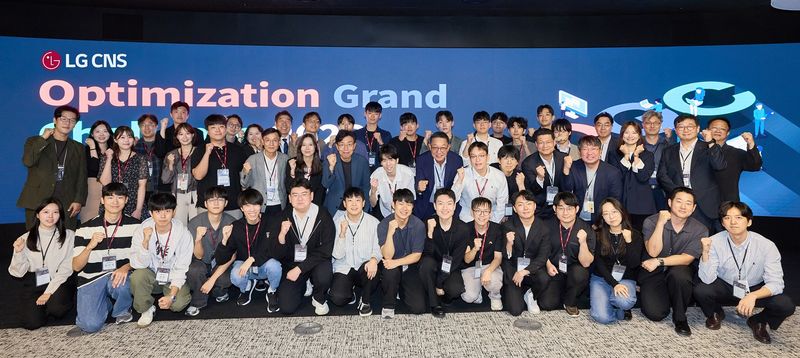
[Financial News] LG CNS announced on the 20th that it had concluded 'Optimization Grand Challenge 2026,' Korea's only mathematical optimization competition, and held an awards ceremony.
Mathematical optimization is a technology that examines the vast number of possible outcomes within given resources and constraints to find the most efficient solution. It is considered a core foundational technology supporting next-generation industries such as artificial intelligence (AI), quantum computing and robotics. LG CNS has held the annual competition with the Korean Institute of Industrial Engineers since 2024 to broaden the field's reach.
Participation grew significantly this year, with contestants from 55 countries—including the United States, the United Kingdom, China, Japan, Germany and India—giving the event the character of an international competition just three years after its launch. The number of participating teams rose about 2.8-fold, from 343 last year to 958, while the number of participants more than doubled from 676 to 1,448. They included students and experts from prestigious overseas universities such as Carnegie Mellon University (CMU), Imperial College London, Stanford University and The University of Tokyo; domestic universities including Seoul National University, Korea Advanced Institute of Science and Technology (KAIST) and Pohang University of Science and Technology (POSTECH); and working professionals from companies including Accenture, IBM, Samsung Electronics and Hyundai Motor.
The challenge focused on a shipyard's 'block placement optimization.' Because ultra-large vessels cannot be built all at once, hundreds of 'blocks'—massive structural sections about the size of a building—are fabricated separately and then assembled. Each block differs in size and shape, while sequencing constraints require one process to be completed before the next can begin, making the problem one of the most difficult challenges in shipbuilding. For judging, teams submitted their algorithms, after which a scoring system calculated their scores immediately and displayed the results on a real-time leaderboard.
The top six teams that advanced through the preliminary and main rounds competed in the final held in Korea. A team from Japan won the grand prize. LG CNS awarded a total of 200 million won to 20 teams, including the grand-prize winner. Depending on their rankings, participants will also receive opportunities for hiring-linked internships or exemptions from the document-screening stage when applying for jobs. The algorithm codes submitted by the top 10 teams will be released as open source. The goal is to share the various approaches to solving difficult problems developed during the competition with academia and industry, laying the groundwork for expanding the reach of mathematical optimization and its ecosystem.
As a leader in mathematical optimization, LG CNS has solved more than 200 business challenges across a wide range of industries, including shipbuilding, defense, steel, logistics, transportation, manufacturing, process engineering, finance, telecommunications, traffic and aviation.
[email protected] Yeon Ji-an Reporter