Asia's Heartbeat Comes Alive... 2026 Aichi-Nagoya Asian Games Begin 16 Days of Competition [Nagoya AG]
- Input
- 2026-09-19 21:58:40
- Updated
- 2026-09-19 21:58:40
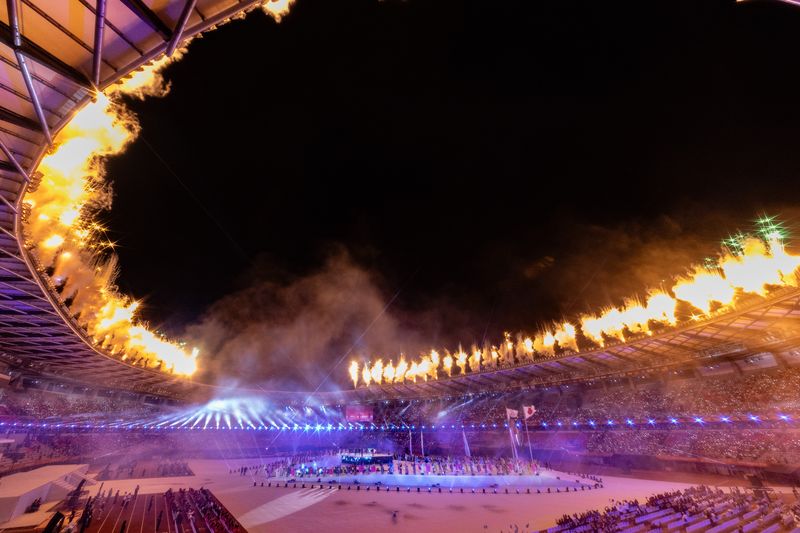
[Financial News] The 2026 Aichi-Nagoya Asian Games, Asia's largest sporting festival, began 16 days of competition on the afternoon of Sept. 19 with the opening ceremony at Paloma Mizuho Stadium in Nagoya, Japan. This is the 20th Asian Games, held three years after the 2022 Hangzhou Games were postponed for a year because of the COVID-19 pandemic. It is also Japan's third Summer Asian Games, following Tokyo in 1958 and Hiroshima in 1994, and the first to be held in the country in 32 years.
The slogan for the Games is "IMAGINE ONE ASIA (Here, as One)," emphasizing ties and harmony across Asia. The opening ceremony was likewise organized around "Harmonic Heartbeat," symbolizing the unity of Asian athletes. Beginning with the sound of a heartbeat, the ceremony created a spectacular scene as hundreds of dancers performed around a huge heart-shaped main stage, accompanied by a violin performance from music director Taro Hakase.
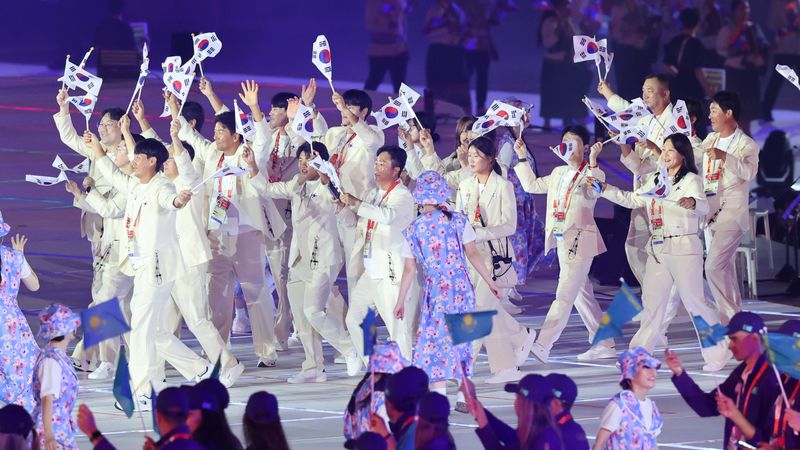
The delegations entered in alphabetical order by their English country names. The South Korean national team delegation entered the stadium 16th, between Kazakhstan and Kuwait. Table tennis star Shin Yu-bin and rower Kim Dong-yong served as co-flag bearers, while 50 athletes from nine sports, including women's basketball and table tennis, marched behind a heart-shaped country-name placard. In the stands, Minister of Culture, Sports and Tourism Choi Hwi-young and Korean Sport & Olympic Committee (KSOC) President Ryu Seung-min welcomed the delegation while waving South Korean flags.
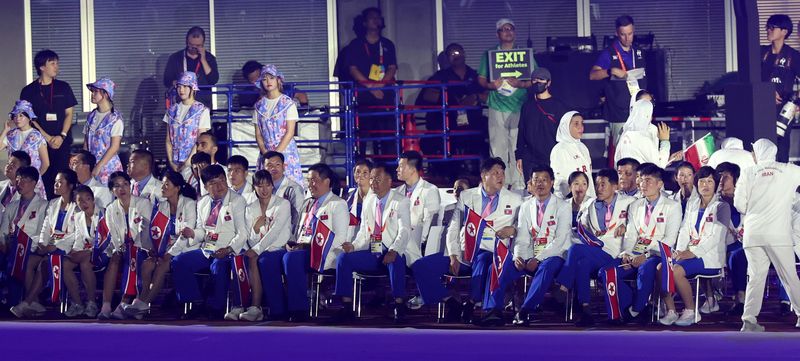
The North Korean delegation entered eighth. This marks the first time North Korea, which did not participate in the Tokyo Olympics held in 2021 because of the COVID-19 pandemic, has competed in an Asian Games hosted in Japan.
After Emperor Naruhito officially declared the Games open, the ceremony reached its highlight with the lighting of the cauldron. The flames, kindled separately in Tokyo in 1958 and Hiroshima in 1994 before being brought together at Nagoya Castle, were passed through a succession of Japanese sports heroes to Koji Murofushi, the 2004 Athens Olympic gold medalist in the hammer throw. Together with his father, Shigenobu Murofushi, a legendary five-time Asian Games hammer-throw champion, he lit the cauldron in a moving finale. The cauldron was modeled on a golden shachihoko, the "guardian deity" of Nagoya Castle.
Despite the elaborate production, a substantial portion of the 30,000-seat stands was empty, leaving attendance as a disappointment. Shortcomings in overall operations, including athlete accommodation and transportation issues that emerged even before the opening, remain urgent challenges for the organizing committee.
Through Oct. 4, more than 10,000 athletes from the National Olympic Committees of 45 countries will compete across 43 sports for 469 gold medals. South Korea, which has sent a 1,051-member delegation to compete in 41 sports, aims to win at least 40 gold medals and retain third place in the overall standings. On Sept. 20, the day after the opening ceremony, the South Korean delegation will begin its first gold-medal bids in events including modern pentathlon and teqball. At 7:40 p.m., South Korea will face Japan in a men's basketball matchup.
[email protected] Park Ji-hyun Reporter