Police identify 1,863 in crackdown on entrenched local corruption; 729 referred to prosecutors, 27 detained
- Input
- 2026-09-20 09:00:00
- Updated
- 2026-09-20 09:00:00
[Financial News] Police conducted a special crackdown on entrenched local corruption, identifying more than 1,800 people in just over six months and referring 729 of them to prosecutors. Illegal acts involving negotiated contracts, in which local public officials use nominee companies or family corporations to pocket profits, were also a major focus of the crackdown.
The National Office of Investigation said on the 20th that it had conducted a special crackdown on entrenched local corruption from March 4 through the 16th, identifying 1,863 people in 693 cases and referring 729 to prosecutors. Of them, 27 suspects facing serious charges were detained. Police plan to continue the special crackdown through October 31.
Various types of corruption, ranging from embezzlement involving hundreds of millions of won to accepting money in exchange for lobbying for permits and approvals, have come under investigation. In South Gyeongsang Province, an official in charge of budget affairs at a county township office was apprehended and detained on suspicion of embezzling 1.39587 billion won in 169 instances. The official allegedly accessed the administrative information system without authorization while the township head and deputy township head were away, then approved payment documents for construction, goods and services.
In South Chungcheong Province, an associate of a former mayor's election campaign committee was apprehended and detained after receiving 100 million won from a local waste company in exchange for promising to use his claimed ties to the mayor and public officials to secure permits through lobbying. In Gyeongsangbuk-do, two people, including a public official, were apprehended after the official used undisclosed information obtained while handling municipal household-waste affairs, such as business plans and bidding conditions, to award a service contract worth 96 million won to a waste-collection company established under a borrowed name and obtain illicit profits.
Police have expanded and reorganized the special crackdown by adding new categories of collusive local corruption and establishing a dedicated organization. At an anti-corruption policy council chaired by the president last August, the Acting Commissioner General of the Korean National Police Agency announced measures to "strengthen the response to collusive local corruption."
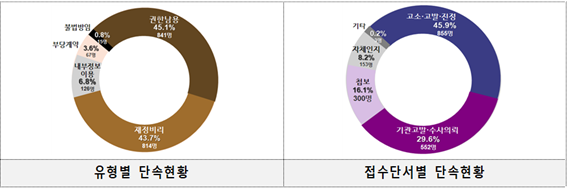
By type of offense, abuse of authority—including exerting undue pressure on others or accepting money in connection with one's duties—was the most common, involving 841 people (45.1%). Fiscal corruption, such as falsifying documents or inflating expenses to defraud public funds, followed with 814 people (43.7%). The figures were 126 people (6.8%) for using insider information, 67 (3.6%) for improper contracts and 15 (0.8%) for illegal dereliction of duty.
By status, public officials accounted for the largest group at 803 people (43.1%), followed by private companies and others at 703 (37.7%). Police explained that many cases involved public officials with authority over permits and approvals colluding with private companies seeking business benefits, often through brokers.
In southern Gyeonggi Province, six people, including public officials who accepted a total of 2.3 million won worth of money and entertainment from local businesspeople in exchange for expediting sewage treatment projects and other initiatives, and a broker who received 50 million won while claiming he could influence public officials, were apprehended. One of them was detained.
Police designated illegal acts involving negotiated contracts—through which local public officials obtain profits using schemes such as operating businesses under borrowed names or through family corporations—as Priority Investigation Task No. 1. So far, 33 cases involving 124 people have been identified; 44 people have been referred to prosecutors, including five who were detained. Investigations into 76 people are ongoing.
In Gangwon State, three people, including a department head in charge of the relevant project, were apprehended for operating an environmental company under a borrowed name while concealing it from the local government and signing a negotiated contract worth 55 million won to supply insect repellent.
Looking at how investigations were initiated, complaints, accusations and petitions accounted for the largest share, involving 855 people (45.9%), followed by institutional accusations and requests for investigations involving 552 people (29.6%). Intelligence tips accounted for 300 people (16.1%), while 153 people (8.2%) were identified through internal investigations. Police explained that most investigations began with self-reporting or tips from insiders, such as bribe providers and those who solicited favors, or with accusations filed by competent authorities that could secure administrative and audit records.
Police plan to award special achievement bonuses for outstanding cases from the crackdown while strengthening performance reviews and cooperation with related agencies. Based on the results of this operation, they will overhaul the response system and launch Special Crackdown Version 2.0 on Collusive Local Corruption in November.
Hong Seok-gi, head of the National Office of Investigation, said, "Entrenched local corruption, including rule-breaking and privilege in local administration, is a serious crime that undermines fairness in local communities and residents' trust in national policies." He added, "We will track the links in corruption to the very end and punish offenders severely so that collusive local corruption cannot take root." He also urged people to actively report and provide tips about corruption in their communities.
[email protected] Kim Ye-ji Reporter