Food Tax Cuts and AI Investment: Where Will the Money Come From? The Real Challenge of Takaichi's Cabinet Reshuffle
- Input
- 2026-09-20 12:04:12
- Updated
- 2026-09-20 12:04:12
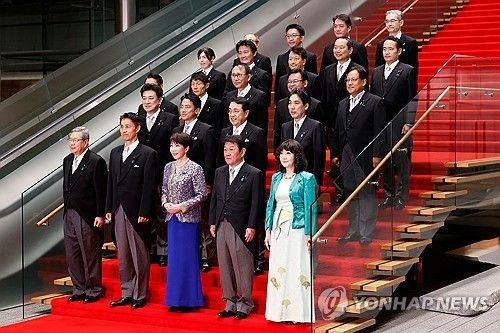
[Financial News, Tokyo—Correspondent Hye-jin Seo]"Lower the consumption tax on food, increase investment in artificial intelligence (AI) and semiconductors, and reduce the national debt ratio at the same time."That was the mandate Sanae Takaichi gave the Second Takaichi Cabinet, which she launched on the 17th.
The policies are welcome news for the public, but the question is where the money will come from. Japan's long-term interest rates have risen to the 3% range for the first time in about 30 years. Excessive fiscal spending could push up government bond yields and weaken the yen. On the other hand, prioritizing fiscal soundness could undermine the tax cuts and growth investments that are the hallmarks of the Takaichi administration.
The key issue in this reshuffle is not who became a minister, but how the administration will reconcile these conflicting goals. While maintaining 'responsible active fiscal policy,' Prime Minister Takaichi instructed her ministers for the first time to "secure market confidence." The new Cabinet has begun walking a tightrope between the politics of expanding spending and markets wary of it.
Spend More, but Reassure the Markets
At the top of the directive she issued to all ministers in conjunction with the reshuffle, Prime Minister Takaichi placed 'economic and fiscal management based on responsible active fiscal policy.' This gave a more concrete direction for fiscal policy than the phrase 'realizing a strong economy' used in her directive last February.
The policy includes public-private investment in 17 strategic industries, including AI and semiconductors; the development of regional industrial complexes; cuts to the consumption tax on food; and support for low- and middle-income groups. The government plans to invest first, raise growth and incomes, and boost consumption, corporate earnings, and tax revenue together.
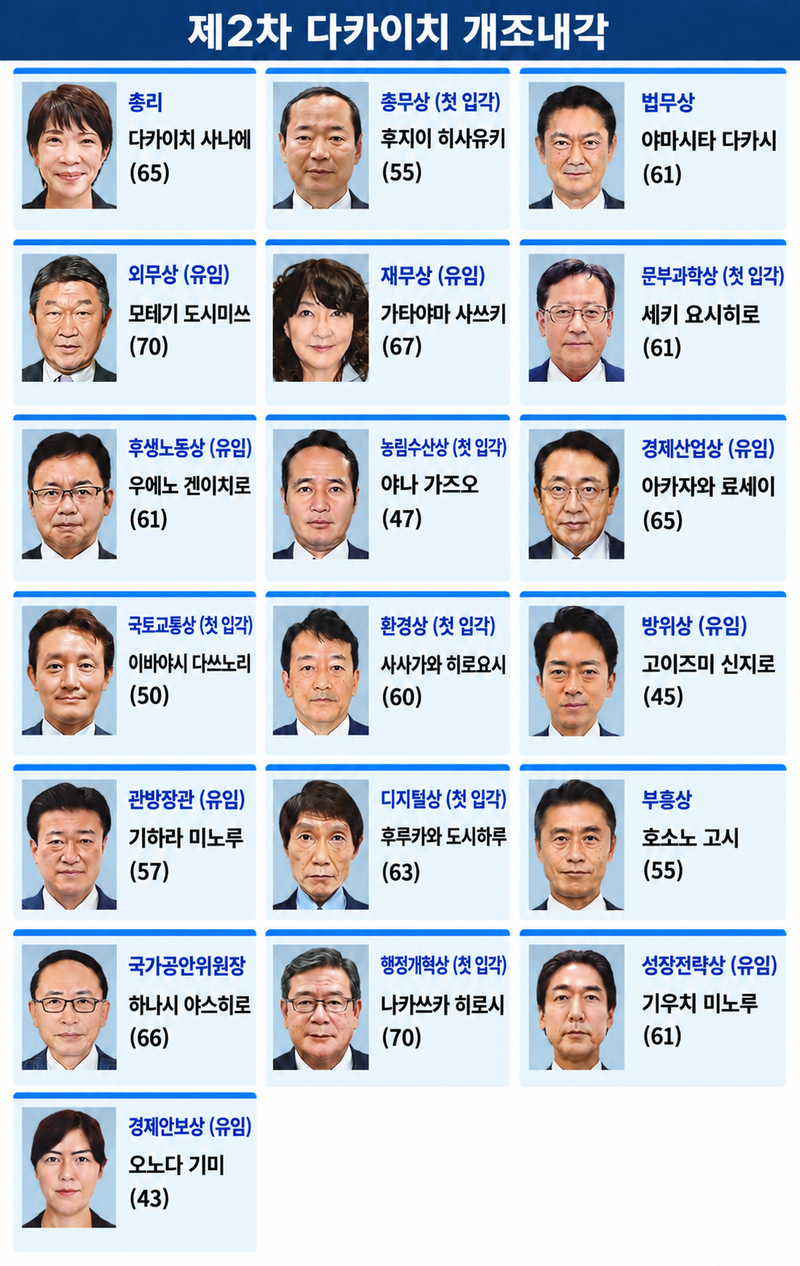
At the same time, Takaichi said the government would steadily lower the government debt-to-GDP ratio and achieve both growth and sustainable public finances. She instructed Finance Minister Satsuki Katayama and economic and fiscal policy minister Minoru Jonouchi to explain economic and fiscal management transparently and consistently to market participants in Japan and abroad. This instruction was absent from the February directive.
The Takaichi administration has consistently emphasized expansionary fiscal policy, so its separate reference to 'dialogue with the markets' is seen as a response to warnings from the government bond and foreign exchange markets. If increased fiscal spending and tax cuts lead to greater government bond issuance, long-term interest rates could rise further. A loss of confidence in public finances could weaken the yen and drive up import prices, reducing the impact of tax cuts intended to curb high inflation.
The situation in the Middle East is another burden. Prime Minister Takaichi has made tackling high inflation her top priority and ordered the creation of supply chains that can procure crude oil and naphtha without passing through the Middle East. International oil prices, the value of the yen, and government bond yields are all constraining policy at the same time.
Ultimately, the success of 'responsible active fiscal policy' will depend on whether the government can prove the word 'responsible' with numbers. The key question is how it will contain the increase in debt while cutting the consumption tax on food and expanding investment in strategic industries.
Why Factional Appointments Matter
Political backing is needed to turn economic policy into actual budgets and legislation. That is why the personnel makeup of this reshuffle matters.
According to Nihon Keizai Shimbun, the number of ministers from the former Abe faction doubled from two to four. The former Motegi faction had the largest representation, with five ministers. Meanwhile, the number of ministers from the former Kishida faction fell from three to one.
Prime Minister Takaichi retained Finance Minister Satsuki Katayama, a member of the former Abe faction, and appointed Agriculture, Forestry and Fisheries Minister Kazuo Yana and Education, Culture, Sports, Science and Technology Minister Yoshihiro Seki. Both had previously been disciplined by the party over the former Abe faction's political-funds scandal.
Former Internal Affairs and Communications Minister Yoshimasa Hayashi, who competed against Takaichi in the 2025 LDP presidential election, was left out of the Cabinet. Yasushi Kaneko, a former Land, Infrastructure, Transport and Tourism minister close to former Prime Minister Hayashi, was also replaced. This has prompted analysis that Takaichi is seeking to contain rival forces while expanding her support base with an eye toward the next party leadership election.
Takaichi publicly denied that the appointments were based on factions. According to The Asahi Shimbun, she had lawmakers submit their preferred posts directly before deciding on the appointments. Instead of faction leaders preparing lists of nominees as in the past, the prime minister personally assessed individual lawmakers.
However, the results still clearly reflected the gains and setbacks of the former factions. While reducing their formal influence, Takaichi appears to have used existing networks and factional numbers to strengthen her power base.
This could help advance policy, but it also carries risks. Removing rival forces and promoting people close to the prime minister could fuel discontent within the party. Appointing figures linked to the former Abe faction's political-funds scandal could also become a burden for the administration.
The First Test: Funding the Tax Cuts
The public's demands on the Takaichi Cabinet are clear. In an emergency poll conducted by Yomiuri Shimbun on the 17th and 18th, 90% of respondents cited 'the economy and employment' as a priority for the new Cabinet, while 85% cited 'measures to tackle high inflation.'
The challenge is execution. The government plans to convene an extraordinary Diet session on the 5th of next month and push for the passage of legislation including a bill to cut the consumption tax on food. As the ruling party holds only a minority, even a small rift within the LDP could become a major obstacle in negotiations with opposition parties over legislation.
The markets are looking for concrete figures, not slogans. The crucial questions are how the government will cover the cost of the food tax cuts, how much it will increase investment in AI and semiconductors, and whether it has a way to curb additional government bond issuance.
If funding measures remain unclear, government bond yields could rise and the yen could weaken further. Conversely, placing too much emphasis on fiscal discipline could weaken economic stimulus and measures to combat high inflation, making it difficult to meet public expectations.
This was a relatively small reshuffle, with eight of the 18 ministers retaining their posts. But the challenges facing the new Cabinet are far from minor. It remains to be seen whether the increased representation of the former Abe faction will strengthen Prime Minister Takaichi's ability to advance her policies or instead revive internal party conflict and political-funds controversies.
The success or failure of the new Cabinet is likely to become apparent first through the funding of the tax cuts, government bond yields, and the value of the yen—not through the list of ministers. The extraordinary Diet session next month will be the first stage for demonstrating whether Takaichi can keep her promise to "spend money while preserving market confidence."
[email protected] Hye-jin Seo Reporter