ECB President Lagarde Hints at Early Resignation... Rumors Swirl of WEF Leadership Role and French Presidential Bid
- Input
- 2026-09-18 23:31:34
- Updated
- 2026-09-18 23:31:34
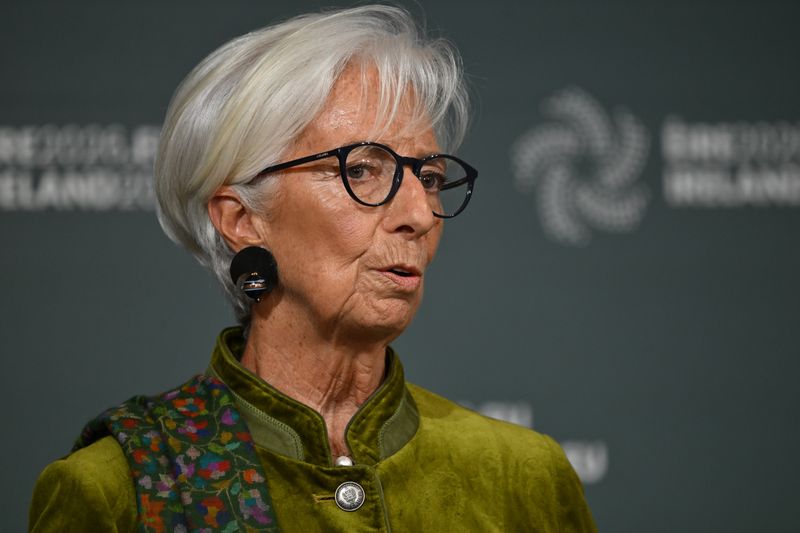
[Financial News] Christine Lagarde, president of the European Central Bank (ECB), has strongly hinted that she could resign before her term expires next October. As speculation swirls over her future—including reports that she could be tapped as the next chair of the World Economic Forum (WEF) and rumors of a French presidential bid ahead of the publication of her memoir early next year—European political circles are already engaged in complex calculations over the next ECB president, with tensions mounting between France and Germany.
According to Bloomberg and other major foreign media outlets on the 18th (local time), Lagarde said in an interview with Ireland's national broadcaster RTÉ radio, "I will leave in 2027." Asked whether she would leave after serving out her term through October 2027, she replied, "We will have to wait and see," leaving open the possibility of an early resignation. She added, "Whenever the time comes, I will conduct my departure in the most professional manner."
Speculation about Lagarde's early resignation has intensified after she received a series of overtures from the World Economic Forum (WEF) and the French political establishment. Foreign media outlets have reported since last year that the WEF, which has faced a leadership crisis, has been courting Lagarde to become its next head and that she is open to accepting the offer.
Her recent activities in France have further fueled speculation about a presidential bid. Lagarde recently announced that she would publish her memoir, "Lady First," in January next year. She also delivered a speech at an apple festival in Normandy at the invitation of Hervé Morin, a former colleague from the cabinet of Nicolas Sarkozy. Lagarde drew a line under the speculation, saying, "I am not a presidential candidate" and "I am old enough to know when to quit." However, she left the door open by adding, "I will be in the most effective position from which to give voice to European integration."
As signs emerge that the timetable for Lagarde's departure may be accelerating, maneuvering over the appointment of her successor at the ECB has already begun. France is taking the most active approach, rushing to reshape the ECB ahead of next April's presidential election amid the possibility that far-right candidate Marine Le Pen could win. French President Emmanuel Macron is reportedly drawing up a plan under which France would secure the ECB chief economist position in exchange for supporting former Dutch central bank governor Klaas Knot as the next ECB president.
However, this could provoke strong opposition from Germany, which has long shared influence over senior European appointments. Germany is also exerting considerable influence over monetary policy through Isabel Schnabel, an influential member of the ECB's Executive Board, and is seeking the chief economist position as well. Some believe that Deutsche Bundesbank President Joachim Nagel should be put forward as the next ECB president. However, the prevailing view is that Germany's monopolizing the top posts would be difficult in practice, given that German-born Ursula von der Leyen is serving as president of the European Commission.
Spanish Economy Minister Carlos Cuerpo said, "Whether the president serves out her term is her decision," while urging, "We must begin discussions on the future of the ECB—not only regarding the presidency, but also the several vacancies whose terms expire next year."
[email protected] Park Ji-hyun Reporter