North Korean Women Were Inside Russian Warehouse Hit by Ukrainian Drone Strike
- Input
- 2026-09-18 23:14:14
- Updated
- 2026-09-18 23:14:14
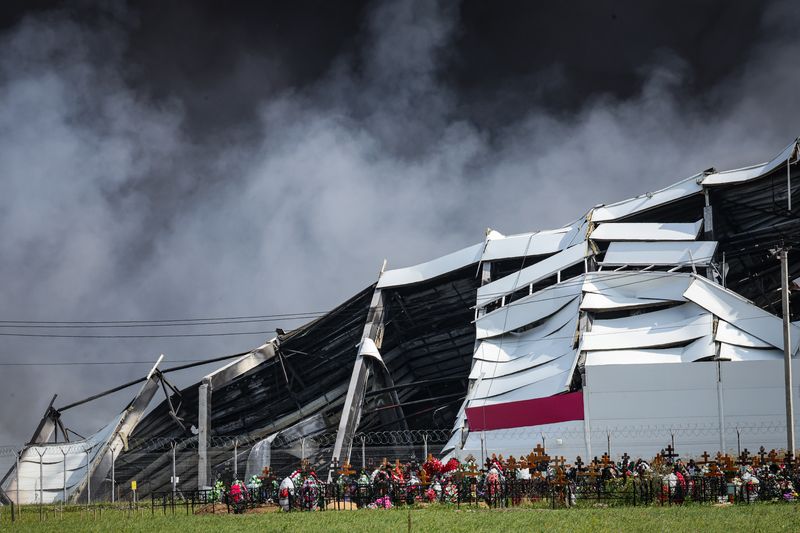
[Financial News] A foreign media report says that Kim Jong Un's regime has dispatched large numbers of North Korean female workers to factories and logistics warehouses in western Russia, where they face the risk of Ukrainian airstrikes, to earn foreign currency. Although they are promised relatively high wages and sent to work at these sites, the regime is believed to confiscate up to 90% of their earnings and divert the money to fund nuclear and missile development.
The Wall Street Journal (WSJ) reported on the 17th (local time) that North Korean female workers had been employed at at least one of the roughly 20 logistics warehouses operated by Wildberries, Russia's largest e-commerce company, that came under long-range Ukrainian drone attacks in July and August. The newspaper cited South Korean officials who analyzed footage from the sites. Russian authorities said at least nine people were killed in the attacks but did not disclose the victims' nationalities.
■ Demand for North Korean Labor Remains Strong Despite Bombing
Despite the possibility of casualties from the attacks, demand for North Korean workers and recruitment efforts in Russia have not cooled. In August, a Russian job website posted an opening for a Korean-language interpreter at a Wildberries warehouse, suggesting that North Korean workers continue to be deployed there.
Demand for North Korean women workers is also surging. In August, a Moscow-based recruitment agency posted a job listing for a team of 40 North Korean women to work as cooks, conveyor-line workers and textile workers. The offered monthly wage was about $1,800, or roughly 2.5 million won, nearly matching the approximately $2,000 monthly pay of North Korean soldiers deployed to Russia, according to South Korean intelligence authorities. Russia's largest seafood processing plant has also continued recruiting, seeking 30 North Korean women through Telegram.
■ Group Living Under "Study-Abroad Visas": A Trap of Labor Exploitation
Russia mainly issues these workers "education (study-abroad) visas" and employs them through a workaround to evade sanctions on North Korea. According to the WSJ, more than 98% of the roughly 36,000 visas Russia issued to North Koreans last year were study-abroad visas.
The workers generally live in tightly controlled communal settings at dormitories near production facilities, forming groups with supervisors, cooks, interpreters and doctors. Alisa Svitova, a Russian university student who interpreted for North Korean workers at an agricultural facility in Russia, said, "Many of the workers had learned basic Russian and firmly believed that their labor was helping promote friendship between the two countries." In July, local social media also showed North Korean women receiving practical training at a meat-processing plant near a military airfield outside Moscow and performing in traditional clothing at a celebration.
■ "Kim Jong Un Cares Only About Money—90% of Money Earned at the Risk of Their Lives Is Seized"
Experts say the North Korean regime is focused solely on securing dollars while completely disregarding the workers' safety. Peter Ward, a research fellow at The Sejong Institute, told the WSJ, "Kim Jong Un's primary concern is economic gain, not whether the workers live or die." He added, "Moving beyond its past practice of sending men to construction sites, the regime is diversifying its sources of foreign currency by dispatching female workers to factories."
According to the Multilateral Sanctions Monitoring Team (MSMT), a group involving 11 countries, including South Korea, the United States and Japan, North Korean workers in Russia earn an average of $7,500 a year—up to five times more than workers sent to China. However, the regime confiscates up to 90% of those earnings, which ultimately flow into funding Kim Jong Un's regime and its illicit nuclear weapons and ballistic missile programs.
[email protected] Park Ji-hyun Reporter