Five infectious diseases threatening to hit during the Chuseok holiday... "Just follow this one rule"
- Input
- 2026-09-20 12:00:00
- Updated
- 2026-09-20 12:00:00
[Financial News] With travel and outdoor activities expected to increase during the Chuseok holiday, the Korea Disease Control and Prevention Agency (KDCA) has provided comprehensive guidance on key infectious-disease prevention measures the public should know.
Infectious diseases to watch for when traveling abroad
Japan has recorded 549 measles cases as of the end of August, the highest figure in the past 10 years. Measles spreads through the air and is highly contagious; when an unimmune person comes into contact with a patient, the probability of infection exceeds 90%. Accordingly, people who have not received two doses of the measles, mumps and rubella (MMR) vaccine or are unsure of their vaccination status are advised to get vaccinated.
Japan is also entering its influenza season in epidemiological week 34, five weeks earlier than usual, in week 39. Travelers visiting Japan, including athletes and spectators attending the 20th Asian Games Aichi-Nagoya 2026, held from the 19th through October 4, as well as festivals and crowded public facilities, should take particular care to prevent respiratory infections. Hands should be washed with soap for at least 30 seconds after going out and before and after meals. People should also practice cough etiquette by covering their mouth and nose with their sleeves when coughing. Those with symptoms such as fever or cough should wear a mask and reduce contact with others.
Those traveling to Southeast Asian countries such as Vietnam, Thailand and the Philippines should use mosquito repellent every three to four hours when outdoors and wear light-colored, long-sleeved clothing to avoid mosquito bites. Travelers who have been bitten by mosquitoes or have suspected symptoms such as fever, headache or muscle pain upon entering the country should report this to quarantine officials and receive a free dengue fever test. If suspected symptoms develop within two weeks of entry, they should visit a nearby medical institution, disclose their overseas travel history and receive medical attention. In addition, measles cases have recently surged in Bangladesh, so visitors should take special care to prevent both mosquito bites and measles.
When visiting China, people should avoid poultry farms and live poultry markets to prevent avian influenza infection in humans (AI), and strictly follow mask-wearing and cough-etiquette practices. In particular, anyone entering the country after visiting or transiting through areas in China subject to enhanced quarantine management must submit Q-CODE or a Health Status Questionnaire.
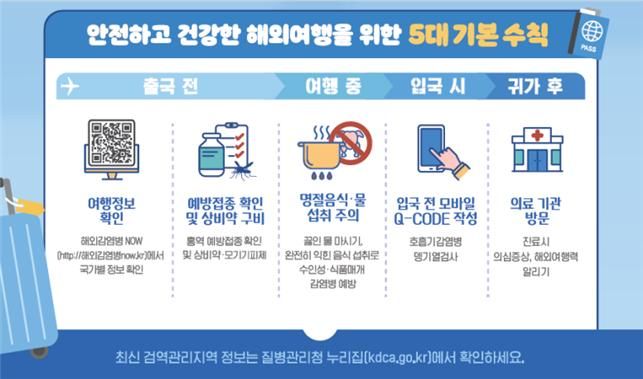
Regardless of the overseas destination, travelers should take special care to prevent waterborne and foodborne infectious diseases caused by contaminated water and food. Food should be thoroughly cooked, and safe water such as boiled or bottled water should be consumed. Travelers should also be cautious about eating food whose sanitary conditions are uncertain or consuming street food. Health information for overseas travel, including the status of enhanced quarantine-management areas and preventive measures before, during and after travel, is available through Overseas Infectious Disease NOW.
Respiratory infectious diseases: stronger protection needed for high-risk groups
Influenza began circulating earlier than usual, while COVID-19 is also on the rise. During the Chuseok holiday, when many people gather, preventive measures must be strengthened to protect older adults and other high-risk groups from respiratory infectious diseases.
According to KDCA sentinel surveillance at primary care medical institutions, the proportion of influenza-like illness (ILI) patients in epidemiological week 37 of 2026, from the 6th to the 12th, was 31.0 per 1,000 outpatients. This was up from 25.3 the previous week and significantly higher than the 6.7 recorded during the same period last year. The number of COVID-19 inpatients reported by hospital-level sentinel surveillance institutions in week 37 was 287. Although this was lower than the 459 recorded during the same period last year, the number has risen for eight consecutive weeks.
To prevent influenza and COVID-19, people should follow basic precautions such as washing their hands after going out, covering their mouth and nose with their sleeves when coughing, and wearing a mask when experiencing respiratory symptoms. High-risk groups, including people aged 65 or older and those with weakened immune systems who face a higher risk of developing pneumonia or severe illness after infection, should avoid participating in crowded indoor events. If they attend, they should wear a mask. Anyone with a fever or respiratory symptoms should visit a nearby hospital that provides care during the holiday, even during the break, for early diagnosis and treatment. Those visiting nursing facilities or medical institutions during the holiday must wear a mask and follow the facility's infection-prevention rules. People with respiratory symptoms should refrain from visiting high-risk individuals.
Waterborne and foodborne infections: outbreaks up more than 20%
During the Chuseok holiday, the risk of outbreaks of waterborne and foodborne infections may increase because many people gather to share food or consume food that has been stored for a long time after cooking. Food kept at room temperature for extended periods is particularly vulnerable to bacterial growth. It is therefore important to strictly follow preventive measures, including safe storage at temperatures of 5°C or below and hygienic food preparation.
According to KDCA surveillance, the cumulative number of waterborne and foodborne infectious-disease outbreaks through epidemiological week 37, ending September 12, was up 20.8% from the same period last year. The number of cases also increased by 29.4%, requiring caution. People should follow preventive measures such as 'washing their hands with soap for at least 30 seconds' and 'washing ingredients under running water and cooking them thoroughly at 85°C or higher.' Anyone experiencing symptoms such as diarrhea or vomiting must not prepare food. If two or more people who ate the same food are suspected of having developed the illness, the case should be reported immediately to the nearest public health center.
Travelers abroad should also be alert to cholera. Cholera is mainly transmitted through contaminated drinking water and food. Symptoms include high fever, vomiting, cramping abdominal pain and diarrhea, including bloody, mucoid or watery stools, as well as a feeling of incomplete evacuation. Symptoms become severe in 5% to 10% of infected people, potentially leading to dehydration, hypovolemic shock and death, so particular caution is needed.
Beware of tick-borne diseases during ancestral grave visits and weed cutting
People should follow preventive measures during outdoor activities such as visiting ancestral graves, cutting weeds and doing farm work over the Chuseok holiday to prevent tick-borne diseases, which increase in the fall. The main tick-borne diseases occurring in Korea are scrub typhus and severe fever with thrombocytopenia syndrome (SFTS). Over the past three years, 72.1% of all patients were reported during the fall, from September to November.
An analysis of the epidemiological characteristics of 3,685 patients with major tick-borne diseases in 2025 found that home garden plots accounted for 30.6% of infection risk factors, agricultural activities, including orchard work, for 28.0%, and weeding, including ancestral grave visits and weed cutting, for 8.1%. Agricultural and weeding activities together accounted for a high 66.7%.
Scrub typhus may cause symptoms such as high fever and chills within 10 days of being bitten by a chigger larva, which is the incubation period. The disease is characterized by the formation of an eschar, or black scab. Patients are most commonly reported from October through December. As of the end of August this year, 123 cases had been reported, down 37.9% from the 198 cases recorded during the same period last year. SFTS is transmitted by the bite of a tick carrying the virus, with symptoms such as high fever and vomiting appearing after an incubation period of five to 14 days. There is no vaccine or treatment, and the fatality rate is high at 18.0%. SFTS cases are most common from April through November. As of the end of August this year, 94 cases had been reported, down 44.7% from the 170 cases recorded during the same period last year.
The best way to prevent tick-borne diseases is to avoid being bitten by ticks. During outdoor activities such as weeding, visiting ancestral graves and farm work, people should wear long clothing and use repellent. After returning home, they should immediately wash their clothes and take a shower. If symptoms such as fever, vomiting, diarrhea or digestive problems develop within about two weeks of outdoor activity, people should immediately visit a medical institution, inform medical staff about any tick bites and outdoor activities such as weed cutting or farm work, and receive treatment.
Beware of the risk of imported mosquito-borne diseases
The risk of mosquito-borne diseases being imported into Korea may rise as overseas travel increases during the Chuseok holiday. There were 105 imported mosquito-borne disease cases through epidemiological week 34 in 2025, from January through August 22, and 103 cases during the same period in 2026.
More than 5 million dengue fever cases were reported in 106 countries in 2025, including 3,000 deaths. Cases occurred mainly in the Americas, including Brazil, Mexico and Colombia; Southeast Asia, including Vietnam, Indonesia, Bangladesh, India, Cambodia and Thailand; and Africa, including Sudan and Mali. Even people who have been infected before can be reinfected with a different serotype. Severe dengue, including dengue hemorrhagic fever and dengue shock syndrome, has a high fatality rate of about 5%, so caution is needed when visiting outbreak areas.
In 2024, malaria affected approximately 282 million people in 80 countries and caused 610,000 deaths. Falciparum malaria carries a particularly high risk of progressing to severe disease and has a fatality rate of more than 10%, making prompt diagnosis and treatment important. After checking the risk areas, travelers should receive preventive medication before departure, taking into account drug resistance in the malaria prevalent in their destination, and take it according to the prescribed instructions.
There were 450,000 chikungunya fever cases and at least 146 deaths reported in 2025, mainly in the Americas and Asia. Although most people recover, eye diseases such as uveitis and retinitis, heart complications such as myocarditis, and neurological complications such as Guillain-Barré syndrome can occur. Newborns and older adults with underlying conditions should take extra care.
Zika virus infection continues to be reported at low levels in 92 countries where the disease is endemic, including Brazil. In addition to direct transmission through mosquito bites, it can spread through sexual contact with an infected person or vertical transmission from mother to child. Women who are pregnant or planning to become pregnant should take precautions, including postponing pregnancy for three months when traveling to affected areas. Pregnant women are advised to avoid or postpone travel to affected countries, consult a medical institution before traveling about necessary precautions, and have the fetus's health checked. Those planning a pregnancy should avoid sexual contact and postpone pregnancy for at least three months after returning home, for both men and women.
To prevent imported mosquito-borne diseases, travelers should check infectious-disease information for their destination through Overseas Infectious Disease NOW before departure. During travel, the most important measure is to avoid mosquito bites by wearing long-sleeved tops and long pants and using mosquito repellent.
KDCA Commissioner Im Seung-kwan said, "The KDCA will maintain its emergency disease-control system throughout the Chuseok holiday and closely monitor infectious-disease trends, including by operating the KDCA Call Center (1339) 24 hours a day, so that we can respond swiftly." He added, "Chuseok is a precious time for families and relatives to be together, so it is important to make an effort to protect one another's health. I urge everyone to check in advance the information on infectious diseases to watch for during the holiday and follow everyday preventive measures such as handwashing and cough etiquette so that you can enjoy a healthy and pleasant holiday."
[email protected] Jeong Myeong-jin, medical specialist Reporter