North Korea Unresponsive, Yet Ruling Party and Government Send 'One-Sided Peace Messages' on Gyeongwon Line Restoration and More
- Input
- 2026-09-18 17:06:42
- Updated
- 2026-09-18 17:06:42
On the 18th, the office of Democratic Party of Korea lawmaker Lee Jae-kang held a seminar at the National Assembly to discuss restoration of the Gyeongwon Line and ways to revitalize border areas. The Gyeongwon Line once ran from Seoul through Yeoncheon in Gyeonggi Province and Cheorwon in Gangwon Province to Pyeonggang and Wonsan in North Korea, but the railway was severed after the division of the Korean Peninsula. In 2015, the government began construction to first restore the section on the South Korean side from Baengmagoji Station in Cheorwon to Woljeong-ri Station, with plans to eventually connect it to the Military Demarcation Line through an inter-Korean agreement. Construction was suspended the following year as inter-Korean relations deteriorated. The latest restoration plan seeks to revive a project that has been halted for roughly 10 years.
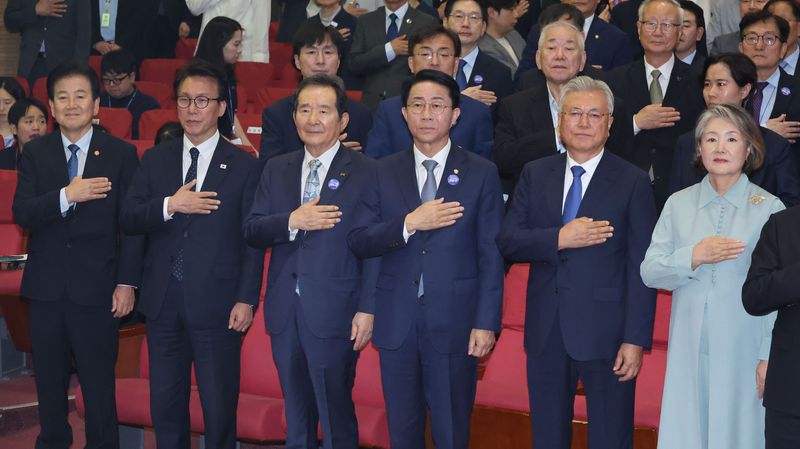
At an event held at the National Assembly the same day to mark the eighth anniversary of the September 19 Pyongyang Joint Declaration, figures from across the ruling bloc also emphasized peace through the restoration of inter-Korean relations. In congratulatory remarks read by Kim Kyoung-soo, special adviser to the president for political affairs, President Lee Jae Myung said, "I will do my utmost to ensure that the resumption of U.S.-North Korea dialogue develops into discussions on ending the war on the Korean Peninsula and establishing a peace regime." In a congratulatory address, former President Moon mentioned North Korea's advancing nuclear capabilities and the severing of inter-Korean roads and railways, while urging, "North Korea should also actively engage in inter-Korean dialogue alongside U.S.-North Korea talks."
The government is also backing expanded civilian exchanges. On the 17th, the Ministry of Unification (MOU) supported an amendment to the Inter-Korean Exchange and Cooperation Act that would remove the government's grounds for rejecting notifications of contact with North Korean residents. The measure is intended to lower the barrier to civilian contact while retaining the prior-notification system.
Some observers, however, said the focus should not be placed solely on establishing a connection with North Korea. Jung Yoo-seok, an associate research fellow at the Korea Institute for National Unification (KINU), who attended the Gyeongwon Line seminar, said, "If we focus on how to connect with North Korea, it may actually make it more difficult to move the project forward," adding, "There is no need to focus so heavily on North Korea." He also said it would be necessary to consider whether the resumption of tourism to North Korea would actually lead domestic and foreign tourists to use the Gyeongwon Line. "If I were going to North Korea as a tourist, honestly, I think I would land at Incheon International Airport, take the KTX to Gangneung, where tourism infrastructure is already in place, enjoy myself there, and then go up to North Korea. I don't think I would go there by taking the Gyeongwon Line," Jung said.
A realistic argument was also raised that, before pursuing a blueprint for inter-Korean rail links, the country must first secure routes for trains operating domestically. Bang Geon-seok, head of the GTX team at the Gyeonggi Provincial Government, said that after GTX-C opens, the Uijeongbu section could share tracks with Seoul Line 1 and the existing Gyeongwon Line. If shuttle trains and inter-Korean rail services are added later, track capacity could reach its limit. As a solution, he proposed securing underground space for a connection in Uijeongbu now, while construction of GTX-C is under way, and eventually extending an underground dedicated line to Yangju. The proposal is based on the view that preparations for bottlenecks on the Gyeongwon Line must begin now, since starting additional construction after GTX-C service begins would significantly increase costs and the burden of construction.
[email protected] Song Ji-won Reporter