Senior Fire Service Appointments to Cross City and Provincial Boundaries... Fire Commissioner’s Authority Strengthened
- Input
- 2026-09-18 18:41:58
- Updated
- 2026-09-18 18:41:58
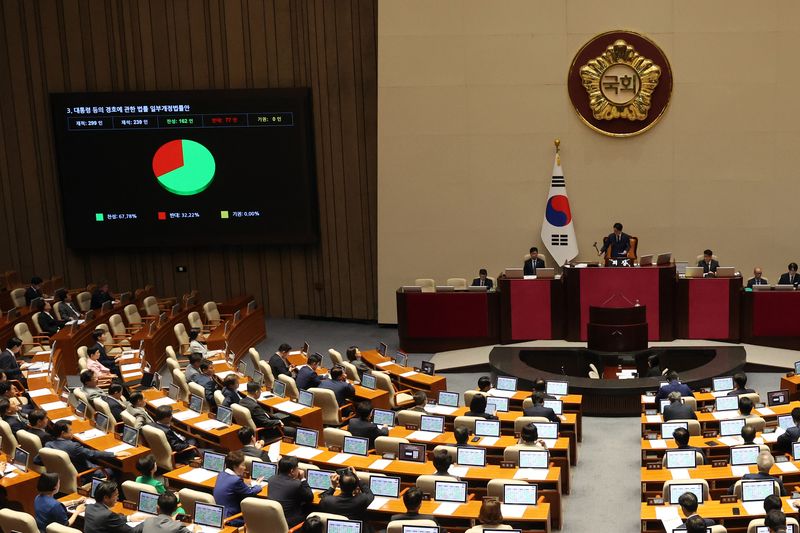
[Financial News] Senior fire service personnel management, previously confined within individual cities and provinces, can now be conducted nationwide. As the President or Fire Commissioner will be able to directly exercise appointment authority over promotions to chief superintendent and assistant fire commissioner, as well as transfers and secondments of fire chiefs and higher-ranking officials between cities and provinces, the amendment lays the groundwork for broader use of cross-regional personnel exchanges and disaster-response experience.
The National Fire Agency (NFA) said on Sept. 18 that an amendment to the Fire Officers Act containing these provisions had passed the plenary session of the National Assembly of the Republic of Korea. The amendment consolidates four bills proposed by lawmakers into an alternative bill drafted by the Public Administration and Security Committee of the National Assembly of the Republic of Korea, and was approved as submitted during the plenary session.
The amendment’s key provision allows the President or Fire Commissioner to directly exercise, within the scope of delegated appointment authority, that authority when necessary for nationwide personnel management, even if it has been delegated to cities and provinces or other authorities.
The measure applies to joint promotions of chief superintendents and assistant fire commissioners from among fire officials belonging to the NFA and city and provincial authorities. It also covers transfers and secondments of fire chiefs and higher-ranking officials between the NFA and cities and provinces, or among cities and provinces. Transfers and secondments resulting from adjustments to personnel quotas in individual cities and provinces are included as well. Specific categories and procedures will be established by presidential decree.
Accordingly, city and provincial personnel authority itself will remain intact, while a channel will be created to assign senior officials across regional boundaries.
The National Assembly of the Republic of Korea explained in the bill’s rationale that the fragmented, city-and-province-based personnel structure had limited opportunities for promotion and advancement to senior positions depending on an official’s duty location. It also said the structure had made personnel exchanges and balanced assignments between regions difficult.
A competency assessment for senior fire officials will also be introduced. The appointing authority or authority authorized to recommend appointments may assess the abilities and qualifications required of fire officials in ranks designated by presidential decree and use the results in personnel management, including promotions. The ranks subject to assessment and the specific methods will be set by presidential decree.
The education and training system will also be revised. The current legal term “fire academy” will be changed to “education and training institution,” and eligibility for training will be expanded from fire officials to include people required to receive fire training under other laws, as well as workers requiring fire-related training as designated by presidential decree. The change is intended to establish a legal basis for expanding specialized fire training for private-sector initial-response personnel, such as members of in-house fire brigades.
The term “fire officer candidate,” which has been used since the Fire Officers Act was enacted in 1977, will also be eliminated. To reflect the actual recruitment process, it will be changed to “successful applicant in the open competitive recruitment examination for fire lieutenants,” while the examination’s name will be standardized as the “open competitive recruitment examination for fire lieutenants.” Fire officer candidates selected under the previous rules before the amended Act takes effect will be deemed successful applicants under the amended Act, preserving the legal status of existing trainees.
The amended Act will take effect on the day six months after promulgation. However, the provision allowing the President and Fire Commissioner to directly exercise delegated appointment authority will take effect first, on the day three months after promulgation.
“This amendment is significant because it preserves the basic framework of the existing city and provincial personnel authority while supplementing nationwide personnel management and laying the foundation for a senior-official personnel system centered on capabilities and performance,” Fire Commissioner Choi Yong-cheol said. “We will move forward smoothly with revising subordinate legislation and gathering opinions from cities and provinces to strengthen on-site response capabilities and further bolster public safety,” he added.
[email protected] Lee Bo-mi Reporter