30 Years of Child-Friendly Cities... United Nations Children's Fund (UNICEF) Discusses Legal and Institutional Measures to Narrow Regional Gaps
- Input
- 2026-09-18 15:58:35
- Updated
- 2026-09-18 15:58:35
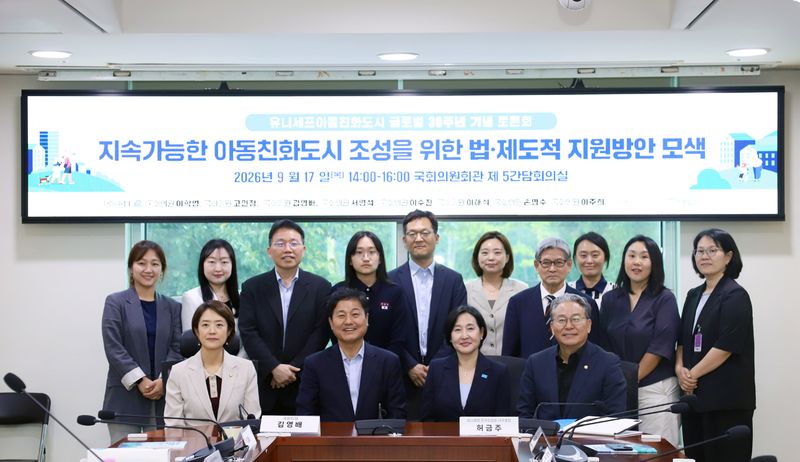
UNICEF Korea said on the 18th that the 'Policy Forum Celebrating the 30th Global Anniversary of UNICEF Child-Friendly Cities' was held at the National Assembly Members' Office Building on the 17th. The forum was jointly organized by UNICEF Korea, eight lawmakers and the UNICEF Child-Friendly Cities Local Government Council.
The UNICEF Child-Friendly City initiative is an international program launched in 1996 to implement the Convention on the Rights of the Child (CRC) at the community level. It is currently being carried out in more than 3,000 cities across 35 countries.
In South Korea, 129 of the country's 243 local governments, or 53.1%, are participating in the initiative, beginning with Seongbuk District, Seoul, in 2013. Of these, 113 have received certification, while 16 are pursuing certification.
Ryu Hyeon, director of UNICEF Korea's Child Rights Division, emphasized in a presentation, "A national legal and institutional foundation is needed for Child-Friendly Cities to become established sustainably rather than depending solely on the commitment of local communities."
Lawmaker Kim Young-bae also stated, "The government must establish a national legal basis so that every child can enjoy an equally child-friendly environment, regardless of where they live."
The panel discussion, chaired by Ick-Joong Chung, a professor in the Department of Social Welfare at Ewha Womans University, brought together officials from local governments, research institutions and the Ministry of Health and Welfare (MOHW). Key issues included urban-rural disparities and declining policy continuity resulting from changes in local government heads and officials in charge.
Seo Min-ji, a child affiliated with a child participation body in Seongbuk District, said, "Meaningful participation is needed so that children's views lead to actual policy changes," adding, "I hope that 'the same Child-Friendly City, the same rights' will be guaranteed regardless of region or age."
[email protected] Jang In-seo Reporter