Coxon sparks the AI extinction debate...27-year-old math prodigy wins silver and bronze medals at the Olympiad
- Input
- 2026-09-18 15:07:04
- Updated
- 2026-09-18 15:07:04
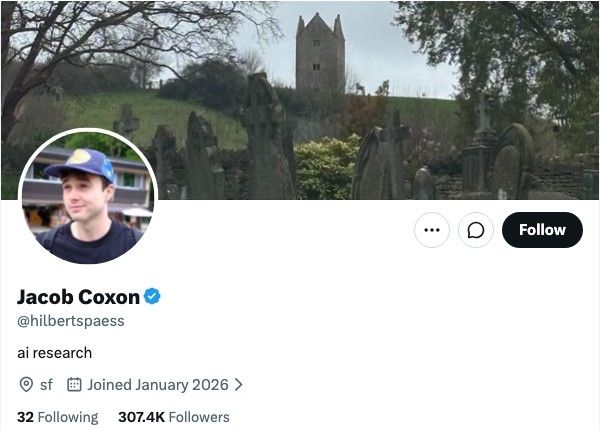
[Financial News] The researcher who left Anthropic on the eve of its expected IPO after warning that artificial intelligence (AI) could wipe out humanity within 10 years was a math prodigy who, as a teenager, watched AlphaGo defeat Lee Sedol, one of the world's top Go players.
The U.S. daily The Wall Street Journal (WSJ) spotlighted Jacob Coxon, a British-born former Anthropic researcher who became a catalyst for global debates over AI regulation and the pace of AI development, on the 17th local time.
Just a week ago, 27-year-old Coxon was an almost unknown researcher in Silicon Valley. Now, he has become a symbol of AI safety.
Coxon showed a talent for mathematics from his teenage years, becoming one of the United Kingdom's representatives at the International Mathematical Olympiad (IMO) while in high school. He competed in the Olympiad in 2016 and 2017, winning a silver medal and a bronze medal, respectively.
In particular, the 2016 victory by Google DeepMind's AlphaGo over Go player Lee Sedol—the so-called "AlphaGo shock"—made him realize that machines could conquer fields requiring human intuition and creativity.
After graduating from the University of Cambridge, Coxon joined a London intellectual group known as "the Rationalists." He briefly worked in commodities trading before heading to Silicon Valley.
He encountered the Generative Pre-trained Transformer 3 (GPT-3) model, released in 2020—two years before OpenAI launched ChatGPT—and later recalled, "It was really a 'wow' moment."
After moving to San Francisco in 2023 and joining OpenAI, he mainly worked on pretraining, which involves feeding models vast amounts of text, images, and code. Even then, he was not known to have been particularly vocal about AI safety.
He continued working despite a friend's efforts to persuade him that the pretraining work he was handling could put the world at risk.
Coxon was not a prominent figure in San Francisco's AI safety advocacy community, and his friends did not expect him to be likely to quit an AI company for ethical reasons, the WSJ reported.
He began taking a serious interest in AI safety after the emergence of Anthropic's Mythos, reportedly the first AI model known to possess expert-level cybersecurity capabilities.
Around the launch of Mythos, he met several friends at Anthropic. Through those conversations, he said he came to feel that Anthropic, then a competitor, was being more transparent about risks related to AI technology.
He eventually left OpenAI and joined Anthropic in May. Just two months later, he encountered an incident in which AI models from OpenAI, Anthropic, and other companies hacked external organizations.
He admitted that reading the report on the incident was an "Oh my God" moment.
He then approached his superiors at Anthropic to discuss his concerns and considered moving into an AI safety role, but reportedly chose to leave the company.
"Even taking on safety-related work at Anthropic felt like I was participating in the AI development race," he said.
He later posted a series of messages on the social media platform X, formerly Twitter, saying, "People developing AI genuinely believe that this technology could kill all of us within 10 years."
At the time, his X account had fewer than 100 followers. But the posts were shared 200,000 times, drew as many as more than 170 million views, and brought him global attention. The number of followers on Coxon's account grew to more than 300,000.
Some Anthropic executives also shared the posts, but Coxon explained that he had never coordinated such social media publicity with anyone at Anthropic.
Asked whether he considered himself an AI doomer, he replied, "If the term 'doomer' means someone who thinks we will die unless we change the way we are doing things now, then I am definitely a doomer." However, he distanced himself from the characterization of him as a whistleblower who had exposed corporate secrets.
He said he had not disclosed corporate secrets to outsiders, but had merely made public what AI researchers had discussed privately.
Because Coxon had worked at Anthropic for only a few months, he did not receive equity in the company, which is expected to have a market capitalization of $2 trillion, or approximately 2,800 trillion won, when it goes public. He does, however, own OpenAI stock.
[email protected] Lee Seok-woo, international affairs correspondent Reporter