Samsung Electronics' Exynos share rises to 9%, raising its profile on the back of the Samsung Galaxy S26
- Input
- 2026-09-18 14:29:55
- Updated
- 2026-09-18 14:29:55
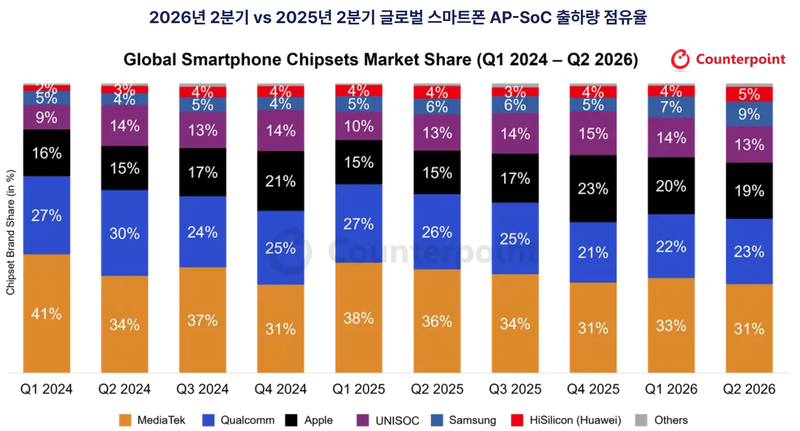
[Financial News] Samsung Exynos posted a 9% share of the application processor (AP) market in the second quarter of this year, marking its highest level since the survey began in 2024. An AP is a semiconductor that serves as a smartphone's brain. Samsung Exynos chips are designed by the System LSI Business of Samsung Electronics' Device Solutions (DS) Division and manufactured by Samsung Foundry.
According to market research firm Counterpoint Research on the 18th, Samsung Exynos accounted for 9% of shipments in the global smartphone AP market in the second quarter, up 2 percentage points from 7% in the previous quarter. The figure was also up 3 percentage points from 6% a year earlier.
Counterpoint Research analyzed, "The increase in Samsung Exynos shipments occurred simultaneously in the premium and mid-range segments."
In the premium segment, the Exynos 2600, installed in the standard and Plus models of the Samsung Galaxy S26, drove the increase in shipments. In the mid-range segment, the Exynos 1680 in the Samsung Galaxy A57 and the Exynos 1480 in the Galaxy A37 were seen as contributing to the growth.
Qualcomm's shipments declined from a year earlier, partly because the Exynos 2600 was adopted in the standard model of the Samsung Galaxy S26 in some regions, as well as because of memory supply shortages. Taiwan-based MediaTek also saw shipments fall amid weak demand for mainstream and entry-level products and slower sales of premium devices. However, the MediaTek Dimensity 8500 fared well, helped by sales of the POCO X8 Pro and Honor Power2.
Apple's chipset shipments edged up on strong sales of the Pro models in the iPhone 17 series. UNISOC's total shipments declined because of weakness in the entry-level market, but broader adoption of the Unisoc T7250 for LTE and the T8300 for 5G supported some demand.
Counterpoint Research explained, "Global smartphone shipments in the second quarter fell 21% from a year earlier due to rising memory costs and smartphone manufacturers' (OEMs') conservative inventory management," adding, "The declines in MediaTek and Qualcomm shipments reflect the overall downturn in the market."
[email protected] Im Su-bin Reporter