"Caregiving Costs Break the Retirement Formula" — A Couple With 7.6 Million Won in Take-Home Pay: How Much Can They Save in 12 Years? [Money Planning Office]
- Input
- 2026-09-19 15:00:00
- Updated
- 2026-09-19 15:00:00

Setting aside money to support their parents does not resolve the issue. They must examine how their cash flow and assets change before and after their parents' illness and caregiving needs, then incorporate their parents' income and assets into their own retirement plan.
1 Million Won a Month in Support for Their Parents
Jung Woo-jin, 48, and Choi Soo-hyun, 46, both pseudonyms, live in Yongin, Gyeonggi Province. They have recently begun worrying about the 1 million won that leaves their accounts every month. They can manage it for now, but they are no longer confident that they can build enough retirement savings if the situation continues.They have a daughter in 11th grade and a son in eighth grade. With both spouses working, their combined monthly take-home pay is 7.6 million won. They live in an apartment valued at 700 million won and have a 200 million-won mortgage. Their 200 million won in financial assets consists of 40 million won in emergency funds and short-term deposits, 30 million won for their children's education, and 130 million won in retirement savings.
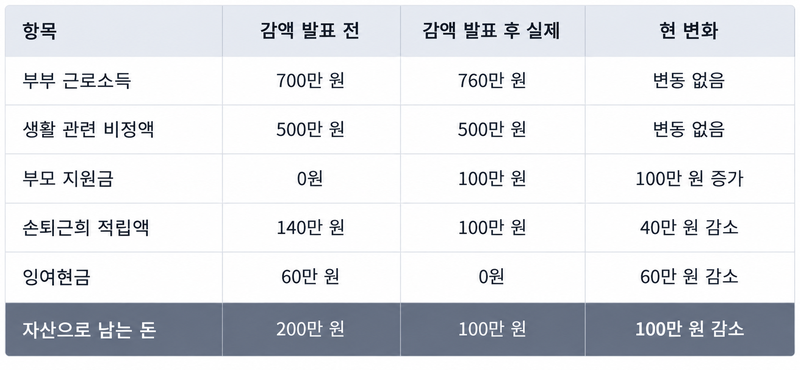
Before Jung's father began needing care, the couple allocated 5.6 million won a month to loan principal and interest, education expenses, living costs, and savings for irregular expenses. After setting aside 1.4 million won for retirement, they had 600,000 won left over.
The problem is that, given that Jung's father began treatment three months ago, the couple now has to send his parents 1 million won every month. As a result, they cut their retirement savings by 400,000 won and their surplus cash disappeared. Under their pre-caregiving plan, they would have accumulated 6 million won over this period: 4.2 million won in retirement savings and 1.8 million won in surplus cash.
480,000 Won in Monthly Retirement Living Expenses? "That Won't Work..."
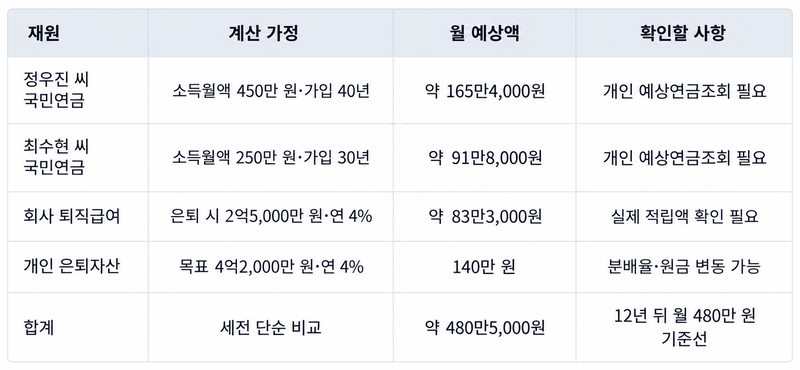
Jung hopes to have 4.8 million won a month for living expenses 12 years from now, when he turns 60. That figure represents about 3.8 million won in today's value after applying an annual inflation rate of 2%. Jo Hyeong-geun, an AFPK financial planner who advised the couple, examined whether this cash flow would actually be possible. He assumed that both spouses would begin receiving the NPS 19 years from now, when Choi turns 65. The actual amount will vary depending on factors such as contribution periods, reported income, credit standing, and policy changes, so they should check the exact figure through the "Check My Pension" service.Jung is expected to receive 1,650,400 won a month based on monthly income of 4.5 million won and 40 years of contributions. Choi is expected to receive about 918,000 won based on monthly income of 2.5 million won and 30 years of contributions. In addition, if their 250 million won company severance payment is managed through a retirement pension or similar vehicle, it could generate an average monthly return of about 833,000 won.
Subtracting these amounts from their target of 4.8 million won leaves a shortfall of about 1.4 million won. At an annual return of 4%, they would need 420 million won in retirement assets. If they continue contributing 1.4 million won a month to their current 130 million won in savings at a nominal annual total return of 3%, they will have about 427 million won in 12 years. In other words, they would barely meet the target only by maintaining their pre-caregiving savings plan.
Even if they save only 1 million won a month for the next five years and then restore their contributions to 1.4 million won, they will accumulate just 395 million won. That is about 25 million won short of their target.
"Use Their Parents' Apartment for the Korean Home Pension"
Jo advised the couple to make use of their parents' assets. Jung's parents currently have 50 million won in deposits and own an apartment with no outstanding loan. The recognized market value used to calculate the Korean Home Pension's monthly payment is 300 million won. They also receive 1.3 million won a month in pension and other income.Their budget included 1 million won for the mother's living and housing expenses and 1.8 million won for the father's rehabilitation hospital and caregiving costs, for a total of 2.8 million won. Adding 100,000 won for health insurance premiums, taxes, and transportation, as well as 200,000 won for irregular medical and caregiving expenses, brought the total to 3.1 million won. Until now, after accounting for their parents' 1.3 million won in income and the couple's 1 million won contribution, they had been withdrawing the remaining 800,000 won from their deposits.
However, as of June, the monthly payment for the younger spouse, Jung's mother, who is 75, was calculated at 1,143,000 won under the Korean Home Pension. This means the Jung couple could prevent further withdrawals from their deposits by providing only 6.57 billion won.
Jo also recommended reducing discretionary spending, such as dining out and leisure activities, by 200,000 won a month. Of the 543,000 won in monthly funds secured through spending adjustments and reduced support, he advised them to use 400,000 won to restore their retirement savings.
Jo explained, "If they save 1 million won a month for the next six months and then contribute 1.4 million won for the following 11 years and six months, they will accumulate about 424 million won at an annual return of 3%." He added, "When providing financial support to parents, they must accurately consider not only the amount but also how long they can sustain it and how much it will affect their ability to meet their own financial goals."
Earning, spending, and saving money are lifelong routines, but financial planning is often pushed aside. Money, however, has its own timeline and will not wait. If we do not make decisions at each stage, our finances are neglected; if we do not set a direction, money slips away. That is why we need to design the flow of money across our entire lives.[Money Planning Office]works with the Korea Financial Planning Association (IFPK), an AFPK certification institution, to support life planning.
[email protected] Kim Tae-il and Lee Hyeon-jeong Reporter