Korea Aerospace Industries (KAI) Obtains International Compliance and Anti-Bribery Certifications, Advancing Ethical Management
- Input
- 2026-09-18 13:47:41
- Updated
- 2026-09-18 13:47:41
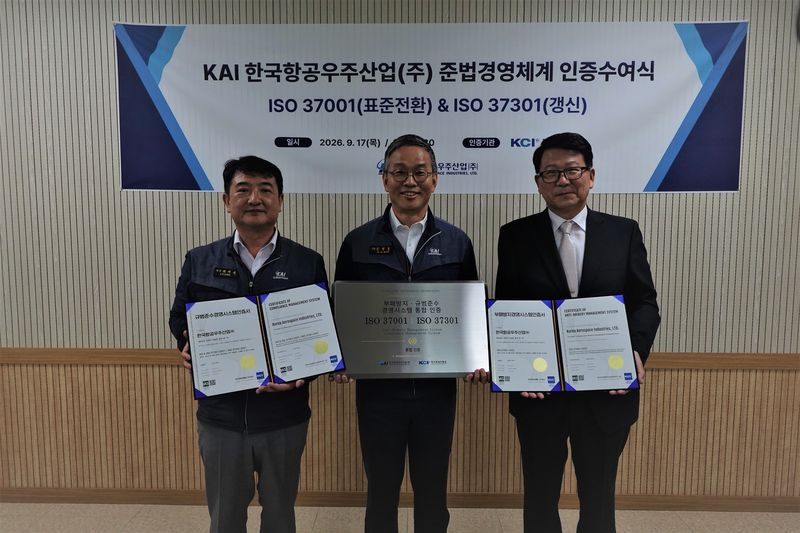
[Financial News] Korea Aerospace Industries (KAI) has obtained international-standard compliance and anti-bribery management system certifications, taking steps to strengthen its ethics and compliance management framework.
KAI announced on the 18th that it had obtained renewal certification for the ISO 37301:2021 Compliance Management Systems standard and certification for the transition to the ISO 37001:2025 Anti-Bribery Management Systems standard from the Korea Compliance Institute (KCI).
ISO 37301 and ISO 37001 are international certifications that assess whether the compliance and anti-bribery requirements established by the International Organization for Standardization (ISO) have been incorporated into a company's management systems and are being systematically operated and managed.
KAI became the first company in Korea's defense industry to obtain ISO 37001 certification in 2018, followed by ISO 37301 certification in 2023. Since then, it has continuously upgraded its related internal management systems and control activities. KAI plans to use the international-standard certifications not merely to enhance its external credibility, but also to strengthen its ethics and compliance management framework so that employees and business partners practice fairness and transparency in their actual work.
To this end, KAI assesses corruption and compliance-related risks, sets department-specific improvement goals and control activities, and monitors implementation and the status of follow-up measures through internal reviews. Major compliance-control activities and management results are reported to the board of directors and the audit committee after review by top management. The scope of the ethics and compliance standards has also been expanded from employees to business partners and major business transactions. The relevant standards are reflected in everything from supplier registration and selection to contract signing and performance, partner evaluations, and the selection of counterparties for export marketing transactions.
KAI plans to link its fair-trade compliance program (CP) and ethics and compliance management with environmental, social and governance (ESG) management, operating them as a core management system for sustainable management.
Kim Myung-ho, an executive director and head of KAI's Compliance Management Office, said, "The purpose of ISO certification is not the certificate itself, but to ensure that employees make decisions based on laws and principles in their actual decision-making processes." He added, "We will establish risk management, training, reviews, and improvements in our daily work and continue to build trust as a global aerospace and defense company."
[email protected] Jung Won-il Reporter