First Attempt to Develop Domestic Drive Components for Space Exploration Rovers... Demonstration Planned on Fifth Nuri (KSLV-II) Launch
- Input
- 2026-09-20 12:00:00
- Updated
- 2026-09-20 12:00:00
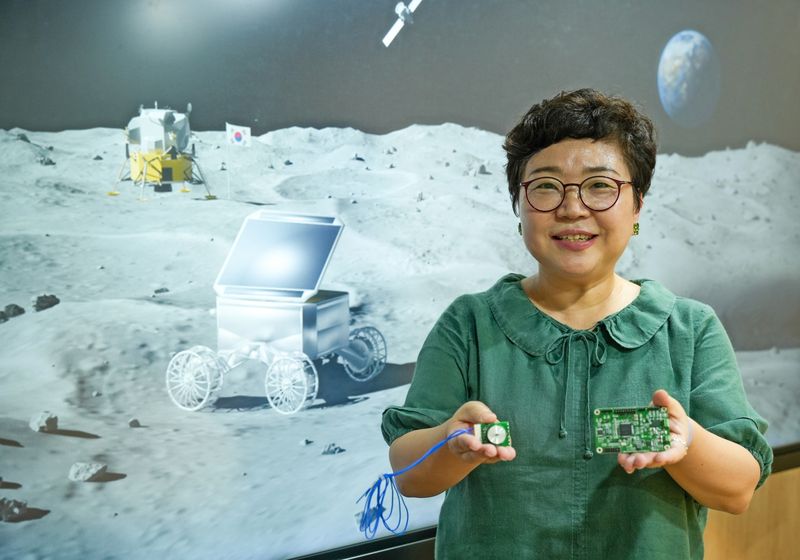
On the 20th, the Korea Electrotechnology Research Institute (KERI) said that a team led by Dr. Lee Ji-young from its Aerospace Mobility Propulsion Research Team had joined forces with Unmanned Exploration Laboratory (UEL), a South Korean space robotics startup. The team is launching full-scale research into drive technology for exploration rovers capable of withstanding extreme space environments and seeking to secure a "Space Heritage" record for domestically developed components.
According to the government's Future Space Economy Roadmap, South Korea aims to conduct lunar exploration in 2032. The plan's key objective is not merely to reach the Moon but to demonstrate the ability to conduct meaningful activities on its surface. Exploration rovers will play a critical role in achieving this goal. However, core components of South Korea's space systems—particularly space-grade actuators that move rovers—are currently imported entirely from overseas. Research into the relevant foundational technologies and the establishment of a self-reliant base are therefore urgent.
Dr. Lee Ji-young's team has established a pioneering collaboration model that combines KERI's design capabilities as a specialized component research institute with UEL's field expertise as a space robotics systems company. The long-term vision is to proactively secure the national security value of an independent space exploration and operations capability amid global competition for space dominance.
The research team is conducting preliminary studies on electric motor and power conversion technologies that would enable a rover weighing no more than 25 kg to climb a 10-degree slope and travel at 4 meters per hour, even amid extreme conditions on the lunar surface, including temperatures of up to 125°C, high vacuum and blowing sand and dust. Recently, to improve technological maturity, the team has established a real-time performance verification system (HILS) that recreates virtual space environments on computers and continuously verifies component performance. It is gradually enhancing the system through testing under various operating conditions and further development.
While continuing ground-based performance testing and technological refinement, the team will conduct demonstrations in the actual space environment in parallel and enter the full-scale stage of accumulating "Space Heritage." In cooperation with UEL, KERI will provide technical support for the in-space demonstration of certain components, including control boards developed by UEL, during the fifth launch of Nuri (KSLV-II), scheduled for October this year. The goal is to improve technological reliability by sharing the results and technical data obtained through the process and applying them to ground-based research. The scope of the demonstrations will later be expanded to the entire electric drive system, including the target motors.
Starting with this demonstration of components aboard Nuri (KSLV-II), the team is drawing up a future vision in which an exploration rover incorporating KERI technology lands on the lunar surface before 2032. Dr. Lee Ji-young, the project leader, said, "We will definitely send a rover containing KERI's proprietary technology to the lunar surface in 2032 and open the true era of space mobility for the Republic of Korea."
[email protected] Yeon Ji-an Reporter