"Pay another KRW 300 million because home prices rose"—a meltdown... Someone will be left to foot the entire bill [Real Estate AtoZ]
- Input
- 2026-09-19 14:00:00
- Updated
- 2026-09-19 14:00:00
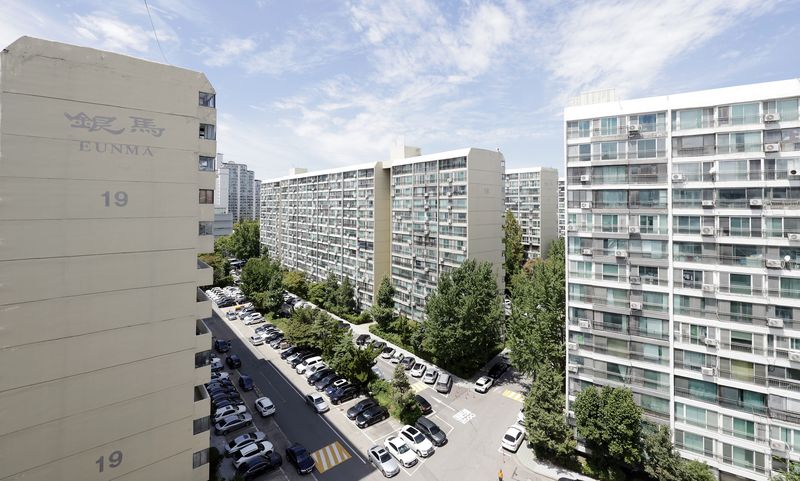
[Financial News] A reconstruction levy is a system that recovers part of the excess profits generated by reconstruction after excluding normal housing price increases and development costs. The final amount is determined after housing prices at the time of completion and project costs have been confirmed.
The imposition of the levies is expected to begin in the second half of this year. Although the reconstruction levy is intended to recover unearned gains, it is, in reality, a system that blocks reconstruction. Regardless of whether the system is justified, it has raised various concerns, from administrative convenience to fairness.
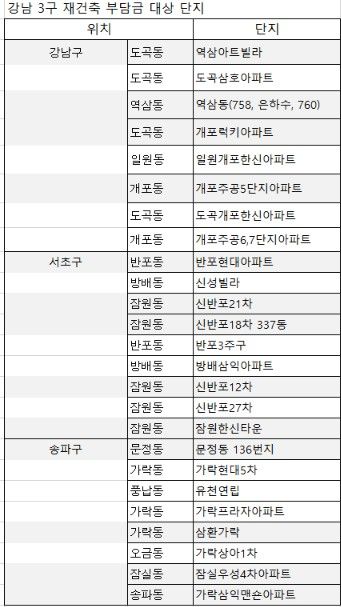
Levy targets... 25 in the Gangnam 3 Districts (Gangnam-gu, Seocho-gu, and Songpa-gu), and 21 elsewhere
The complex currently expected to face the highest reconstruction levy is Raemian Trinity One in Banpo-dong, Seocho District (Jugong Complex 1, District 3). The total levy is estimated at KRW 514.9 billion. Divided among the association members, the average would be approximately KRW 317.87 million per person.
According to industry sources, 46 complexes in Seoul are currently expected to be subject to reconstruction levies. By region, more than half—25 complexes—are concentrated in the Gangnam 3 Districts. Seocho District has nine complexes, including Banpo Hyundai Apartments in Banpo-dong. Gangnam-gu has eight, including Gaepo Jugong Complexes 6 and 7 in Gaepo-dong, while Songpa District has eight, including Jamsil Woosung 4th Complex in Jamsil-dong.
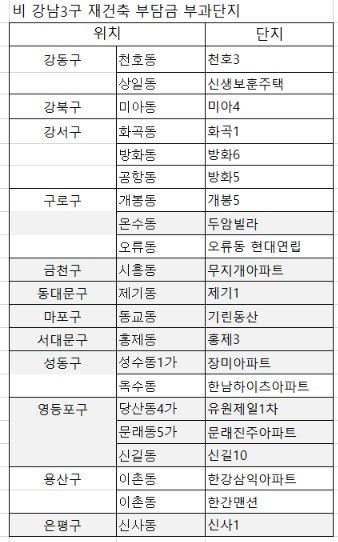
In the three districts outside the Gangnam 3 Districts, 21 complexes are subject to the levies. In Yongsan District, the targets include Hangang Samik Apartments and Hangang Mansion in Ichon-dong. Hangang Mansion's estimated levy totals KRW 472.2 billion. In Yeongdeungpo District, three complexes, including Singil District 10 in Singil-dong, are subject to the levy. The estimated levy for Singil District 10 is KRW 143.5 billion.
Some association members will be left to foot the entire bill... There are no allocation criteria either
As the imposition of the levies draws near, controversy over reconstruction charges is also intensifying. Regardless of whether imposing the levies is justified, the biggest problem is that the question of "how" remains unresolved.
Kim Ye-rim, an attorney at Simok Law Firm, said, "In a nutshell, the structure leaves associations to impose the levies on their members as they see fit," adding, "The biggest problem is that detailed guidelines on the matter have still not been established."
The reconstruction levy is largely designed for administrative convenience. Local governments simply impose it on the association. The association must decide how to divide the charge among individual members. Since no criteria have yet been established, the allocation method may differ from one association to another.
In addition, the owner at the time of completion is, in principle, the person subject to the reconstruction levy. Rather than imposing it equally on association members who owned the properties during the reconstruction process, the entire charge is imposed on a single final owner. In short, the owner at the time of completion can be left to foot the entire bill.
Kim Je-gyeong, head of Tumi Real Estate Consulting, said, "The reconstruction excess-profits recovery system was created to tell people not to rebuild, so it is far from rational. It should not be partially amended; it should be abolished."
[email protected] Lee Jong-bae Reporter