Asan Medical Center Ranked in the World Top 10 in Six Fields, Most in South Korea [U.S. Newsweek]
- Input
- 2026-09-18 11:19:48
- Updated
- 2026-09-18 11:19:48
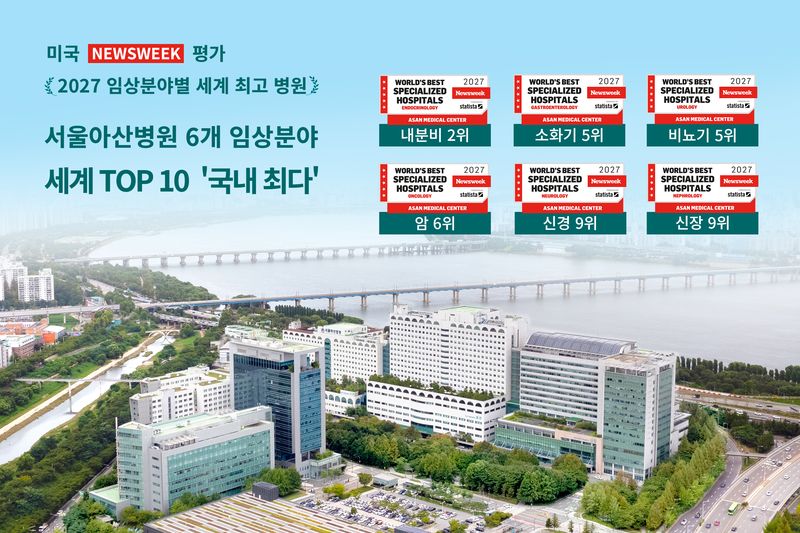
[Financial News] Asan Medical Center’s endocrinology specialty ranked among the world’s top five for the seventh consecutive year, reaching an all-time high of No. 2 this year. Asan Medical Center said six of the 13 specialties evaluated in Newsweek’s “World’s Best Specialized Hospitals 2027” ranked among the world’s top 10.
Asan Medical Center ranked No. 2 worldwide in endocrinology, No. 5 in gastroenterology and urology, No. 6 in cancer, and No. 9 in neurology and nephrology. Asan Medical Center is the only hospital in South Korea—and one of only a select few worldwide—to rank in the top 10 in six specialties.
Asan Medical Center ranked No. 1 in South Korea in six specialties: endocrinology, gastroenterology, neurology, nephrology, cardiology and cardiac surgery, the highest number in the country.
Newsweek conducted the “World’s Best Specialized Hospitals 2027” evaluation in collaboration with global research firm Statista and announced the final results for 13 specialties on its website on the 17th. The evaluation was based on an online survey of healthcare professionals worldwide, which accounted for 83.5% of the score, international accreditation of medical institutions at 10%, and the implementation of patient-reported outcome measures (PROMs) at 6.5%.
Gastroenterology, cancer and neurology also remained among the world’s top 10 for seven consecutive years. Nephrology, evaluated for the first time this year, ranked No. 9 worldwide. Asan Medical Center also received strong evaluations in orthopedics at No. 11, cardiology at No. 13, respiratory medicine at No. 14 and cardiac surgery at No. 23.
As in previous years, eight specialties improved their rankings this year. Neurosurgery rose by 27 places, obstetrics and gynecology by 11, cardiac surgery by seven, respiratory medicine by six, cardiology by four, endocrinology and pediatrics by two each, and urology by one.
Asan Medical Center has established itself as a global hospital leading the treatment of severe diseases, attracting patients from South Korea and abroad who come seeking a last hope. More than 20,000 foreign patients from the United States, the United Arab Emirates, Mongolia and other countries visit Asan Medical Center each year. In addition to foreign patients, medical professionals from overseas regularly visit to learn the center’s expertise in treating severe diseases.
Over the past 10 years, more than 3,500 medical professionals from around 90 countries have visited Asan Medical Center. As those who completed training programs have recommended Asan Medical Center to patients in their home countries with severe conditions that are difficult to treat locally, international trust in the center has continued to grow.
Asan Medical Center is taking the lead in establishing a value-based care system that considers not only disease treatment but also patients’ quality of life. It regularly measures the discomfort experienced by patients through assessment systems such as patient-reported outcome measures (PROMs) and immediately incorporates the findings into clinical care. The center also plans to expand patient-centered, value-based care by establishing an integrated organization dedicated to combining patient-reported outcomes, patient experience and clinical quality indicators.
Park Seung-il, president of Asan Medical Center, said, "Asan Medical Center, which has led the treatment of severe diseases such as cancer, organ transplantation and heart disease, declared itself a patient-centered hospital when it opened in 1989 and has worked tirelessly to improve patient safety and the quality of medical care." He continued, "We believe these efforts led to the excellent result of being ranked among the world’s top 10 in six specialties." He added, "Asan Medical Center will continue to strengthen patient-centered care by establishing a value-based care system based on patient-reported outcomes and patient experience indicators."
Key Achievements in Asan Medical Center’s World Top 10 Specialties in the Newsweek Evaluation
■ Cancer Center Treats One in Eight Registered Cancer Patients in South KoreaAsan Medical Center Cancer Center treats more cancer patients than any other institution in South Korea, with one in eight registered cancer patients visiting the center. It sees 1.06 million cancer patients annually and performs more than 18,000 cancer surgeries. The center was the first in South Korea to introduce multidisciplinary care, bringing specialists from various departments together to treat cancer patients. More than 5,800 cancer patients now receive multidisciplinary care each year. It is actively adopting the latest cancer treatment technologies, including the operation of a CAR-T Center and South Korea’s first specialized theranostics center. It is also preparing a carbon-ion therapy center, scheduled to begin operations in 2031, to overcome treatment-resistant cancers.■ Gastroenterology Specialty Leads High-Complexity Endoscopic ProceduresAsan Medical Center Gastrointestinal Endoscopy Center received certification as a top endoscopy center from the World Endoscopy Organization. Since opening in 1989, it has performed more than 2.25 million endoscopic examinations and procedures, including more than 150,000 endoscopic retrograde cholangiopancreatography (ERCP) procedures to diagnose and treat pancreatic and biliary diseases. The Inflammatory Bowel Disease Center treats about 20% of ulcerative colitis and Crohn’s disease patients in South Korea. It provides personalized treatment through the country’s largest multidisciplinary clinic, involving medical professionals from multiple departments. Asan Medical Center is preparing to open UAE Asan Gastroenterology Hospital in Dubai to serve critically ill patients from the Middle East who would otherwise need to travel to South Korea for complex treatment.■ Neurology Specialty Establishes an Emergency Care System for Acute Neurological PatientsAsan Medical Center established the world’s first emergency stroke care team. Since 2017, it has operated a Neuro Emergency Team responding to stroke, seizures, unresponsiveness after cardiopulmonary resuscitation and head trauma. Comprising neurology faculty members and specialized nurses, the team rapidly arranges consultations with neurologists in neurological emergencies and makes blood test and brain imaging results available within one hour. It has also significantly reduced the time required for electroencephalography and real-time interpretation. The Neuro Emergency Team’s role extends beyond responding when called during an emergency to providing systematic short- and long-term follow-up care. It plays a key role in establishing a standing crisis response system for neurological emergencies and making the hospital a safe place for patients.■ Nephrology Specialty Provides Specialized Care for Kidney Disease and End-Stage Renal FailureAsan Medical Center’s Department of Nephrology operates an artificial kidney unit, including hemodialysis and peritoneal dialysis units, and provides specialized treatment for patients with kidney disease and end-stage renal failure. The hemodialysis unit provides dialysis treatment to replace lost kidney function across more than 70 beds, including negative-pressure isolation rooms. At the peritoneal dialysis unit, dedicated nurses systematically educate patients starting peritoneal dialysis about the procedure, exercise, diet and how to respond to emergencies, helping them maintain a safe and healthy dialysis routine. Led primarily by the departments of nephrology and kidney-pancreas transplant surgery, the kidney transplant team at the Asan Medical Center Organ Transplantation Center has performed about 8,000 kidney transplants, helping patients with end-stage renal failure achieve long-term survival and a high quality of life.■ Urology Specialty Performs More Than 40,000 Urologic Cancer SurgeriesAsan Medical Center’s Urologic Cancer Center treats one in 10 urologic cancer patients in South Korea and sees more than 70,000 outpatients a year. Since introducing multidisciplinary care for the first time in South Korea in 2009, it has provided personalized treatment for various urologic cancers through about 170 multidisciplinary consultations annually. The center has performed more than 40,000 urologic cancer surgeries to date. Most procedures are minimally invasive, including 99% of prostate cancer surgeries and more than 80% of kidney cancer surgeries, helping minimize complications and side effects for patients.■ Endocrinology Specialty Operates Subspecialty Clinics for Endocrine DiseasesAsan Medical Center’s Diabetes Center includes specialists from more than 10 departments and operates six specialized clinics, including diabetes and diabetic retinopathy clinics. It treats 90,000 patients annually, providing the entire range of care—from diabetes counseling and diagnosis to treatment—in one place. In addition to patient care, the center is actively conducting research to overcome diabetes and has published its findings in leading journals in the field, including Nature, Cell Metabolism and Diabetes. Asan Medical Center’s thyroid team comprises specialists in surgery, radiology, pathology, nuclear medicine and otolaryngology who treat thyroid cancer and other thyroid diseases. More than 2,000 thyroid cancer patients receive preoperative management, postoperative recurrence prevention and treatment for metastatic disease each year. The team presents Asan Medical Center’s thyroid treatment outcomes at international thyroid conferences in the United States, Europe and Asia-Oceania, earning global recognition. More than 20,000 osteoporosis patients visit Asan Medical Center’s Department of Endocrinology each year. As one of the largest patient centers in South Korea, it is actively conducting a variety of clinical studies. The department also conducts basic and translational research into bone metabolism disorders, laying the foundation for developing new biomarkers and treatments.[email protected] Jung Myung-jin, Medical Correspondent Reporter