Last year's public-sector deficit surpasses 83 trillion won, with government spending sending the shortfall snowballing
- Input
- 2026-09-18 12:00:00
- Updated
- 2026-09-18 12:00:00
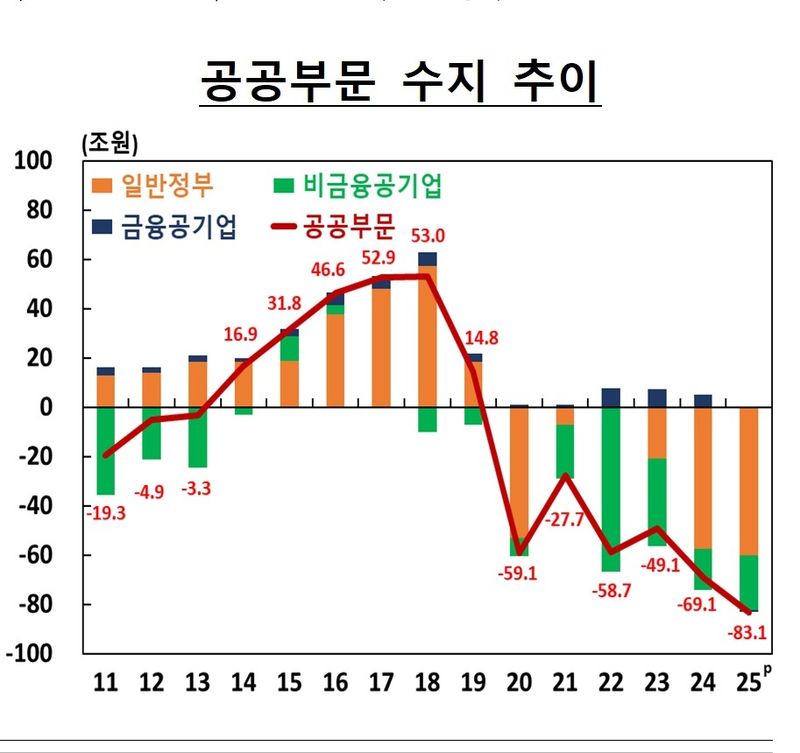
[Financial News] The combined deficit of the government and public corporations exceeded 83 trillion won last year. It was the largest deficit on record and marked the sixth consecutive year of deficits. This was because spending on cash-based livelihood support and public investment far exceeded revenues collected through taxes and other means. Backed by record-high tax revenues driven by the semiconductor boom, the government plans to maintain a highly expansionary fiscal policy, suggesting that the public-sector deficit will persist for a considerable period.
The preliminary public-sector accounts for 2025 released by the BOK on the 18th showed that the public sector, comprising general government and public corporations, recorded a deficit of 83.1 trillion won last year. This was significantly larger than the 69.1 trillion won deficit recorded the previous year. Deficits have continued for six years, beginning with a 59.1 trillion won shortfall in 2020, when the COVID-19 pandemic erupted, followed by deficits of 58.7 trillion won in 2022 and 49.1 trillion won in 2023.
Total public-sector revenue stood at 1,192.1 trillion won last year, up 53 trillion won, or 4.7%, from the previous year. Corporate and income tax revenues increased sharply as corporate profits, particularly in the semiconductor sector, rose and wages climbed. Revenue from pension insurance premiums also grew following increases in National Pension and health insurance premiums.
However, total public-sector expenditure increased by 67 trillion won, or 5.5%, to 1,275.2 trillion won, outpacing the growth in revenue.
Lee Hyun-young, head of the BOK's Expenditure and National Income Team, said, "The deficit was driven by a sharp increase in government spending following two supplementary budgets in 2025, including 13 trillion won in nationwide livelihood recovery consumption coupons, support for small business owners, and transfers for health insurance benefit payments."
Both the government and public institutions ran deficits. This was the first time since statistics began being compiled in 2007.
General government, which accounts for three-quarters of public-sector finances, recorded a deficit of 60.1 trillion won as livelihood support and welfare spending increased substantially despite strong tax collection, including corporate taxes. The deficit widened from 57.5 trillion won a year earlier.
Nonfinancial public corporations, including Korea Electric Power (KEPCO) and Korea Land and Housing (LH), also recorded a deficit of 22.1 trillion won. The shortfall grew from 16.7 trillion won the previous year. Revenue increased due to higher electricity rates and lower raw-material prices, but investment rose sharply, driven by public housing construction and expanded purchases of rental housing.
Financial public corporations, including Korea Development Bank (KDB), swung to a deficit of 900 billion won from a surplus of 5.1 trillion won the previous year as falling interest rates reduced their interest income.
The BOK nevertheless explained that the general-government balance as a share of the economy's nominal GDP stood at negative 2.2%, or negative 3.4% excluding social security funds, which was favorable compared with the corresponding figure for major economies, with the Organisation for Economic Co-operation and Development (OECD) average at negative 4.4%.
[email protected] Jung Sang-gyun Reporter