"Military to Directly Control AI"... NAVER Cloud Unveils Defense Sovereign AI Strategy
- Input
- 2026-09-18 10:41:26
- Updated
- 2026-09-18 10:41:26
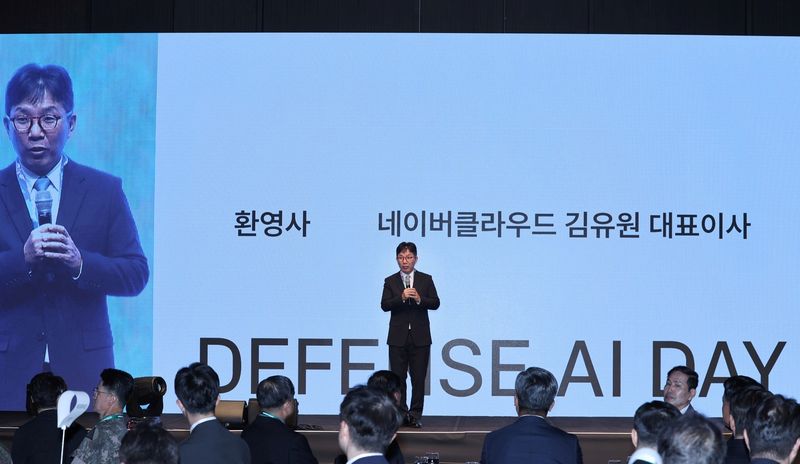
[Financial News] NAVER Cloud has unveiled the 'Defense Sovereign AI' strategy, which enables the military to directly control data and artificial intelligence (AI) models while rapidly deploying civilian AI technology. The plan envisions supporting the entire process of transitioning to defense AI, including securely connecting military data and AI within a closed network and applying advanced AI technologies such as spatial intelligence and world models to autonomous weapon systems.
NAVER Cloud held a 'Defense AI Strategy Seminar' at The Shilla Seoul on the 18th for 550 people, including officials from Retreads, the Republic of Korea Joint Chiefs of Staff (ROK JCS), and each military branch, and unveiled this strategy.
"Defense AI does not end with the introduction of technology; it must continue through the process of defining the problems the military needs, verifying them in the field, and deploying them into the military," said Yuwon Kim, CEO of NAVER Cloud. "We will become a key partner that connects and supports the capabilities of the military, defense companies, startups, and research institutions so that they can solve real-world defense problems."
NAVER Cloud plans to support everything from the construction of defense AI infrastructure to its actual mission application, based on full-stack technology and security capabilities that encompass AI models, services, and infrastructure.
Former Vice Minister of National Defense Kim Seon-ho cited the rapid deployment of innovative civilian technologies as a key factor determining the success or failure of the Defense AI Transformation (AX). He explained that a civil-military convergence ecosystem is necessary where the private sector leads technological innovation under the principle of "civilian technology first," and the military rapidly integrates it. He emphasized that the focus must not be limited to technology demonstration, but that AI must be integrated into military operational concepts and weapon systems to expand it into actual military capabilities.
Yoo Kyung-beom, Executive Vice President and Head of Defense Business at NAVER Cloud, presented a defense AI strategy that involves 'aggregating, connecting, demonstrating, and evolving' civilian technologies. The plan envisions consolidating civilian technologies, such as infrastructure, AI models, and applications, and then connecting these AI models to military data within a closed network to secure the military's control over the data and models.
It also introduces a method of demonstrating technology in stages, starting with missions where effectiveness can be measured, and having Field Deployment Engineers (FDEs) operate the system alongside the military to continuously improve performance. This aims to move away from one-off technology deliveries and continuously incorporate field requirements into the AI system.
Spatial intelligence and world model technologies for the advancement of autonomous weapon systems were also presented. Lee Jeong-tae, Head of Hyperscale AI Technology at NAVER Cloud, emphasized the need for a "shared semantic system" that enables different sensors and platforms to understand battlefield situations in the same way. To this end, NAVER Cloud plans to utilize spatial intelligence, which structures drone video and sensor information into a three-dimensional space, and world models, which simulate and predict behavioral outcomes in a virtual environment that reflects battlefield variables such as terrain, weather, and radar.
Based on this, the entire AI process, from situational understanding to judgment, action, and learning, is connected. The goal is to establish a power system that is not dependent on a specific AI model, but allows the military to directly control and operate the AI it needs, while continuously advancing it.
[email protected] Choi Hye-rim Reporter