Hanwha Systems Begins Development of AI-Based Space Situational Awareness System
- Input
- 2026-09-18 10:40:43
- Updated
- 2026-09-18 10:40:43
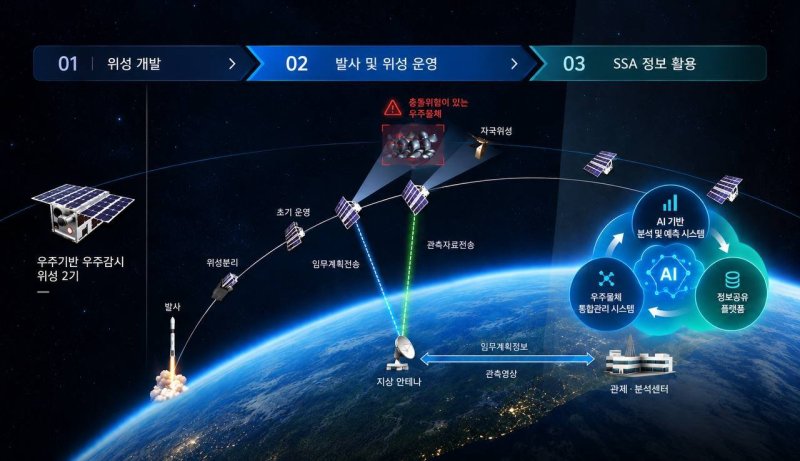
[Financial News] Hanwha Systems announced on the 18th that it had signed a contract with the Korea Astronomy and Space Science Institute (KASI) for the project to develop a space-based space surveillance satellite and a ground-linked space situational awareness system. The company will now begin full-scale participation in the design and development of the National Space Situational Awareness System (K-SSA) as its private-sector system developer.
Space situational awareness (SSA) refers to the observation and analysis of the locations and orbits of space objects to identify and predict hazards in space, such as collisions and reentries.
The rapid increase in the number of low-Earth-orbit satellites has raised the risk of collisions with artificial and natural space objects in orbit. As a result, the importance of space situational awareness capabilities has grown, enabling the country to protect its space assets and proactively respond to the risks of collisions and objects falling to Earth.
The project is part of the National Space Situational Awareness System development initiative being promoted by the Korea AeroSpace Administration (KASA). KASI, the lead research institution, will establish the mission, concept of operations and system requirements for the national space situational awareness system, while overseeing the project’s technical aspects, including detailed technology integration and system integration.
Under the contract, Hanwha Systems will participate as the private-sector system developer for K-SSA under KASI’s overall direction. Its responsibilities will include developing the space-based space surveillance satellite, building the ground-linked space situational awareness system, integrating the individual systems, and conducting testing and verification.
The space-based space surveillance satellite that Hanwha Systems is beginning to develop is a microsatellite designed to operate in low-Earth orbit at an altitude of approximately 480 kilometers. Equipped with an optical camera for space situational awareness (SSA), it will detect and track artificial and natural objects in space in real time and collect key observation data needed to analyze the risks of collisions and reentries.
The ground-linked space situational awareness system being built alongside it is ground infrastructure that integrates, manages and analyzes information on space objects collected from various observation platforms and data sources, including space surveillance satellites. By applying artificial intelligence (AI), the system will precisely predict and analyze the trajectories of space objects and the risks of collisions and reentries. It will also share relevant information to support rapid situational assessments and responses.
Song Seongchan, head of the space business division at Hanwha Systems, said, "The space industry is rapidly expanding beyond the simple development and operation of satellites to encompass the safe use and management of outer space. Through this project, we will secure core technological competitiveness in space situational awareness (SSA) and space domain awareness (SDA), and contribute to strengthening South Korea’s independent space security and response capabilities."
Meanwhile, Hanwha Systems also took its first step toward expanding its business into space exploration last month by signing a contract with the Korea Aerospace Research Institute (KARI) to develop a lunar lander rover deployment device.
The project involves developing a deployment device for a rover mounted on a lunar lander being developed under KARI’s leadership. The device will enable the rover to deploy safely and carry out its mission after the lunar lander touches down on the Moon’s surface.
Hanwha Systems plans to design the device so that the rover can be deployed safely on the ground under various landing conditions, including differences in the elevation of the lunar surface and the lander’s tilt. In cooperation with the Korea Institute of Civil Engineering and Building Technology (KICT), which operates lunar-environment testing facilities, the company will also conduct space-environment tests simulating conditions on the Moon.
[email protected] Yeon Ji-an Reporter