"AI is easier to talk to than people"... 57% of users have confided their concerns to AI [Daily IT Item]
- Input
- 2026-09-18 11:35:00
- Updated
- 2026-09-18 11:35:00
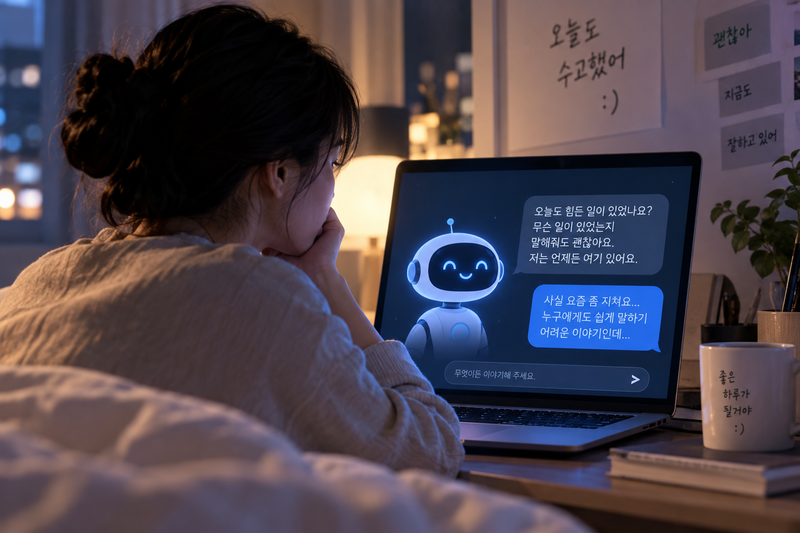
Even things difficult to say to people... AI emerges as a new outlet for discussing concerns
On the 18th, PMI, a research and data intelligence firm, said a survey of 1,000 conversational AI users nationwide aged 20 to 59 found that 57.1% had talked to AI about personal concerns or feelings. The survey was titled the "Awareness Survey on Emotional Interaction with AI."Among those who had not yet done so, 20.8% said they intended to talk to AI in the future. Only 22.1% said they had neither such experience nor any intention of doing so.
The younger the age group, the more likely respondents were to have had emotional conversations with AI. The rate was highest among people in their 20s at 67.6%, followed by those in their 30s at 65.6%, 40s at 50.4%, and 50s at 44.8%.
The more frequently respondents used AI, the more likely they were to confide their concerns or feelings to it. Among those who had used AI at least once a week during the previous six months, 62.9% had experience with emotional conversations, 29.9 percentage points higher than the 33.0% recorded among those who used AI less than once a week.
The most common topic among those who had emotional conversations with AI was "everyday stress," cited by 56.7%. It was followed by workplace and academic problems at 49.6%, interpersonal relationships at 46.1%, and concerns about careers and the future at 32.9%. Based on multiple responses, 24.0% said they had even confided in AI about "concerns that are difficult to discuss with people."
The reasons for turning to AI also highlighted convenience and reduced psychological pressure rather than the absence of someone to talk to. The most common response was "because I can talk anytime," at 40.3%, followed by "because I can say things that are difficult to say to people," at 39.1%. Similar proportions said AI helped them "organize my thoughts or feelings" at 37.7% and allowed them to "hear a relatively objective opinion" at 37.5%.
By contrast, 29.2% said they used AI because "I do not have anyone suitable to talk to." In other words, AI is being used not simply as a substitute for people who lack conversation partners, but as an outlet where users can speak without worrying about the time or the other person's reaction.
A total of 41.2% said a "relationship that feels like friendship" was possible. The proportion fell as the relationship deepened: 35.5% viewed AI as "someone to rely on emotionally," while 26.3% said a "relationship involving romantic feelings" was possible.
They confide in AI but remain wary... 46.5% concerned about "bad advice"
There were also considerable concerns about the expansion of emotional interaction with AI. The most frequently cited concern was "bad advice or information," at 46.5%. "Leaks of personal information or chat content" followed closely at 46.2%.Other concerns included the "possibility of relying on AI even when professional help is needed" at 37.8%, "emotional reliance on AI" at 37.5%, the "possibility that AI may not fully understand human emotions" at 33.4%, the "possibility of taking AI's responses as genuine emotions" at 31.8%, and a "decline in conversations or relationships with people" at 30.1%. Only 5.9% said they had no particular concerns.
Interestingly, users who had already engaged in emotional conversations with AI were more likely to recognize the risks of relying on it. The share concerned about the "possibility of relying on AI even when professional help is needed" was 41.0% among those with experience in emotional conversations, 9.3 percentage points higher than the 31.7% recorded among those with no such experience and no intention of doing so in the future.
Jo Min-hee, CEO of PMI, said, "This survey found that more than half of users had talked to AI about their concerns or feelings, but there was a difference between conversing with AI and accepting it as the subject of an emotional relationship. We need to examine not only when people turn to AI and what role they expect it to play, but also where they set boundaries in the relationship."
[email protected] Yoon Hong-jip Reporter