"Questions and Verification Instead of Memorizing Answers"—AI Sweeps Through University Classrooms, Transforming Education
- Input
- 2026-09-18 09:58:41
- Updated
- 2026-09-18 09:58:41
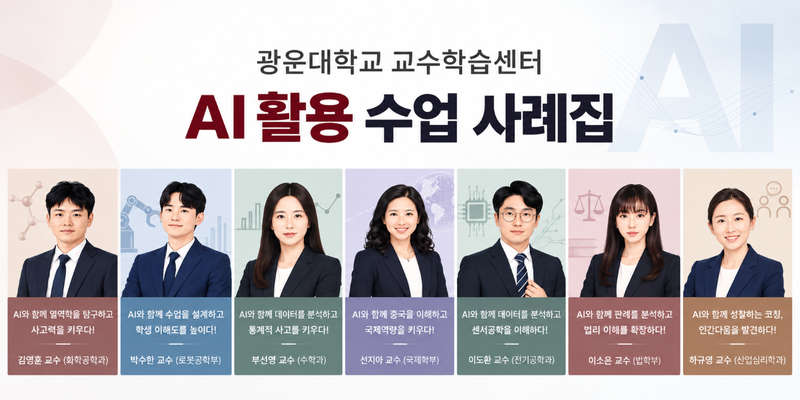
[Financial News] University classrooms are actively embracing artificial intelligence (AI) not merely as a tool that completes assignments, but as an educational instrument for developing critical thinking. Moving away from rote learning, in which students quickly find and memorize the correct answers, university classes are being reshaped around students asking their own questions and verifying AI-generated responses.
Kwangwoon University on the 18th unveiled seven innovative cases in which generative AI was successfully integrated into actual major courses during the first semester of the 2026 academic year. The cases reflect the results of professors from diverse fields, including engineering, natural sciences, and the humanities and social sciences, applying AI in real classrooms after completing the university’s training program on AI-based teaching methods.
The most noticeable change has come in engineering classes, where students have traditionally spent significant time memorizing complex formulas and performing basic calculations. Kim Young-hoon, a professor in the Department of Chemical Engineering, integrated AI tools such as ChatGPT and Gemini into his engineering thermodynamics course to assist with information searches and calculations. Instead, students were assigned to organize their thoughts, converse with AI, fact-check information, and write a final answer. Their role shifted from simply finding the correct answer to evaluating AI responses by identifying and verifying errors.
Another case transformed one-way, instructor-centered lectures into personalized learning. Professor Park Su-han of the Department of Robotics used AI to create differentiated weekly quizzes covering the key points of each class. The quizzes allowed students to immediately identify areas where they were struggling, while Professor Park used an analysis of their incorrect answers to provide supplementary explanations and additional examples in the following class.
Assignment methods that had focused mainly on submitting final products also changed. Professor Bu Seon-young of the Department of Mathematics incorporated an AI analysis program into a team project for mathematical statistics. Each time students submitted a draft of their report, they received feedback from AI and continuously addressed shortcomings, strengthening their ability to solve problems independently.
In sensor engineering, Professor Lee Do-hwan of the Department of Electrical Engineering had students analyze and visualize everyday data measured with smartphone sensors using AI. They also created presentation materials in English, giving them hands-on experience with the entire process of practical research.
Kwangwoon University’s Center for Teaching and Learning plans to share the exemplary cases identified this time both on and off campus. It also intends to continue expanding AI-based educational models and accelerate efforts to develop future-ready talent. The detailed collection of class cases released this time is available on the Kwangwoon University Center for Teaching and Learning website.
[email protected] Kim Man-gi Reporter