Do Not 'Ditch the CSAT' After Applying Through Early Admission... Maintain Balance While Preparing for University Interviews and Essay Exams
- Input
- 2026-09-18 09:49:35
- Updated
- 2026-09-18 09:49:35
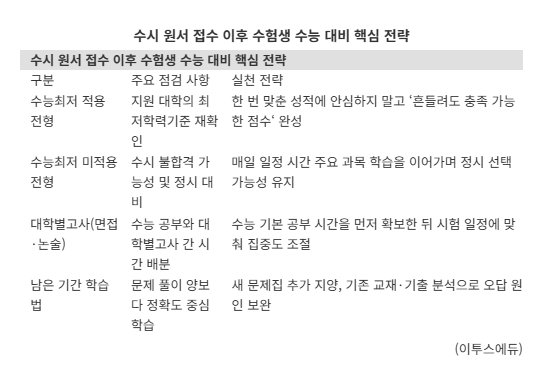
[Financial News] Experts have warned that students should not neglect CSAT preparation in order to focus on interviews or essay exams after submitting their early-admission applications. Students must meet the minimum CSAT score requirements set by universities to secure final admission through early-admission programs. They should also maintain their CSAT studies until the end to preserve their chances of regular admission before early-admission results are announced.
Etoos Edu presented a CSAT study strategy for students after early-admission applications, saying on the 18th that students often find it easy to lose their study momentum after submitting their applications.
Kim Byung-jin, head of the Etoos Education Evaluation Research Institute, said, "It is easy to think of early admission and the CSAT as separate matters." He emphasized, "Students should be particularly careful after submitting their early-admission applications, as their focus on CSAT preparation can easily decline if they become overly optimistic about the results." He added, "Students must concentrate on CSAT preparation not only to meet the minimum CSAT score requirements for early admission, but also as a last line of defense. Preparation for university-specific exams, such as interviews and essay examinations, should remain secondary to CSAT study."
Kim stressed that for students who applied to universities with minimum CSAT score requirements, their current CSAT preparation is directly connected to preserving their chances of early admission. Even extensive preparation for applications, interviews, or essay examinations may not lead to the desired result if students fail to meet the minimum CSAT threshold. Kim advised, "Do not become complacent simply because you have met the minimum CSAT threshold once. Taking into account your condition on test day and the actual difficulty of the exam, you should aim for a score that you can still meet even if your performance fluctuates."
Kim also pointed out that students who applied to programs without minimum CSAT requirements should not abandon their CSAT studies altogether. The absence of a minimum requirement does not mean that early admission is guaranteed, and students may receive results that fall short of their expectations. Therefore, they should set aside a consistent amount of time each day to continue studying their core subjects and preserve regular admission as an option until the early-admission results are finalized.
Kim advised, "Even if your schedule becomes tight because of preparation for university-administered interviews or essay examinations, you should keep the CSAT at the center of your time management." He explained that students should first secure their basic CSAT study hours and then adjust the intensity of their interview and essay preparation according to the exam schedule. Although students may increase their preparation time immediately before an exam, they should work through past questions and review feedback within the time they had set in advance. Once the exam is over, they should return immediately to CSAT-focused study, he added.
He also emphasized that students should focus on improving accuracy rather than indiscriminately increasing the number of CSAT questions they complete during the remaining period. Instead of adding new workbooks, students should carefully review frequently missed question types and the causes of calculation errors using their existing materials and past questions. Reducing mistakes one by one is more effective, he added.
Kim emphasized, "Submitting early-admission applications does not mean that entrance exam preparation is over. Maintaining a balance between early-admission preparation and CSAT study according to the remaining schedule is the most important study principle after September."
[email protected] Kim Man-gi Reporter