Petition to Abolish Visa-Free Entry for Chinese Nationals Draws 78,800 Signatures... Jeju Visa-Free Scheme Also at Issue
- Input
- 2026-09-18 09:49:18
- Updated
- 2026-09-18 09:49:18
[Financial News, Jeju—Reporter Jung Yong-bok] More than 78,000 people have signed a National Assembly public petition calling for an end to visa-free entry for Chinese nationals and stronger entry screening for foreign nationals, moving the debate over immigration policy into the parliamentary review stage. In Jeju, where Chinese tourists make up a large share of visitors, the island’s separately operated 30-day visa-free entry scheme has also become a point of contention alongside the temporary visa-free program for nationwide Chinese group tourists.
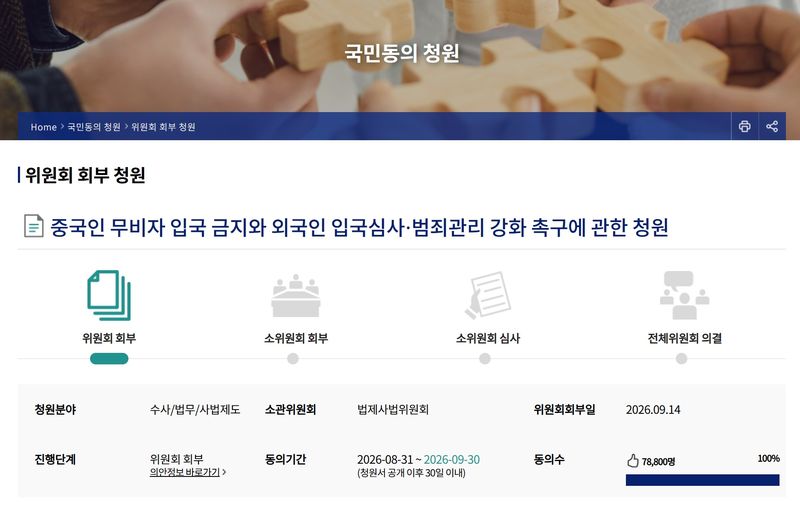
According to the National Assembly Public Petition with Citizen Consent System on the 18th, the petition titled “Petition Calling for a Ban on Visa-Free Entry for Chinese Nationals and Stronger Entry Screening and Crime Management for Foreign Nationals” had received 78,800 signatures.
The petition, made public on August 31, secured more than 50,000 signatures on September 12, meeting the requirements to qualify as an official petition. It was referred on the 14th to the Legislation and Judiciary Committee of the National Assembly, the responsible standing committee. Signatures will be accepted through the 30th. Reaching 50,000 signatures does not mean that the policy will be abolished; it means the petition has become an official petition of the National Assembly and will be reviewed by the responsible committee.
The petitioner called for the abolition of visa-free entry for Chinese nationals and stronger identity checks for all foreign nationals before entry. The demands include comprehensive checks of criminal records, international wanted status, previous entry refusals or deportations, records of illegal stays, and past violations of immigration laws. The petitioner also called for tighter controls on the departure of foreign nationals suspected of crimes and restrictions on the reentry of serious offenders.
However, the term “visa-free entry for Chinese nationals” used in the petition needs to be considered in light of the different systems currently in operation. The temporary visa-free program for Chinese group tourists nationwide does not apply to all individual Chinese travelers. It covers groups of three or more tourists organized by designated travel agencies, who may travel in Korea without visas for up to 15 days.
The government initially planned to operate the program from September 29, 2025, through June 30 this year, but extended the period. On June 23, the Ministry of Foreign Affairs officially announced that the visa-free entry program for Chinese group tourists would be extended from July 1 through December 31. The nationwide visa-free program for group tourists is therefore still in operation.
Jeju has a different system. A separate, permanent visa-free entry scheme operates under the Jeju Special Self-Governing Province Act.
Foreign nationals, except nationals of countries designated by the Minister of Justice as barred from entry, may enter through Jeju International Airport or the Port of Jeju for tourism, transit, or similar purposes and stay in Jeju without a visa for up to 30 days. Chinese nationals are eligible whether traveling individually or in groups.
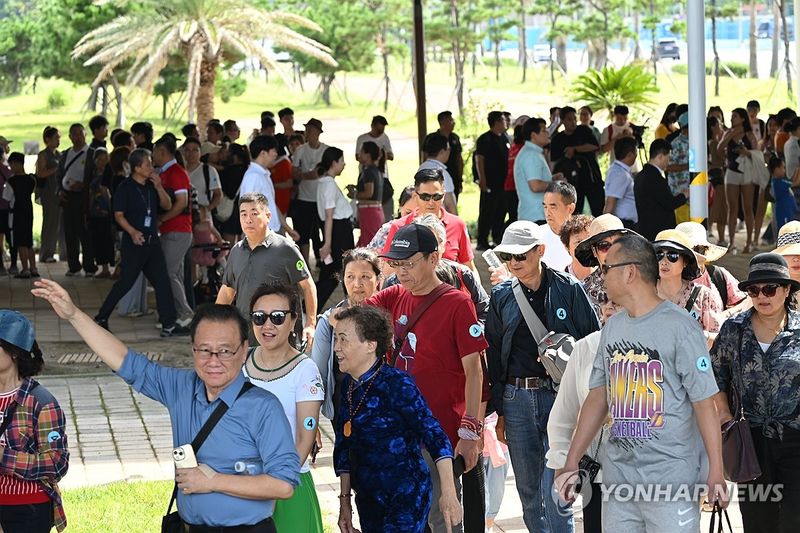
As a rule, people who enter Jeju under the visa-free scheme must remain on the island. Those wishing to travel to other regions need separate permission to expand their permitted area of stay. Thus, the nationwide group-tourist program and the Jeju visa-free scheme differ in terms of the length of stay, eligible travelers, and the areas to which visitors may travel.
It is also inaccurate to regard the system as one with no immigration screening at all. Under the nationwide visa-free program for Chinese group tourists, domestic and overseas designated travel agencies submit passenger lists before entry. Immigration authorities then screen the travelers in advance for high-risk factors, such as entry restrictions and previous records of illegal stays. Those found to fall into such categories are excluded from the visa-free program.
According to e-National Indicators, which uses data from the Korean National Police Agency, the number of foreign suspects residing in Korea stood at 35,296 in 2024, up 6.8% from 33,052 in 2023.
In Jeju, immigration management is a more immediate issue. According to data submitted by the Ministry of Justice to the National Assembly, 10,738 foreign nationals eligible for Jeju visa-free entry were residing illegally as of the end of August 2025. Chinese nationals accounted for 9,100, or 85% of the total.
According to the Jeju Provincial Police Agency, 608 foreign suspects were apprehended in Jeju in 2024, including 412 Chinese nationals, or 67.8%. However, Chinese nationals also account for a larger share of tourism and stays in Jeju than people of other nationalities, and the figures do not distinguish how the suspects entered the country. Therefore, it is difficult to determine a causal relationship between the visa-free scheme and crime based on these statistics alone.
The focus of the parliamentary review is expected to be less on whether to support or oppose the entry of Chinese nationals itself and more on how thoroughly the current immigration management system can verify identities and manage the risks of illegal stays and crime.
In Jeju, the tourism market adds another variable. The effects of attracting Chinese tourists must be assessed alongside the costs of managing unauthorized departures and illegal stays, the system for checking criminal information, and the management of the permitted area of stay, which is limited to Jeju.
With the nationwide visa-free program for group tourists extended through the end of this year, another issue is how to design the role and management system of Jeju’s separately operated 30-day visa-free scheme. Now that the petition has been formally referred to the Legislation and Judiciary Committee, the debate that began with online signatures has moved into a parliamentary review of the effectiveness and safeguards of the current immigration system.
[email protected] Jung Yong-bok Reporter