Jointly Owned, Yet a Spouse Secretly Takes Out a Share-Backed Loan—'Financial Ruin' Overnight
- Input
- 2026-09-23 10:50:09
- Updated
- 2026-09-23 10:50:09

[Financial News] #. A had built a family and household with a spouse for 16 years before belatedly learning that the spouse, B, had borrowed a large sum from a private lending company using B's share of their jointly owned home as collateral. B secretly took out the loan even though A had never consented to it or provided a seal.B actually borrowed approximately KRW 250 million. The maximum secured amount under the mortgage lien was set at KRW 450 million. After the debt went unpaid, the private lending company put the property up for foreclosure auction.Although A had not borrowed the money directly, A was also affected by changes to the property rights involving the jointly owned home. The two later began divorce proceedings, but A did not receive an adequate explanation or apology from B regarding the loan and the resulting property issues. The once-happy 16-year household was shattered in an instant by B's extravagance and other conduct.The case revealed that even for jointly owned property, collateral-loan verification procedures vary by financial institution, potentially creating a blind spot in which a non-borrowing co-owner learns of the situation only after the fact.
Banks and savings banks: "All co-owners must be verified"; private lenders: "Share-backed loans available"
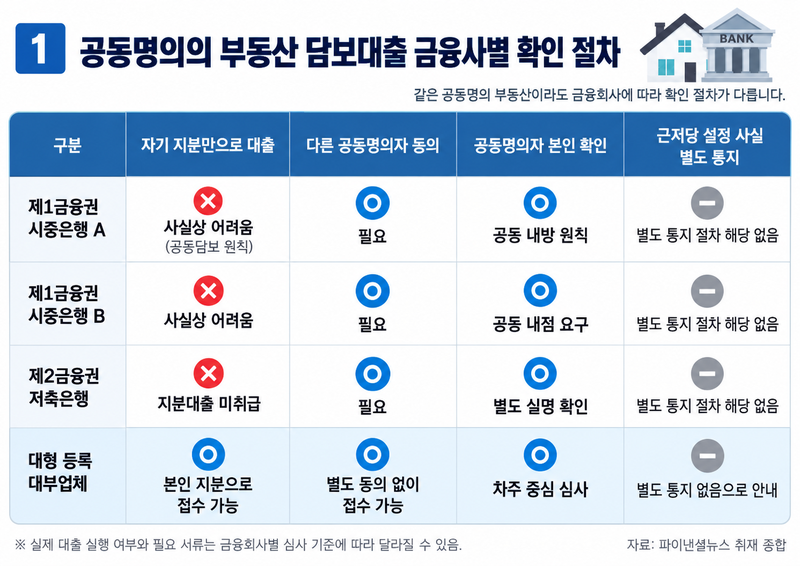
According to Financial News' reporting on the 23rd, two commercial banks said it would be difficult to process a loan secured by jointly owned property without the participation of the other co-owner.
One commercial bank explained, "If the property is jointly owned, all parties must come to the branch together to proceed." Another commercial bank likewise said, "If it is jointly owned, both of you must come," requiring all co-owners to visit the branch.
A savings bank in the secondary financial sector also required the consent and identity verification of the other co-owner. The savings bank explained, "We do not provide loans secured by an ownership share," adding, "Both parties must consent."
By contrast, one private lending company said it was possible to apply for a loan secured solely by the borrower's own share. A representative said, "There is something called a share-backed loan," and added, "A loan corresponding to the customer's share is also possible." Asked whether the company directly notifies the other co-owner of the loan by phone or text message, the representative replied, "That is not the case."
The private lending company was a large registered lender subject to the supervision of the Financial Services Commission (FSC) and the Financial Supervisory Service. According to the registered lending industry, similar cases of harm to A's are believed to number only a few each year on average. The Financial Supervisory Service also has no compiled data on similar cases. However, concerns are growing that such cases could gradually increase, prompting calls for institutional improvements to prevent further harm.
Under the current Civil Act, it is not inherently impossible for one co-owner to take out a loan secured by that person's own share. Article 263 of the Civil Act allows a co-owner to dispose of their share. The consent of the other co-owners is required to dispose of or alter the property as a whole, but not when only the borrower's own share is offered as collateral.
Need for a way to recognize changes in property relations
The problem lies less in consent than in awareness. One co-owner can offer their own share as collateral, but there is no common mechanism requiring the other co-owner to be notified when a mortgage lien is placed on that share and the legal status of the jointly owned property consequently changes. A non-borrowing co-owner may therefore learn only belatedly that a security interest has been established over property they own together.
This is why legal experts point out that, in the absence of a separate notification procedure, the other party may not realize that their property relations have changed until the borrower's debt becomes delinquent or foreclosure proceedings begin.
Establishing a security interest over one co-owner's share is different from disposing of the other co-owner's share itself. Even so, it can have a practical impact on the other co-owner because it complicates the rights associated with the jointly owned property and may lead to subsequent procedures, such as a foreclosure auction, if the debt remains unpaid. Experts say that when the property is used as a residence, a non-borrowing co-owner's livelihood and property relations can be destabilized by a problem unrelated to that person's own debt.
The lack of standardized verification procedures among financial institutions is also cited as a factor widening this blind spot. Some financial companies have their own procedures for obtaining a co-owner's consent or verifying the co-owner's identity, but no standard or supervisory rule requiring all financial institutions to apply such procedures has been identified.
Legal experts believe a practical alternative would be to establish a minimum procedure requiring other co-owners to be notified when an important change in rights, such as the creation of a mortgage lien, occurs, rather than restricting a co-owner's right to dispose of their own share. Simple notification would allow a non-borrowing co-owner to identify the situation early and respond without infringing on the co-owner's right of disposal.
There is currently no unified mechanism at the level of the financial authorities. An FSC official explained, "As far as I know, the Banking Supervision Regulation does not stipulate that this must be done," indicating that the issue is more closely related to property relations under the Civil Act.
Accordingly, legal experts say institutional improvements are needed, including the establishment of minimum notification standards.
A real estate attorney said, "Even if the specific method is left to the discretion of each financial company, it would be advisable to require a procedure for verifying the parties' intentions," adding, "Including a verification procedure in the operating manual could help prevent harm."
Another real estate attorney also said, "Even if a co-owner secretly takes out a mortgage loan on the home, a system requiring both parties to be notified is necessary," predicting, "Without such a system, cases of abuse will gradually increase."
[email protected] Yoo Seon-jun, Reporter
[email protected] Yoo Seon-jun Reporter