Hanwha Systems Begins Developing an AI-Based Space Situational Awareness System
- Input
- 2026-09-18 09:29:50
- Updated
- 2026-09-18 09:29:50
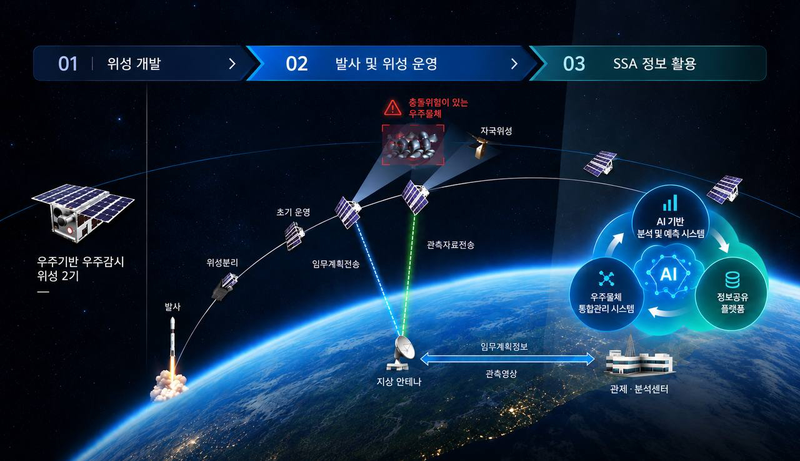
Hanwha Systems announced on the 18th that it signed a contract with the Korea Astronomy and Space Science Institute (KASI) on the 9th for the "Development of Space-Based Space Surveillance Satellites and a Ground-Linked Space Situational Awareness System" project. The company will participate as a private-sector system developer for K-SSA.
Space situational awareness (SSA) refers to activities that observe and analyze the locations and orbits of space objects to identify and predict risks that may occur in space, including collisions and reentries. As the number of satellites in low Earth orbit has grown rapidly, the risk of collisions between space objects, including artificial satellites and space debris, has also increased. As a result, the importance of developing independent space situational awareness capabilities to protect national space assets and respond to the reentry of space objects over land is growing.
The project is part of the K-SSA development program being pursued by the Korea AeroSpace Administration (KASA). As the lead research organization, KASI will establish the mission, concept of operations, and system requirements for the national space situational awareness system. It will also oversee the coordination of detailed technologies and system integration.
Hanwha Systems will develop the space-based space surveillance satellites and build the ground-linked space situational awareness system. It will also handle integration between individual systems, as well as testing and verification. The space surveillance satellite being developed by Hanwha Systems is a very small satellite that will operate in low Earth orbit at an altitude of approximately 480 km. Equipped with an optical camera for SSA, it will detect and track artificial and natural objects in space and collect observation data needed to analyze collision and reentry risks.
On the ground, AI will be used to integrate and analyze space data. The ground-linked space situational awareness system will centrally manage information on space objects gathered from various observation platforms, including space surveillance satellites. Using AI technology, it will predict and analyze their trajectories and collision and reentry risks. The results will be shared with relevant agencies to support rapid situational assessment and response.
Through the project, Hanwha Systems also plans to build technological competitiveness in space domain awareness (SDA). SDA goes beyond SSA's focus on tracking the movements of space objects by comprehensively analyzing the intent and impact of various activities and threats in space.
Song Seongchan, head of Hanwha Systems' Space Business Division, said, "The space industry is rapidly expanding beyond simply developing and operating satellites to include the safe use and management of outer space." He added, "Through this project, we will secure core technological competitiveness in SSA and SDA and contribute to strengthening the Republic of Korea's independent space security and response capabilities."
[email protected] Jung Won-il Reporter