KAIST 17.6 billion won, GIST 400 million won... 44-fold difference in overseas patent commercialization revenue
- Input
- 2026-09-18 08:45:00
- Updated
- 2026-09-18 08:45:00
It has been pointed out that not only overseas patent filing performance but also the results leading to commercialization must be managed.
According to data submitted by the four major science and technology institutes to Rep. Lee Hoon-gi of the Democratic Party of Korea, a member of the Science, ICT, Broadcasting, and Communications Committee of the National Assembly, on the 17th, the proportion of overseas patent applications among total patent applications from 2021 to 2025 ranged from 22.1% to 32.0% for KAIST.
The figures were 25.3–34.5% for Ulsan National Institute of Science and Technology (UNIST), 25–35% for Daegu Gyeongbuk Institute of Science and Technology (DGIST), and 21.67–32.29% for GIST. Although there were differences by institution and year, the figures were generally in the 20–30% range.
However, there was a significant gap in the extent to which overseas patents led to actual revenue.
KAIST recorded the highest cumulative overseas patent-related revenue from 2021 to 2025, at 17.642 billion won. It was followed by UNIST with 2.04 billion won, DGIST with 1.371 billion won, and GIST with 399 million won. The gap between KAIST and GIST was approximately 44.2-fold.
There was also a significant difference in the proportion of overseas patent-related revenue within total patent-related revenue. During the same period, KAIST's overseas patent-related revenue was 17.642 billion won, accounting for 59.1% of its total patent-related revenue of 29.848 billion won. In other words, more than half of its patent-related revenue came from overseas patents.
For UNIST, overseas patent-related revenue was 2.04 billion won, accounting for 42.8% of its total patent-related revenue of 4.769 billion won. DGIST's overseas patent-related revenue over the five-year period totaled 1.371 billion won, while its share of total annual patent-related revenue ranged from 3% to 31%.
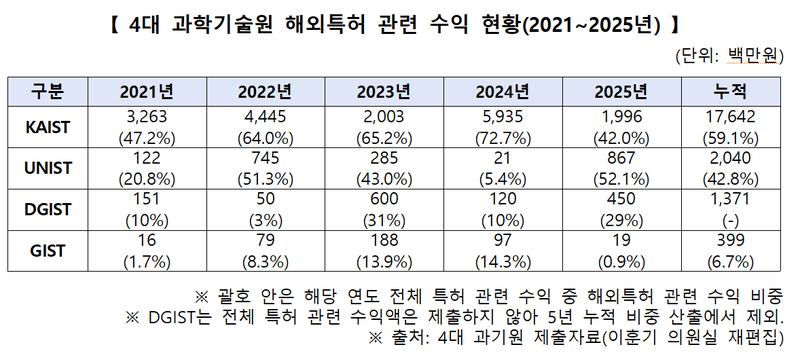
By contrast, although GIST's proportion of overseas patent applications did not differ significantly from those of the other science and technology institutes, the proportion converted into revenue was relatively low. Of GIST's total patent-related revenue of 5.928 billion won over five years, overseas patent-related revenue amounted to only 399 million won, or 6.7%.
In particular, last year, total patent-related revenue was 2.029 billion won, the highest during the period examined, but overseas patent-related revenue amounted to only 19 million won. Its share of total patent-related revenue was also just 0.9%. Although the proportion of overseas patent applications remained similar among the four major science and technology institutes, their commercialization performance in converting those applications into actual revenue varied considerably.
Rep. Lee Hoon-gi said, "Overseas patents are not an end in themselves, but a means of utilizing outstanding research results in the market and commercializing them," adding, "Performance must be managed not only in terms of patent filing records, but also in terms of how much they lead to actual technology transfers and commercialization."
[email protected] Yoon Hong-jip Reporter