Canada and the European Union Draw Closer as Trump Warns of "High Tariffs" ... Carney: "No One Can Decide for Us"
- Input
- 2026-09-18 00:28:56
- Updated
- 2026-09-18 00:28:56
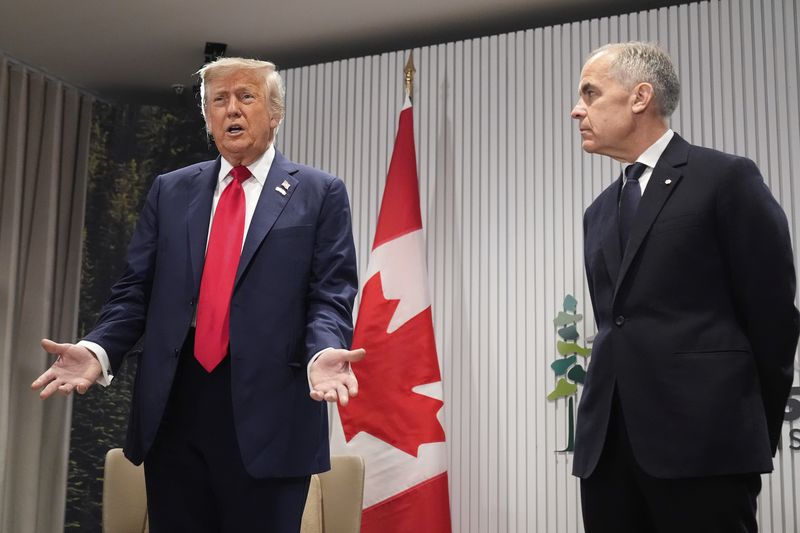
Speaking at the European Parliament in Strasbourg, France, on June 17 (local time), Canadian Prime Minister Mark Carney urged closer cooperation between the two sides. "Europe and Canada are each strong. But together, we are stronger," Carney said. He added, "Economic integration is being weaponized, and tariffs are becoming a tool of coercion. A single tree falls in a fierce storm, but a forest does not."
Carney also welcomed the proposal, put forward the previous day by European Commission President Ursula von der Leyen, to make Canada an EU 'associate member.' "We welcome that proposal," he said. However, he stressed that Canada and Europe were not seeking to create a 'third bloc' against the United States and China.
He stressed, "We are not seeking power to dominate other countries. We are seeking resilience so that no one can control our open markets, undermine our sovereignty, or weaken freedom, democracy and the rule of law."
Trump immediately pushed back. Describing the plan to make Canada an EU associate member as "ridiculous" the previous day, he warned, "If we determine that it is even slightly hostile, we will impose very serious tariffs or halt trade with Europe in many areas." He added, "If the intentions are good, that's fine, but if the intentions are bad, we will impose very high tariffs on Europe."
Carney did not back down. Responding to Trump's remarks, he said, "No one can dictate our culture or decide with whom we make agreements internationally." However, he explained that closer ties with the EU did not mean a break with the United States; rather, Canada could become a more effective partner for the United States.
The closer ties are expanding beyond trade into security and advanced industries. Carney identified critical minerals, the defense industry, artificial intelligence (AI) and computing, energy security, space, and payment systems as areas for cooperation. Canada also formally applied the previous day to join the Joint Expeditionary Force (JEF), a rapid-response military cooperation framework led by the United Kingdom. The move is aimed at reducing Canada's economic and security dependence on the United States while strengthening ties with Europe.
The proposal came to the fore after von der Leyen said in her annual State of the Union address on June 16 that she would elevate relations with Canada to "the highest level possible" in response to "an openly hostile world" and proposed making Canada the EU's first associate member. However, because 'associate member' is a status not currently recognized under EU treaties and requires the consent of member states, substantial discussions are expected before it can be formally established.
[email protected] Correspondent Lee Byung-chul Reporter