Takaichi’s Second Cabinet Takes Office—Key Ministers Retained, Hands-On Figures Placed in Key Posts
- Input
- 2026-09-18 06:00:00
- Updated
- 2026-09-18 06:00:00
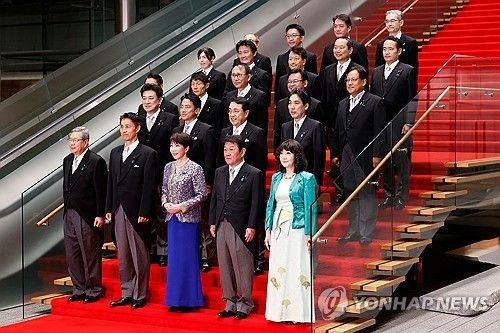
[Financial News, Tokyo—Correspondent Seo Hye-jin] Sanae Takaichi, Japan’s prime minister, carried out her first Cabinet reshuffle since taking office. Key ministers were retained, while hands-on figures were placed in prominent posts. The result is an “execution-oriented Cabinet” designed to accelerate food consumption tax cuts, proactive fiscal policy, and the strengthening of Japan’s defense capabilities.
The Second Takaichi Cabinet was inaugurated the previous day following an attestation ceremony at the Imperial Palace, Yomiuri Shimbun and The Asahi Shimbun reported on the 18th. Eight ministers remained in office, while seven entered the Cabinet for the first time. Including three ministers returning to the Cabinet, 10 of the 18 ministers were replaced.
Sanae Takaichi described the new Cabinet as “a Cabinet of determination, challenge, and execution,” adding, “We will accelerate policies to achieve a strong economy under responsible proactive fiscal policy.”
■Key Ministers Retained as Tax-Cut Drive Accelerates
Satsuki Katayama as finance minister, Minoru Kihara as chief cabinet secretary, Motegi Toshimitsu as foreign minister, Shinjirō Koizumi as defense minister, and Ryosei Akazawa, Japan’s minister of economy, trade and industry, all remained in office.
Finance Minister Satsuki Katayama will newly oversee the “Consumption Tax and Support Payments Bill.” The government plans to reduce the food consumption tax rate from 8% to 1% for two years starting next April and provide support payments based on income.
At its first Cabinet meeting, the government also finalized a basic policy covering consumption tax cuts, integrated tax and social security reform, and revisions to three key security-related documents. It designated the response to high prices as its top priority while seeking to secure both growth and fiscal sustainability.
Sanae Takaichi stressed that the government could secure funding for the tax cuts without relying on special-purpose government bonds. However, next year’s general-account budget requests have already surpassed a record 143 trillion yen, and the combination of tax cuts and increased defense spending is expected to fuel debate over fiscal soundness.
Hiroshi Nakatsuka, a former secretary-general of coalition partner Japan Restoration Party, entered the Cabinet for the first time as minister in charge of regulatory reform. It marks the first participation of a Japan Restoration Party figure in the Cabinet, expanding policy cooperation between the two parties into “intra-Cabinet cooperation.”
■Disaster Management and Reconstruction Merged; Digital Minister to Oversee AI
The ministers’ responsibilities were also reorganized. The disaster management and reconstruction portfolios were merged, with Reconstruction Minister Goshi Hosono also taking charge of disaster management at the Disaster Management Agency, which is scheduled to launch in November. The aim is to apply the experience of reconstruction after the Great East Japan Earthquake to advance disaster preparedness and international cooperation.
The digital minister was assigned responsibility for artificial intelligence (AI) policy and tasked with promoting AI adoption across industries and “AI transformation (AX)” throughout society. A post overseeing content strategy was also created to support the gaming and animation industries. Measures to address bear-related damage were added to the environment minister’s responsibilities.
The government’s key economic policy, the “Regional Future Strategy,” was transferred to the minister of internal affairs and communications. The ministry, which oversees local governments, will promote local investment and economic revitalization while reflecting on-the-ground demand. The minister will also oversee preparations for a “backup capital” capable of taking over Tokyo’s capital functions in the event of a disaster.
■Rivals Brought In, Hayashi Excluded
The reshuffle also carries political implications. At last year’s LDP presidential election, Defense Minister Shinjirō Koizumi, Foreign Minister Motegi Toshimitsu, and LDP Policy Research Council Chair Takayuki Kobayashi—all of whom competed against Sanae Takaichi—remained in key posts. By contrast, former Internal Affairs and Communications Minister Yoshimasa Hayashi, who received more Diet votes than Sanae Takaichi at the time, was excluded from the Cabinet.
Japanese political circles interpret the appointments as an attempt to keep potential rivals in key posts and prevent the consolidation of “anti-Takaichi forces.” Sanae Takaichi rejected the interpretation, saying, “These appointments have absolutely nothing to do with next year’s LDP presidential election.”
It is a potential liability that Education, Culture, Sports, Science and Technology Minister Yoshihiro Seki and Agriculture, Forestry and Fisheries Minister Kazuo Yana, both from the former Abe faction, were appointed despite having unreported entries in their political funds income-and-expenditure reports. This is the first time since the issue emerged in 2023 that lawmakers with undisclosed entries have been appointed as Cabinet ministers.
The new Cabinet must handle bills on consumption tax cuts and support payments, among others, during next month’s extraordinary Diet session.
[email protected] Seo Hye-jin Reporter