KCTU to Join Social Dialogue on Mega Special Zone
- Input
- 2026-09-17 21:32:42
- Updated
- 2026-09-17 21:32:42
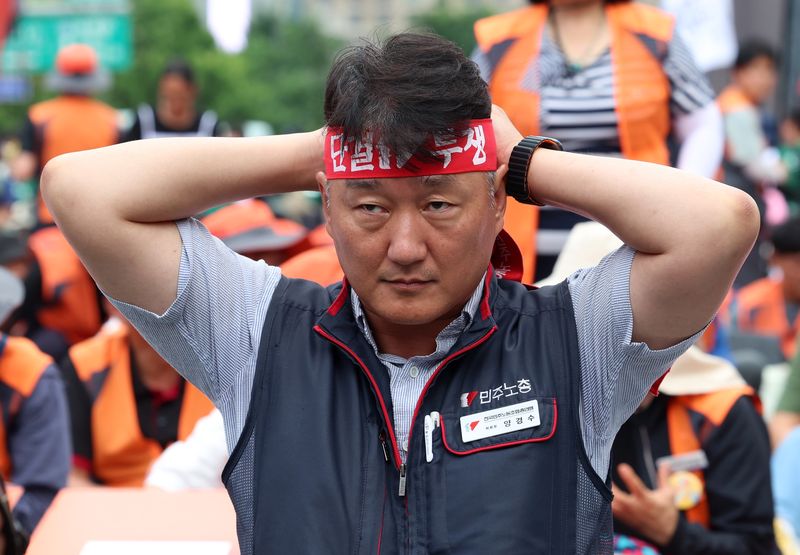
[Financial News] The Korean Confederation of Trade Unions (KCTU) will participate on the 17th in a one-point social dialogue proposed by the government to discuss labor exemptions under the Mega Special Zone Special Act. This marks the first time in six years that KCTU has participated in tripartite social dialogue since talks on overcoming the COVID-19 pandemic in 2020.
KCTU said on the 17th that its Central Executive Committee had convened that day and decided to participate in the one-point social dialogue on the Mega Special Zone Special Act.
KCTU said, "KCTU has consistently called for zero-base discussions that do not presuppose negotiations on labor exemptions." It added, "We determined that participating in the dialogue and directly voicing our opposition is necessary to prevent the expansion of labor exemptions and the erosion of labor rights."
KCTU chairman Kyung-soo Yang stressed, "KCTU must enter the social dialogue and argue for blocking an exception to the 52-hour workweek and the introduction of a 'white-collar exemption,' while calling for the promotion of a four-and-a-half-day workweek."
Yang continued, "The government is seeking to expand the Dispatch Workers Act and the Fixed-Term Workers Act, while we should argue for restricting the grounds for using nonregular workers in the Mega Special Zone." He explained, "As enormous tax benefits are being directed to companies, it is imperative to demand measures that return the resulting gains to society."
Earlier, on the 15th, Minister of Employment and Labor (MOEL) Kim Young-hoon proposed creating a forum for one-point social dialogue involving labor and business to discuss special labor provisions that would ease labor regulations only in the Mega Special Zone. Because KCTU does not participate in the Economic, Social and Labor Council (ESLC), the presidential tripartite dialogue body, he requested that a separate forum be established for discussions limited to the Mega Special Zone provisions.
The main agenda items are the 'white-collar exemption,' which would remove the 52-hour workweek cap for high-income managers and research and development workers and exclude overtime, night-work, and holiday-work allowances, and the 'fixed-term 2+2' system, which would extend the current two-year limit on employing fixed-term workers by an additional two years with the worker's consent.
The business community argues that labor exemptions are necessary to secure the Mega Special Zone's competitiveness. Labor groups, however, oppose the measure, saying such exceptions could become a catalyst for dismantling labor regulations as a whole.
With the Federation of Korean Trade Unions (FKTU) expressing its intention to participate in the social dialogue, followed by KCTU's decision to join, the forum is expected to open. MOEL plans to arrange the first meeting soon if the parties agree.
However, whether the social dialogue can produce tangible results remains uncertain.
During the social dialogue held amid the COVID-19 pandemic, labor, management, and the government reached an agreement calling for them to share the burden. However, the agreement failed to win internal ratification from KCTU, and its then-chairman, Kim Myung-hwan, resigned. As a result, the final tripartite agreement was signed without KCTU's participation.
Meanwhile, KCTU also discussed whether to return to the ESLC. KCTU has not returned to tripartite social dialogue since withdrawing from the Economic and Social Development Commission of Korea, the predecessor to the ESLC, in February 1999.
The Central Executive Committee also discussed whether to refer the matter to a delegates' convention but failed to reach a conclusion. Accordingly, Yang decided to convene a delegates' convention in early October under his authority as chairman.
[email protected] Choi A-young Reporter