KOCCA President Kim Yun-ji: "The situation on the ground is more desperate; IP monetization is the breakthrough... Pushing for conversion to a government-funded institution"
- Input
- 2026-09-17 20:37:47
- Updated
- 2026-09-17 20:37:47
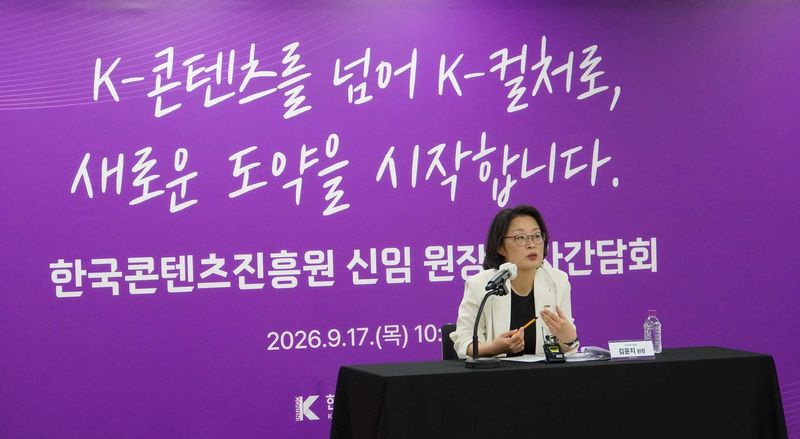
[Financial News] "When I was a researcher, I was frustrated wondering why policies weren't changing quickly. However, after coming to the field, I found that companies were pleading for increased support for production funds, saying that they are facing severe immediate difficulties."
Kim Yun-ji, President of the Korea Creative Content Agency, explained the difference between the content industry she viewed as an external researcher and the reality she faced while leading a policy support agency at a press conference commemorating her 100th day in office, held at the CKL Business Support Center in Jung-gu, Seoul on the 17th.
President Kim, who has been researching the economic and export effects of the Korean Wave, revealed that although she had emphasized the need for a shift in content industry policy prior to her inauguration, the situation of the companies she met in the field was much more desperate than expected.
She said, "The field also agrees that the industry needs to move in a new direction, but they say it is too difficult right now," adding, "I have reflected a lot on the fact that I have been talking a little ahead of reality."
What industry insiders most urgently demanded was an expansion of production funding. However, they assessed that simply continuously increasing production cost support would not be enough to fundamentally resolve the industry's crisis.
President Kim stated, "I am aware of the importance of production funding support, but it cannot be increased indefinitely, nor is it the only or necessarily the best approach," adding, "We must change the direction of the industrial structure to ensure funds are used efficiently while maintaining existing support."
On this day, President Kim presented four new strategies: leaping forward as the leading agency for the K-culture industry, establishing a support system centered on content intellectual property (IP), strengthening growth foundations such as finance, talent, and technology, and transforming into a field-oriented specialized organization. The awareness that it is difficult to resolve the industry's crisis solely through production funding support served as the foundation for the four new strategies and 10 key initiatives announced on this day.
The broadcasting and video industry faces significant difficulties.
President Kim cited the broadcasting and video industry as the sector currently facing the greatest difficulties. While K-dramas and series have gained global fame through global OTT platforms like Netflix, profitability at actual production sites is deteriorating.
President Kim stated, "There is a problem where production costs have risen significantly, and sufficient production margins cannot be secured depending on the method of selling content to global OTT platforms." She added, "As overseas platforms have grown, the purchasing power of domestic broadcasters has weakened, and as a result, a phenomenon of reduced broadcast content production itself is also emerging."
The government and the Korea Creative Content Agency (KOCCA) have been supporting production companies in securing intellectual property rights (IP). However, President Kim believes that merely possessing IP cannot guarantee profitability.
She said, "Even if you secure IP, you won't generate profit if you can't sell it to various places or utilize it properly," adding, "As the broadcasting environment has been reorganized around OTT, the distribution channels for selling finished content have also decreased compared to the past."
Ultimately, she concluded that a structure capable of generating more revenue from a single IP was necessary to cover the increased production costs.
President Kim emphasized, "Countries with highly profitable content industries, such as The United States and Japan, are increasing revenue by maximizing the utilization of IP," adding, "The direction we should pursue going forward is to create representative IP and expand it into various genres and businesses to enhance profitability."
Need to Convert to a Government-Funded Institution Raised
President Kim also cited the agency's rigid budget structure as a problem she identified after taking office. She noted that since most of the agency's projects are funded by government subsidies and the budget is allocated by genre, coordination between projects is difficult.
She said, "There were many constraints requiring execution within a fixed budget and project structure," adding, "It was also not easy to connect and support various projects due to genre-specific silos."
In particular, it was pointed out that the one-year budget execution method has limitations in supporting multi-year content projects. It was explained that it is difficult to flexibly support projects that start in the second half of the year and continue into the following year, or long-term projects that require two to three years.
As an alternative, President Kim raised the need to convert the Korea Creative Content Agency into a government-funded institution.
She stated, "If we transition into a government-funded institution, we can manage our budget and projects more flexibly to meet corporate demand," adding, "During my term, I want to consult with relevant ministries to create an industry-friendly support system."
[email protected] Shin Jin-ah Reporter