[Editorial] Last-Minute Hurdles in U.S. Investment Talks: Korea Must Carefully Weigh Gains and Losses to Protect the National Interest
- Input
- 2026-09-17 18:49:38
- Updated
- 2026-09-17 18:49:38
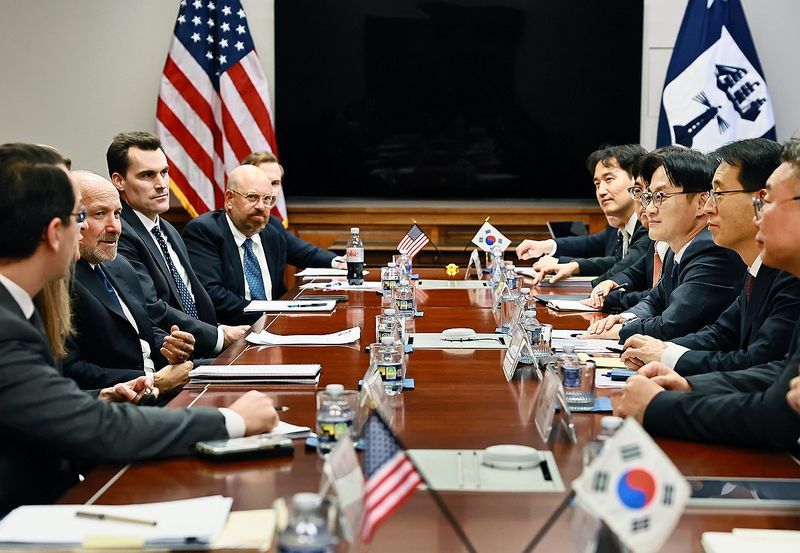
The government reportedly asked the National Assembly to postpone reports on U.S. investment projects by the Finance, Economy and Planning Committee and the Trade, Industry, Energy, SMEs and Startups Committee, which had been scheduled for the 17th. Since the government must complete the report to the National Assembly before proceeding with follow-up procedures with the United States under the Korea-U.S. Strategic Investment Special Act, the schedule for the MOU on the first project—a $22.3 billion gas-fired combined-cycle power plant in Encinal, Texas—is also expected to be delayed.
The exact reason is unknown, but it appears that some issues remain unresolved between South Korea and the United States. Regarding the second project, a large-scale nuclear power plant construction project, an analysis that the two sides disagree over making two of the eight units Korean-designed is gaining traction. The U.S. side is also said to be reluctant to allow South Korea to invest in Westinghouse Electric Company, a U.S. company with core nuclear technology, in order to secure voting rights. Whether to include the Alaska LNG Project, which President Donald Trump has strongly demanded, has also emerged as a key issue.
There are also reports that negotiations are facing difficulties because the United States is demanding project-by-project accounting, unlike an umbrella investment structure that manages the gains and losses of the entire portfolio together. If South Korea accepts the U.S. demand, it may become difficult to offset losses from uncertain projects with profits from highly profitable ones, increasing Korea's investment risks. Under a structure in which the United States receives 90% of the net profits after the recovery of principal and interest, South Korea could hand over the gains from successful projects early while bearing the deficits from unsuccessful ones.
Given the scale of the investment, the South Korean government cannot ignore profitability risks. The Alaska LNG Project and gas-fired power generation projects could lead to massive losses if infrastructure costs surge or long-term demand forecasts prove inaccurate. Ultimately, the public and businesses would have to shoulder any losses. With the United States steadily increasing the pressure, the government appears to be in a difficult position with no easy way out.
The United States is a key ally of South Korea as well as an important partner in advanced-industry cooperation. Even so, an agreement that leaves South Korea to bear the risks unilaterally would be difficult to win public support for and must not be allowed. The government should persuade the United States as much as possible on key terms, including securing nuclear technology and participation rights in projects and improving the profit-and-loss distribution structure, and conclude the negotiations on favorable terms.
Whether to build Korean-designed nuclear reactors, along with ownership stakes, voting rights and infrastructure investment risks, is intricately interconnected. The government must therefore carefully weigh the gains and losses and coordinate the terms until the final stage. The outcome must deliver sufficient returns that the public can accept, as well as tangible benefits for the nation. Even if the hard bargaining continues, the government should uphold its principles and use meticulous calculations to secure practical gains. It must create a win-win model for cooperation with the United States through thorough risk controls. Kim Jung-kwan, Minister of Industry, previously said, "It is not over until it is signed." In keeping with those words, Korea needs the resolve to protect the national interest until the very last moment.