Stronger Tightening Signals... “Korea’s Rate Is Headed to 3.75%”
- Input
- 2026-09-17 18:39:54
- Updated
- 2026-09-17 18:39:54
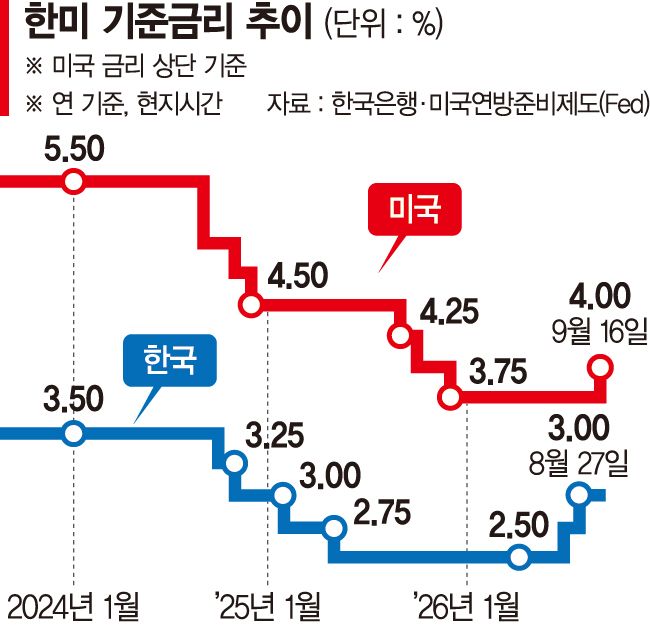
According to a survey of research institutes affiliated with the five major financial holding companies conducted by Financial News on the 17th, forecasts for the peak of the BOK’s base rate during the current rate-hike cycle ranged from 3.25% to 3.75% per year. This implies an additional increase of 0.25–0.75 percentage points from the current level. Based on the upper end of the forecast, the rate would reach its highest level since 4.00% in November 2008.
The BOK ended eight consecutive rate holds by raising its base rate by 0.25 percentage points in July. It followed that with another 0.25-percentage-point hike in August, bringing the base rate to 3.00% per year. This marked a shift in its monetary policy stance toward “tightening” for the first time in approximately three years and six months. Markets expect the tightening trend to continue for the time being now that the policy stance has changed.
The research institutes cited an economic recovery driven by the semiconductor boom and upward pressure on prices as the reasons for further rate hikes. Although growth is concentrated in certain industries and regions, they believe monetary tightening is necessary because both growth and inflation remain high. In the minutes of the BOK’s 16th Monetary Policy Board meeting of 2026, held on August 27, six of the seven Monetary Policy Board members also supported a base-rate hike. They cited stronger-than-expected growth resulting from the semiconductor boom, upward pressure on core inflation, rising home prices in the Seoul metropolitan area and the accumulation of household debt.
The research institutes expected the base rate to reach its peak as early as the first half of next year or sometime next year. An official at one financial holding company’s research institute said, “The base rate could remain at a high level for a considerable period, depending on whether the war in the Middle East is prolonged and whether the semiconductor boom continues.”
A base-rate hike also puts upward pressure on bond yields. When yields on safe-haven assets such as government bonds rise, investors demand higher yields on bank bonds issued by commercial banks. As higher bank-bond yields increase banks’ funding costs, they also put greater upward pressure on mortgage rates. However, the research institutes expect market rates to gradually decline and stabilize after the rate-hike cycle ends, since they have already priced in the base-rate increases.
COFIX (Cost of Funds Index), the benchmark for variable-rate loans offered by banks, rose for four consecutive months from April through July. During that period, the BOK raised its base rate twice. This has fueled concerns in the market that the upper end of mortgage rates could exceed 8% per year.
A financial-sector official said, “If bank-bond yields remain high because of elevated oil prices and concerns over monetary tightening at home and abroad, mortgage and other lending rates could also stay high. If lending rates rise further, they will burden borrowers who are preparing to purchase homes or refinance their loans.”
[email protected] Byung-jung Ye and Hyun-jung Lee Reporter