KIST to Begin Demonstration of Humanoid Robots in 2030
- Input
- 2026-09-17 17:21:25
- Updated
- 2026-09-17 17:21:25
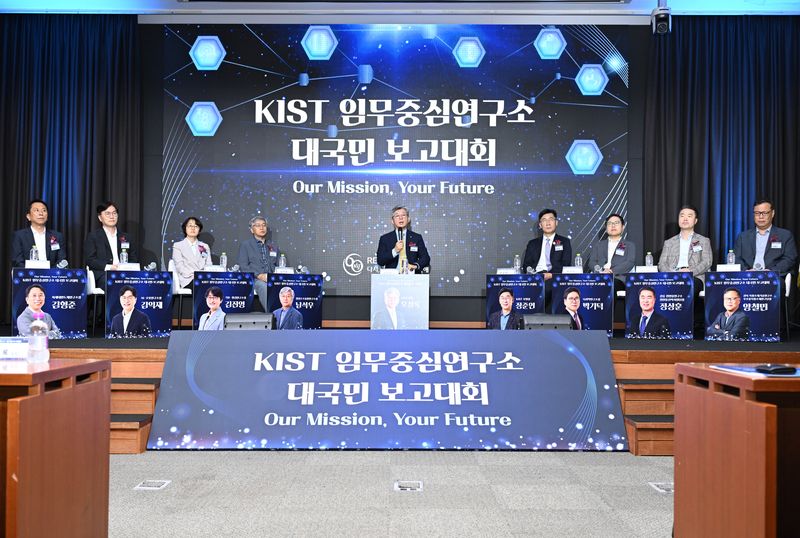
[Financial News] With KIST having introduced mission-oriented research and development (R&D), it plans to begin demonstrating humanoid robots in 2030. It is also pursuing the development of future computing with computational performance 1,000 times higher than current levels.
KIST held a public briefing on its mission-oriented research institutes on the 17th at its headquarters in Seongbuk District, Seoul, and announced these plans. Earlier, KIST introduced a mission-oriented research system in 2024 to address national agendas and has been implementing the PM (Project Manager) system.
First, the Next-Generation Semiconductor Research Institute, led by PM Hyung-jun Kim, is taking on the challenge of developing an RPU (Random Processing Unit) with computational performance 1,000 times higher than that of existing computing and power consumption at one-hundredth the level. The institute has succeeded in designing high-performance chips and implementing route-optimization algorithms for distribution, logistics, and autonomous driving. It plans to take the lead in the future computing market following further technology demonstrations. In quantum technology, it also plans to overcome, step by step, the key challenges required to realize large-scale quantum computers, building on its achievements in developing an ultrafast, highly efficient quantum simulator.
Next, the AI and Robotics Research Institute, led by PM Ik-jae Kim, is accelerating the development and demonstration of humanoid technology that works alongside people in industrial settings and everyday life by 2030, using the technology transfer of "KAPEX" from LG Electronics as a springboard. Ultimately, it aims to secure South Korea's technological sovereignty by taking the lead in humanoid technology, a key area of competition in physical AI.
The Climate and Environmental Research Institute, led by PM Jin-young Kim, has strengthened the Korean Peninsula's ability to respond to climate disasters by developing a globally leading AI-based climate prediction model. It also plans to secure mass-production technology for its independently developed carbon-absorbing material by 2030 and enter the industrialization phase.
The Clean Hydrogen Convergence Research Institute, led by PM Seok-woo Nam, has lowered hydrogen production costs to the $5-per-kilogram range and implemented the world's first ammonia-based system for simultaneous hydrogen and electricity production. In response to surging future electricity demand from AI data centers and other sources, it will accelerate technology scale-up and demonstrations, while taking on the challenge of producing hydrogen at $1 per kilogram by 2033.
The Brain Science Institute, led by PM Ki-deok Park, is pursuing final approval for a dementia drug based on the success of a global technology transfer worth KRW 500 billion. It aims to overcome dementia, the biggest challenge facing a super-aged society, while entering the global new drug market by expanding the clinical pipeline for new treatment candidates and accelerating the commercialization of early-diagnosis technology. The Natural Products Drug Development Program, led by PM Sang-hoon Jung, also successfully transferred technology for a candidate for the world's first eye-drop treatment for macular degeneration. It plans to accelerate its entry into the global market for treatments for age-related diseases by leveraging the safety and therapeutic efficacy of natural products along with an AI-based end-to-end platform.
The Space-Use Composite Materials Research Group, led by PM Cheol-min Yang and launched in January this year, plans to lay the foundation for South Korea's technological self-reliance in the space industry by developing ultralight, highly shielded, and highly insulating composite materials capable of withstanding extreme environments.
KIST President Oh Sang-rok said, "The past two years have been a process of shifting from research centered on individual researchers to collaborative research aimed at addressing national missions, while changing our research methods and systems together. This event was organized not only to share our achievements, but also the trial and error and deliberations we experienced along the way, with the hope that KIST's experience will help research institutes funded by the government as a whole transition to mission-oriented R&D."
[email protected] Yeon Ji-an Reporter