Telecom Industry Faces Dilemma in the 'AX and 6G Era': "We Must Move Beyond Competition-Centered Regulation"
- Input
- 2026-09-17 18:49:48
- Updated
- 2026-09-17 18:49:48
■"The Decoupling of Investment and Revenue Is at the Core of the Telecom Industry's Problems"
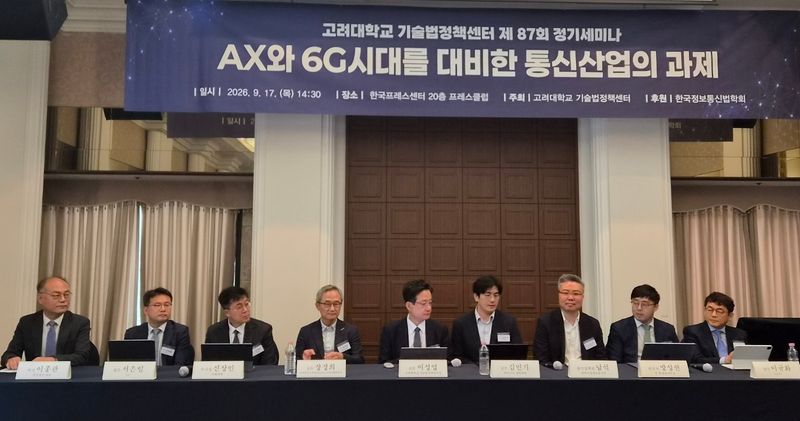
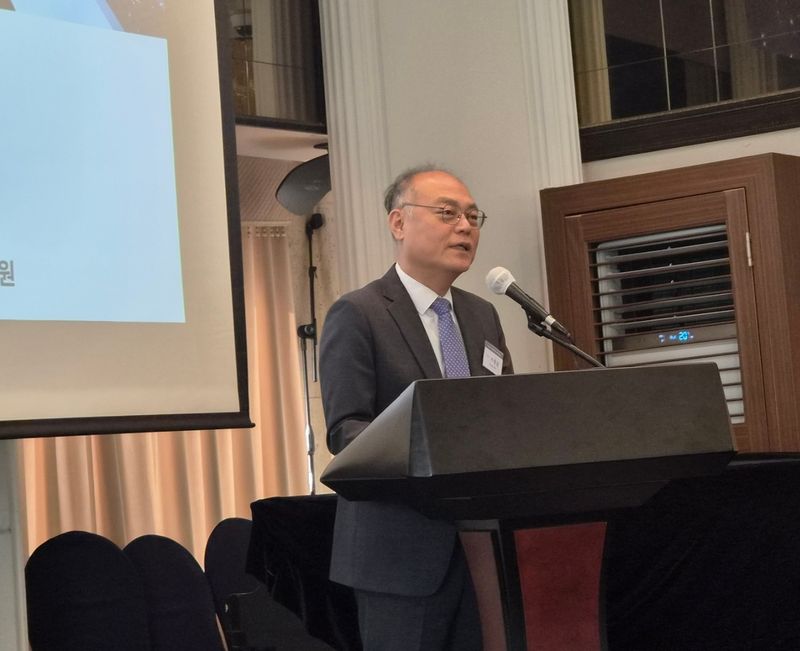
Korea University's Center for Technology Law and Policy (CTLP) held a regular seminar on the 17th at the Press Center in Jung-gu, Seoul, under the theme "Challenges Facing the Telecommunications Industry in Preparation for the AX and 6G Era." The seminar was organized to examine the challenges facing South Korea's telecom industry ahead of the accelerating AX transition and the 6G era, and to explore sustainable business strategies.Lee Jong-gwan, a senior expert adviser at Shin & Kim, gave a presentation titled "Network Policy and Revenue Model Strategies in the AX and 6G Era." He identified the core problem facing the telecom industry as the "decoupling of investment and revenue."
“We cannot stop investing, but investment does not lead to a structure in which revenue increases,” Lee said. “Ordinary investment decisions are based on future returns, but if expected future returns are not significantly high, it is difficult for investment to take place.”
South Korea's mobile traffic increased approximately 2.3-fold, from 5,817,000 TB (terabytes) in 2019 to 13,257,000 TB in 2024. During the same period, the cumulative capital expenditures (CAPEX) of the three mobile carriers reached approximately 51 trillion won. By contrast, the average revenue per user (ARPU) of the three telecom operators fell 7.6%, from 31,103 won in 2019 to 28,746 won last year. In other words, the costs and traffic associated with networks increased, while the revenue telecom operators generated through those networks actually declined.
Lee noted that simply having high-quality network infrastructure is no longer enough to guarantee ICT competitiveness. In an ICT environment reshaped around global platforms, South Korea's infrastructure competitiveness could remain merely a "localized competitiveness" with limited influence.
Lee proposed that network policies and business structures must also change to reflect the 6G and AI eras. In the case of 6G, policy support is needed because network investment for commercialization will be required even amid stagnating growth in the telecom industry. For AI, he suggested upgrading networks so they can reliably deliver the quality required by AI services.
■"Regulations Must Be Normalized to Secure Room for Investment"
During the discussion session, Lee Seong-yeop, director of CTLP at KU, moderated a conversation on policy directions for helping telecom operators secure new sources of revenue and promoting network investment.Kim Min-gi, a professor in the Department of Business Administration at Korea Advanced Institute of Science and Technology (KAIST), emphasized that telecom operators must move beyond revenue models centered on subscribers and data usage. “The future revenue of telecom operators must not remain limited to a model in which platforms that generate large amounts of traffic share the cost,” Kim said. He proposed that they transform into businesses providing the infrastructure needed to operate AI agents and physical AI.
Shin Sang-min, vice president at SKT, emphasized that the policy perspective on networks itself must change in the AI era. “Future policy should focus on normalizing regulation to create room for investment, allowing new network services to create reasons to invest, and efficiently transitioning aging telecom networks to secure resources for future investment,” Shin said. He added, “Now is the time for a policy shift that views networks in the AI era not simply as services whose prices should be lowered and that should be regulated, but as strategic infrastructure supporting South Korea's AI competitiveness.”
Nam Seok, a telecommunications policy officer at the Ministry of Science and ICT, expressed agreement with the need for legal, institutional and regulatory improvements to promote network investment. “In addition to a fair economy and user protection, we are also considering investment promotion as one of our policy directions,” Nam said. “We are forming a private consultative body and consulting with telecom operators as we comprehensively examine how to transition existing legacy networks and build next-generation infrastructure networks.”
[email protected] Yoon Hong-jip Reporter