President Lee: "The transition to renewable energy is facing difficulties because of the war in the Middle East"... Nuclear power also discussed
- Input
- 2026-09-17 17:00:06
- Updated
- 2026-09-17 17:00:06
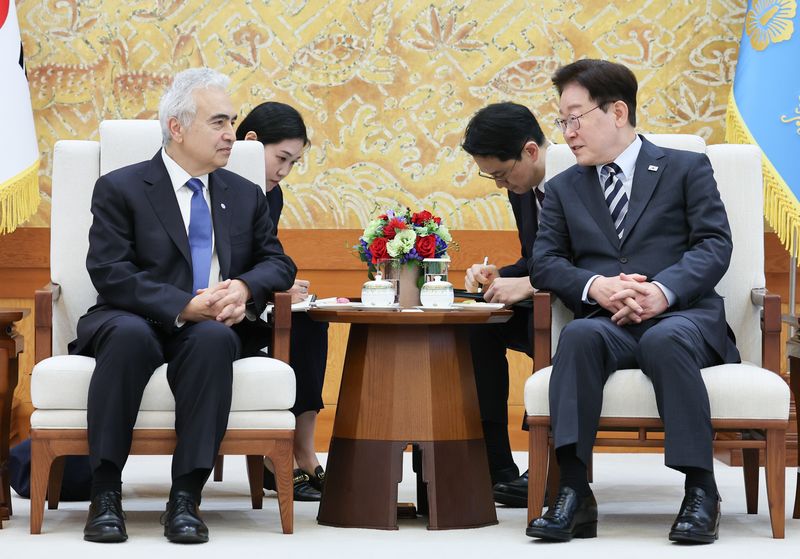
[Financial News] President Lee Jae Myung reviewed both an energy transition centered on renewable energy and the role of nuclear power amid an energy crisis originating in the Middle East. The International Energy Agency (IEA) stated that while renewable energy will become a primary power source in the future, nuclear power can also serve as a supplementary source to reduce dependence on fossil fuels. It particularly evaluated South Korea's electrification policy and industrial capabilities as global models.
President Lee Jae Myung met with Fatih Birol, executive director of the International Energy Agency (IEA), at Cheong Wa Dae on the afternoon of the 17th. He said, "The energy crisis is intensifying around the world, so I imagine the IEA also has a great deal to consider," adding, "South Korea will spare no effort in international cooperation in line with the IEA's strategic direction."
President Lee said, "We, too, are in the process of making a sweeping shift in our energy system toward renewable energy, but the energy crisis triggered by the recent crisis in the Middle East seems to be creating a major obstacle to this transition."
He continued, "This is a critical juncture for South Korea, and awareness of the energy crisis is likely high around the world. I would appreciate your views on how to respond and how the situation may unfold going forward."
Kang Yoo-jung, senior presidential spokesperson, said in a written briefing that President Lee expressed empathy with the IEA's deliberations and efforts to overcome the international energy crisis during the meeting. She added that South Korea is also experiencing difficulties in its energy transition because of the war in the Middle East as it shifts its energy structure toward renewable energy, and that the president asked about response strategies.
In particular, President Lee asked about the IEA's position on nuclear power, saying that as countries move toward electrification through renewable energy sources such as solar and wind, the war in the Middle East is prompting them to return to dependence on fossil fuels and increase their reliance on nuclear power.
Birol replied that France, Sweden, the United Kingdom, and the Netherlands are expanding new nuclear power capacity while maintaining their existing reactors. He also said that renewable energy will firmly establish itself as a primary power source, but that nuclear power, if operated as a supplementary source, could reduce dependence on fossil fuels and contribute to cutting greenhouse gas emissions, Kang said.
Birol also said South Korea's automobile industry could lead the electrification drive. He assessed that if falling electric vehicle prices make EVs the mainstay of the transport sector, South Korea, with its strong foundations in electric vehicle and battery manufacturing, will lead the electrification of transportation.
[email protected] Choi Jong-geun Reporter