Three Early-Admissions Applications Submitted After Checking Competition Rates During System Outage Recommended for Cancellation... Universities to Make Final Decision
- Input
- 2026-09-17 17:21:32
- Updated
- 2026-09-17 17:21:32
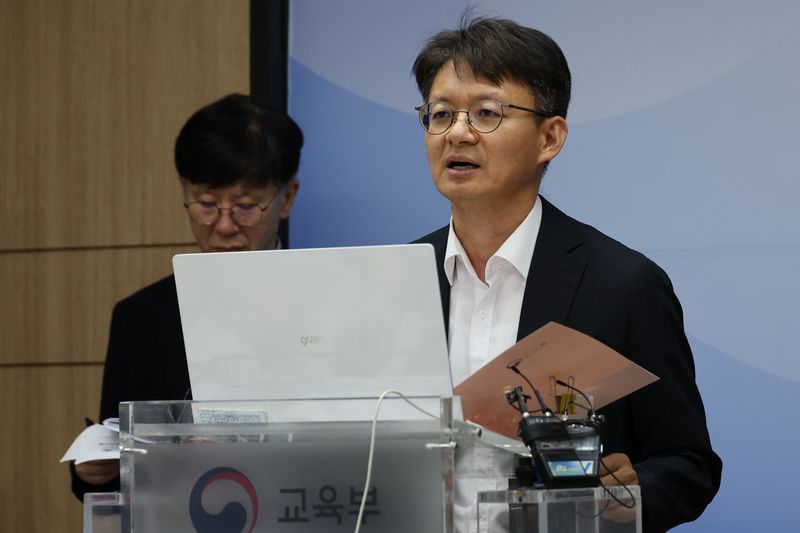
[Financial News] Of the 1,588 relief requests submitted following the application system failure during the 2027 academic year's university early-admissions application period, 414 were recognized as eligible for relief. Of these, 354 applicants completed their final applications. The universities concerned will be advised to cancel three applications submitted after applicants directly checked the competition rates disclosed during the extended application period.
The Ministry of Education and the Korean Council for University Education (KCUE) announced the results on the 17th of their review of relief measures for applicants and their examination of unfair cases stemming from the Uway Apply application system failure at Government Complex Sejong.
According to the Ministry of Education, a total of 1,588 relief requests were submitted from the 14th through the 16th. After reviewing objective IT records—including error logs from when the failure occurred at 5:50 p.m. on the 11th, as well as records of attempts to complete, save, submit, and pay for applications to the relevant admissions tracks—414 cases were recognized as eligible for relief.
The Ministry of Education informed applicants in these 414 cases that they could submit their applications again to the relevant universities, and 354 of them ultimately completed the process. The remaining 60 applicants did not submit applications despite being given the opportunity for relief. Requests not recognized as eligible involved cases in which no IT records could be found showing attempts to complete, save, submit, or pay for an application to the relevant admissions unit at the time of the failure. However, the Ministry of Education and KCUE did not disclose a detailed breakdown of the excluded cases by reason.
The review also produced results on unfair cases during the extended application period. A total of 100 universities extended their deadlines from 6 p.m. to 7 p.m. because of the system failure. Of these, 17 universities, including Sungkyunkwan University and Hanyang University ERICA Campus, disclosed competition rates during the extension. The fact that only 17 universities disclosed their rates was because the timing of disclosure was left to each university's discretion. Universities used different approaches, such as not disclosing competition rates after 1 or 2 p.m. or releasing the final rate at 6 p.m. The final decision on whether to disclose the rates also rests with each university.
The Ministry of Education and KCUE obtained the raw application data and related IT records from the 17 universities and conducted a full review of all 39 applications submitted after the competition rates were disclosed. The 39 applications involved 38 applicants. After comparing records of competition-rate checks with payment times and other data, they confirmed three cases in which applicants actually checked the disclosed rates and then completed payment. The criterion was not simply whether an application was submitted after the rates were disclosed; it was whether the IT records confirmed that the applicant had checked the competition rate before making payment.
The Ministry of Education and KCUE determined that the three cases could seriously undermine fairness and equity among applicants as well as fairness in university admissions. They therefore decided to recommend that the relevant universities cancel the applications. The remaining 36 applications will be recognized. The Ministry of Education added that it could not rule out the possibility that the applicants had checked the competition rates through other people or other channels, but this possibility was not factored into the assessment because no objective IT records were available to verify it.
The three applications will not be canceled automatically. The authority to cancel an application rests with the relevant university, and the Ministry of Education has no legal basis to cancel them on its own authority.
Song Geun-hyeon, a university policy director at the Ministry of Education, said, "The universities concerned also recognize the issues of fairness and equity as serious," adding, "We expect them to cooperate with the Ministry of Education's recommendation."
The 354 final applications were distributed across 306 admissions units and tracks at 40 universities. Kyungpook National University (KNU) provided the most relief, with 72 cases, followed by Kyung Hee University with 51, Chung-Ang University (CAU) with 48, Chonnam National University (CNU) with 27, Kookmin University with 26, Inha University with 18, and Seoul National University of Science and Technology (SeoulTech) with 15. The average competition rate at the 40 universities where applicants receiving relief submitted applications rose from 9.634 to 1 to 9.635 to 1, an increase of 0.001 percentage points. The total number of applications across all universities increased by 354, from 2,554,259 to 2,554,613, while the overall competition rate rose from 9.801 to 1 to 9.802 to 1. Nine admissions units had at least three applicants receiving relief, and their average competition rate was 71.25 to 1.
With this announcement, the Ministry of Education's administrative relief process has also concluded. A Ministry of Education official explained, "We will not pursue any further administrative relief, such as additional appeals, for applicants excluded from the relief program," but added, "The possibility of legal disputes related to these measures remains."
The Ministry of Education will consider both opening a system operated directly by the government and maintaining the private agency system while strengthening government management and oversight as it reviews reforms to the public university application system.
Song said, "We will determine which approach would cause the least harm to applicants and contribute to university admissions policy in the fairest and most equitable way," adding, "We will keep both options open and seek the best solution." He continued, "If the government were to build the system directly, it is expected to take at least around two years to establish the legal basis and develop the system." Accordingly, the Ministry of Education believes it would be difficult to fully introduce a government-operated public application system starting with the 2027 academic year.
For the 2027 academic year's regular admissions, the Ministry of Education plans to focus on improving system stability under the current structure. The ministry currently considers bugs that occurred during a security-system upgrade to be the main cause of the failure. However, as a special investigation is still under way, the final cause will be determined based on its findings.
The Ministry of Education said it would conduct system maintenance and error checks before regular and additional admissions to ensure that the same failure does not occur during either process.
[email protected] Lee Bo-mi Reporter